 Environment

Private conglomerates expand economic contributions through jobs, taxes and investments
1.
|
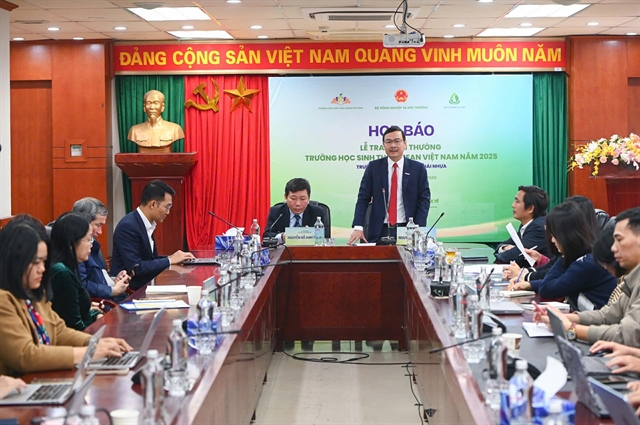
| Participants at a press conference unveiling the Việt Nam’s 2025 ASEAN Eco-School Award ceremony on Tuesday in Hà Nội.— VNS Photo Tố Như |
HÀ NỘI — The Việt Nam’s 2025 ASEAN Eco-School Award ceremony will take place on the morning of January 31, 2026, at Kim Đồng Theatre in Hà Nội, bringing together around 800 delegates.
Award-winning schools are located in 20 provinces and cities, covering all regions from mountainous and midland areas to deltas, coastal zones, the Central Highlands, and the Mekong Delta.
The information was announced on Tuesday afternoon at a press conference unveiling the award ceremony, themed “Plastic-Waste-Free Schools”, organised by the Ministry of Agriculture and Environment.
Beyond honouring outstanding schools, the event will also serve as a platform for Việt Nam to showcase models and practical experience in environmental education, contributing to the development of a regional network of plastic-waste-free schools across ASEAN.
The organisation of the award under the theme “Plastic-Waste-Free Schools” is widely seen as a pioneering step, reflecting Việt Nam’s proactive role and sense of responsibility in promoting environmental education at the regional level.
More than a recognition initiative, the award is gradually shaping a model for plastic-waste reduction education in schools, making a tangible contribution to ASEAN environmental cooperation.
The ASEAN Eco-School Award are part of cooperation activities under the ASEAN Senior Officials on the Environment (ASOEN).
Under the common mechanism, the ASEAN Secretariat assigns member states to host the award on a rotating basis.
Winning schools are honoured at side events of ASOEN meetings or ASEAN Ministerial Meetings on the Environment, helping to disseminate good practices in environmental education throughout the region.
Nguyễn Đỗ Anh Tuấn, Director General of the Department of International Cooperation at the ministry, said that eco-school models across ASEAN in recent years have begun integrating plastic-waste reduction content.
However, these efforts remain fragmented, lacking a common evaluation framework or a region-wide campaign.
Many countries have implemented stand-alone initiatives, but a standardised model suitable for scaling up and sharing across ASEAN has yet to take shape, he said.
Against this backdrop, Việt Nam’s initiative to host the 2025 ASEAN Eco-School Award with the theme “Plastic-Waste-Free Schools” is regarded as an opportunity to develop a clear, substantive and replicable model.
“The model not only aims to reduce plastic waste within schools but also helps shape sustainable education solutions and contribute shared initiatives to ASEAN environmental cooperation,” he added.
Tuấn also said the award has evolved into a genuine action-oriented movement within the education system.
In 2025, the award attracted 294 submissions from educational institutions nationwide, a 3.5-fold increase compared with the 2024 season.
Alongside the surge in participation, the quality of submissions also improved markedly, reflecting schools’ serious investment in practical, action-based environmental education.
The participation of less-advantaged mountainous localities such as Lào Cai, Cao Bằng, Gia Lai, Đắk Lắk, Tuyên Quang, and Lạng Sơn demonstrates the high adaptability of the eco-school and plastic-waste-free school model, which can be effectively implemented under diverse socio-economic and ecological conditions.
The award also recorded broad participation from different types of schools, including public and private institutions, multi-level schools, and international and bilingual schools.
The diversity indicates that efforts to expand and replicate the eco-school model across varying educational contexts are gradually being realised.
From an organisational and communications perspective, Nguyễn Ngọc Thạch, Editor-in-Chief of Nông nghiệp và Môi trường (Agriculture and Environment) newspaper, said that practical implementation of the award has shown that environmental education has far-reaching impact, not only raising awareness but also gradually shaping environmentally friendly thinking, attitudes and lifestyles among younger generations from the school level.
Thạch added that this represents an important opportunity for Việt Nam to make deeper and more substantive contributions to ASEAN environmental education, while also affirming its leading role in promoting initiatives for the environment and a green generation.
These activities also help concretise major orientations on environmental protection and sustainable development set out in the Resolution of the 14th National Party Congress.— VNS
Environment
 Environment
 Environment
 Environment
 Environment
 Environment
 Environment
 Environment
 Environment
 Environment
 Environment
 Environment
 Environment
 Environment
 Environment