 Environment

Vietnamese Prime Minister meets Cambodian National Assembly President
1.
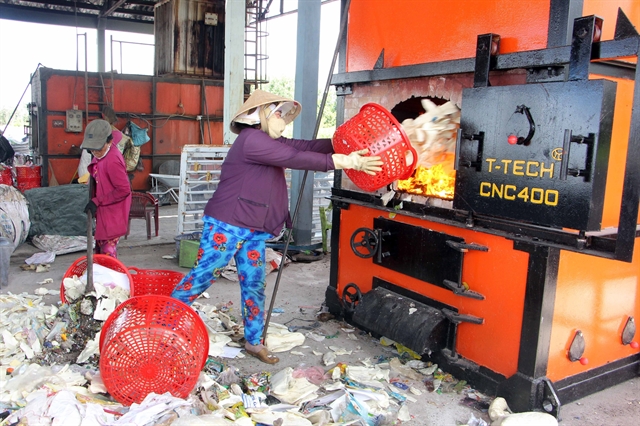 |
| A worker feeds waste into an incinerator at a waste-treatment facility in the southern province of Cà Mau. — VNA/VNS Photo |
By Thu Trinh & Mai Hương & Thu Hà
Việt Nam is preparing its most far-reaching overhaul of environmental regulation in years, as policymakers seek to strike a more delicate balance between accelerating economic growth and tightening oversight of pollution, waste and industrial emissions.
Officials say the move will ease the compliance burden on lower-risk businesses while keeping the full weight of environmental review on the projects most likely to cause harm.
The draft amendment to the 2020 Environmental Protection Law, unveiled at a government consultation workshop, would restructure how environmental impact assessments are conducted, allow large infrastructure projects to obtain permits in stages rather than all at once, and, in a notable philosophical pivot, legally reclassify certain types of waste as raw materials eligible for use in manufacturing.
Lê Công Thành, deputy minister of Agriculture and Environment, framed the revisions as both an economic and ecological necessity.
"We must cut administrative procedures and remove the institutional obstacles that hold businesses back, but we absolutely cannot let environmental oversight go slack," Thành told Môi trường & Cuộc sống (Environment & Life) magazine.
"We are pushing harder than ever to put more decision-making power and accountability in the hands of local governments. Given how urgent that pressure has become, amending the 2020 law is no longer optional," he said.
 |
| Lê Công Thành, deputy minister of Agriculture and Environment. — VNA/VNS Photo |
Tiered oversight
The centrepiece of the reform is a reclassification of projects into three tiers rather than the current four, with each tier tied directly to a corresponding set of procedures.
Group I projects – those posing significant pollution potential – would be required to complete a full environmental impact assessment subject to formal review and an official approval decision.
Group II projects, carrying moderate risk, would undergo a streamlined assessment resulting in a notification rather than a binding approval.
Group III projects would need only to register with authorities or obtain a standard environmental permit before breaking ground.
Projects located within established industrial zones, those with limited capacity and no sensitive environmental characteristics, and those outside high-pollution industries would be exempt from impact assessment altogether.
Đặng Kim Chi, president of the Vietnam Association for Conservation of Nature and Environment, described the shift as a meaningful break from the country's traditional approach.
"Before, we mainly tried to control everything upfront, screening projects through layers of procedure before they could move forward," she said.
The emphasis now, she added, would shift to risk and incident management through post-monitoring, centred on supervision, inspection and heading off problems before they arise.
She noted that the transition would need to be phased carefully, since provincial and municipal authorities would need time to train staff and build administrative capacity before absorbing their expanded responsibilities.
Trịnh Xuân Đức, director of the Science Institute of Infrastructure Engineering and Environment, acknowledged the significance of the tiered framework but stressed that simplification should not be mistaken for superficial.
Even lower-risk projects can generate wastewater, air emissions and hazardous waste, he noted, and any project discharging into vulnerable waterways, operating large emissions stacks or sitting near residential areas should still face rigorous technical scrutiny regardless of its tier classification.
Phased permits
A separate reform addresses a practical mismatch in the current permitting system: the blanket requirement that a single permit cover an entire project, regardless of how many phases remain unbuilt.
The draft would allow permits to be issued in stages, each tied to a completed phase of construction, provided the relevant pollution control infrastructure is also in place.
Mai Văn Trịnh, director of the Institute for Agricultural Environment, called it a breakthrough that would allow investors to generate revenue from completed phases without waiting for an entire project to finish.
"Investors can apply for an environmental permit for each completed stage, thereby improving cash flow and overall investment efficiency," he said.
The proposal also refines the underlying function of the permit itself. Under the draft, permits would be issued after pollution control works are completed but before discharge into the environment begins, a sequencing that officials say turns the license into a genuine checkpoint rather than a bureaucratic formality.
Bùi Thị An, director of the Institute of Natural Resources, Environment and Community Development, said the phased permit concept pointed in the right direction but needed strict safeguards.
She called for mandatory real-time environmental monitoring systems connected directly to regulators, and argued that financial penalties alone would be insufficient if violations are not made public.
"If we only impose fines without transparency, businesses can keep violating the rules," she said.
Waste reframed
Perhaps the most philosophically ambitious element of the draft is a provision that would allow certain categories of waste to be legally managed as raw materials or commodities, provided they meet applicable technical standards.
The change formally reframes waste from a liability requiring disposal into a potential resource. Under current rules, even byproducts that meet quality benchmarks for secondary use are classified as industrial waste and must be collected and processed by handlers.
Trịnh pointed to a telling example: factories that burn rice husk for boiler heat generate ash viable as a soil amendment, yet under existing rules, it must be treated as industrial solid waste, stripping it of productive value and adding to the manufacturer's costs.
Treated industrial wastewater that meets Class A standards, he noted, similarly could not be used for crop irrigation or street cleaning despite being safe enough to do so.
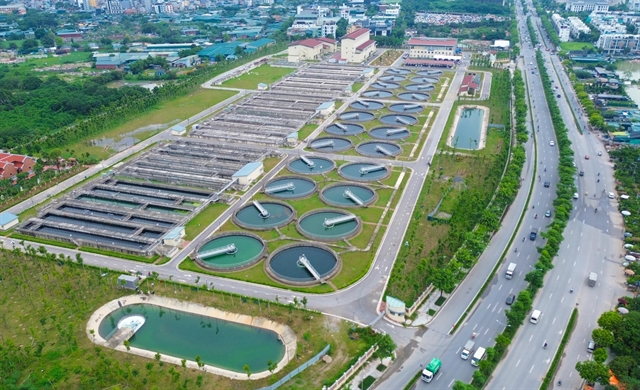 |
| A wastewater treatment plant in Hà Nội with a treatment capacity of 270,000 cubic metres per day. — VNA/VNS Photo |
Under the draft, waste meeting the technical specifications for raw materials, fuels or construction inputs could be managed as commodities rather than disposed of as waste.
A new Article 72a would require recycled products to meet product quality standards before entering the market, and would direct state procurement, public investment projects and infrastructure spending to give preference to certified recycled materials.
Đức said the reclassification, if paired with rigorous technical standards and enforcement, could help transform Việt Nam's recycling sector from an informal, fragmented patchwork into an industrial-scale value chain.
"This is an important shift from seeing waste as a burden to seeing it as a secondary resource. It will drive markets for recycled materials, alternative fuels, waste co-processing and energy recovery," he said.
While experts at the consultation workshop broadly endorsed the draft's direction, several raised concerns that its ambitions could outpace the country's capacity to carry them out.
Tạ Đình Thi, deputy chairman of the National Assembly's Science, Technology and Environment Committee, noted that Việt Nam was simultaneously chasing double-digit economic growth and holding firm to a policy of not sacrificing environmental quality to get there.
"Pushing authority down to local governments is right, but it must come with meaningful oversight mechanisms. The move from front-end inspection to back-end monitoring has to be grounded in digital, real-time governance," Thi said.
Chi warned that decentralisation without oversight would risk producing a fragmented landscape of inconsistent local standards.
"We need independent monitoring, cross monitoring and regional monitoring to ensure objectivity and to prevent every province and city from drawing up its own version of environmental standards," she said.
Officials described the revision not as a departure from the 2020 law, but as a necessary evolution aimed at balancing faster economic development with stronger and more adaptive environmental governance.
“Environmental problems are no longer isolated or local,” Chi said. “They are systemic and cut across entire regions. If the legal framework is not modernised in time, the cost of repairing environmental damage later will far exceed the cost of preventing it today.” — VNS
Environment
 Environment
 Environment
 Environment
 Environment
 Environment
 Environment
.jfif) Environment
Environment
 Environment
 Environment
 Environment
 Environment
 Environment
 Environment
 Environment