 Environment

Việt Nam, China seek stronger substantive parliamentary cooperation
1.
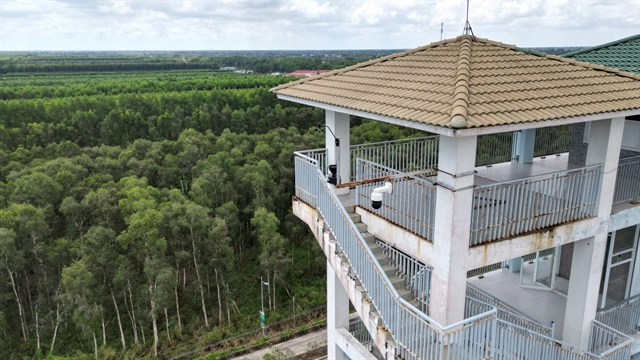 |
| A specialised modern camera system has been set up at the U Minh Hạ National Park in Cà Mau Province to help forest rangers detect fires as soon as mere traces of smoke appear. — VNA/VNS Photo Huỳnh Anh |
CÀ MAU — Cà Mau Province is strengthening forest fire prevention efforts by deploying advanced surveillance systems.
More than 50,500ha of dry forest in the country’s southernmost province face the threat of fires, according to its Forest Fire Prevention and Control Steering Committee.
Of the area, around 11,700ha are under the third fire warning level, more than 11,700ha under the fourth level and over 27,100ha under the fifth level, the highest and most dangerous warning level.
Forest areas facing a high fire risk include U Minh Hạ National Park, as well as forests managed by U Minh Hạ Forestry One Member Co., Ltd, the Southwest Forestry Experimental Research Centre and the Hòn Khoai Island Forest Protection Unit.
Many forests have dried out, while thick layers of vegetation have become highly flammable.
Authorities warned that even a small mistake involving fire could trigger a major blaze.
To improve monitoring, U Minh Hạ National Park has installed a specialised camera system described as “guardian eyes” for the forest.
The system is mounted on a 26-metre-high observation tower and integrates thermal imaging and optical cameras. The cameras are capable of rotating 360 degrees and can operate continuously around the clock.
With a monitoring range of about five kilometres, the system can cover roughly 2,500ha of forest.
When abnormal heat levels or smoke are detected, the system automatically sends alerts to the control centre and on-duty staff via mobile phones, enabling emergency responses to be deployed quickly.
At the same time, flycams equipped with thermal sensors have also been introduced to support forest protection work in the national park.
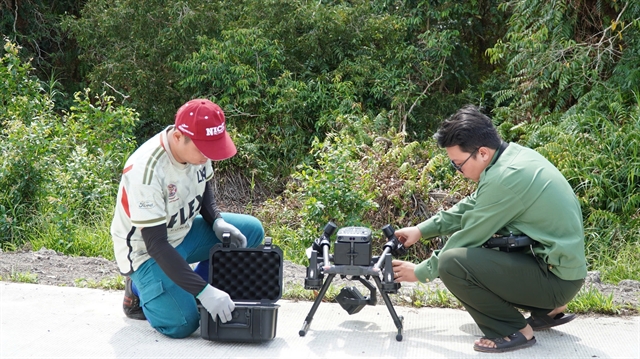 |
| Flycams equipped with thermal sensors are considered an effective tool in detecting forest fires, helping protect forests more effectively. — VNA/VNS Photo Huỳnh Anh |
Lê Thanh Dũng, deputy director of the national park, said: “During the seasonal transition period, steel observation towers are often exposed to lightning during thunderstorms, making it unsafe for staff to remain on the high towers.”
“At such times, flycams equipped with thermal cameras are highly effective in detecting fire hotspots. They can fly directly to the exact location of a fire, transmit live data and guide rescue teams along the shortest access routes,” he said.
The national park is seeking investment for three additional camera systems worth around VNĐ7.2 billion (US$273,000) to expand monitoring coverage across nearly all of its managed forest area.
Although unseasonal rains have recently occurred, the forest fire risk remains high, according to the steering committee.
Dũng warned that early-season rains could make some people less cautious when entering forests to collect honey.
In addition, lightning during early-season thunderstorms could also trigger forest fires, he said.
“Rainwater may wash away the acid sulphate layer on cajuput leaves and forest vegetation, causing dry leaves to become highly flammable again quickly. If a fire occurs, flames may spread faster than usual,” he said.
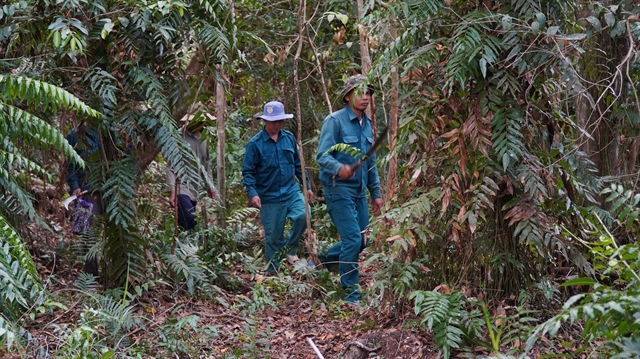 |
| Alongside modern technical solutions for detecting forest fires, forest protection forces in Cà Mau Province patrol 24/7 during the dry season to prevent fires. —VNA/VNS Photo Huỳnh Anh |
The steering committee has instructed forest owners, local authorities and relevant agencies to strengthen forest fire prevention and control measures during the dry season amid complicated weather conditions.
Forest management units have been asked to maintain 24-hour duty shifts at watchtowers and ranger stations, strictly control access to forests and ban field burning, vegetation burning, illegal honey collection and wildlife hunting in and around forests when fire warnings reach dangerous levels.
Forest owners have strengthened preventive measures, including reinforcing sluices and dams to retain water, adding firefighting equipment, consolidating local response forces and organising emergency drills. — VNS
Environment
 Environment
 Environment
 Environment
 Environment
 Environment
 Environment
 Environment
 Environment
 Environment
 Environment
 Environment
 Environment
 Environment
 Environment