 Sci-Tech

Vietnamese, Panamanian first ladies bond over ethnic textiles at Hà Nội cultural event
1.
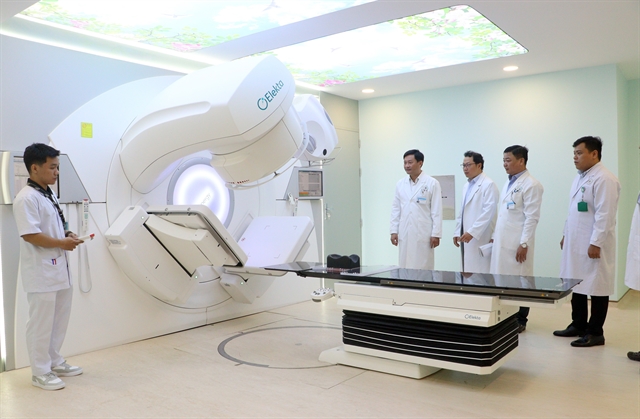 |
| Doctors from Chợ Rẫy Hospital and Vĩnh Long General Hospital examine the trial operation of a linear accelerator-based radiotherapy system for cancer treatment. Atomic energy has been widely applied in the healthcare sector, primarily through nuclear medicine and radiotherapy. — VNA/VNS Photo Thúy Hằng |
HÀ NỘI — Deputy Prime Minister Hồ Quốc Dũng has signed Decision No. 893/QĐ-TTg approving a national scheme on training, capacity building and development of human resources for state management, research and development, technical support and applications in the field of atomic energy.
The scheme aims to build a workforce with sufficient quantity, balanced structure and high-quality expertise to meet the country’s growing demand for atomic energy development and applications, while ensuring radiation safety, nuclear safety and nuclear security.
Under the plan, by 2030 all personnel engaged in State management of atomic energy at both central and local levels are expected to receive professional training and capacity building to effectively carry out duties related to radiation safety, nuclear safety, nuclear security and atomic energy applications.
Việt Nam also aims to establish a core group of highly qualified research and development specialists capable of mastering, transferring and advancing nuclear technologies in support of future nuclear power development and the expanded use of radiation and radioisotopes across socio-economic sectors.
A specialised workforce for the safe and efficient operation of research nuclear reactors will also be developed to serve scientific research, training and radioisotope production.
The scheme further targets full training coverage for technical support personnel serving regulatory agencies, enabling them to effectively conduct appraisal, inspection, environmental radiation monitoring and emergency response activities.
Personnel responsible for nuclear security, radiation monitoring and incident response across ministries and sectors are likewise expected to receive advanced professional training.
In addition, all radiation workers at licensed facilities will be required to undergo radiation safety training in accordance with legal regulations.
The plan seeks to build a skilled workforce capable of safely and efficiently operating radiation technologies in healthcare, industry, agriculture, environmental protection and other technical sectors.
By 2035, Việt Nam aims to ensure that 100-per cent State management personnel in the atomic energy sector are fully trained and retrained to meet professional requirements.
The national radiation and nuclear safety authority is expected to achieve self-reliance in up to 70 per cent of appraisal, assessment, inspection and supervision activities for nuclear power projects, and full autonomy for research reactor projects.
Looking toward 2050, the scheme envisions a highly qualified workforce capable of independently conducting safety analyses, technical assessments, licensing, inspections, supervision and emergency response for both large-scale nuclear reactors and small modular reactors.
The initiative is also expected to strengthen Việt Nam’s strategic coordination capacity in radiation safety, nuclear safety and nuclear security.
The approved plan covers personnel in state management agencies, public and private scientific organisations, enterprises, technical support institutions and facilities using radiation technologies.
Training programmes will be tailored to specific groups and implemented through diverse formats, including short-term and advanced courses, postgraduate education, on-site training and specialised radiation safety programmes.
The scheme also outlines measures to modernise training curricula, improve infrastructure, expand international cooperation and accelerate digital transformation in training and human resources management for the atomic energy sector. — VNA/VNS
Sci-Tech
 Sci-Tech
 Sci-Tech
 Sci-Tech
 Sci-Tech
 Sci-Tech
 Sci-Tech
 Sci-Tech
 Sci-Tech
 Sci-Tech
 Sci-Tech
 Sci-Tech
 Sci-Tech
 Sci-Tech
 Sci-Tech