 Society
Rural tourism needs to cash quantities over goods sold
1.

|
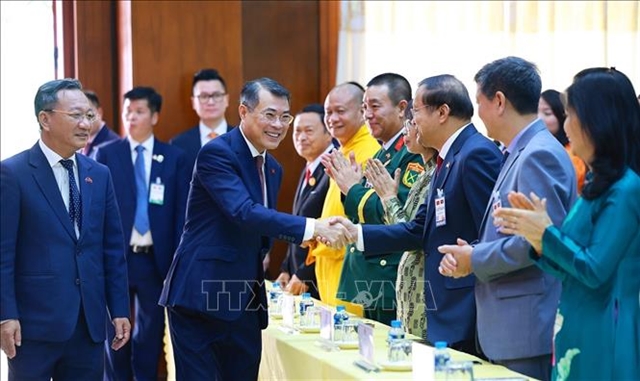
| Ngô Đông Hải, vice chairman of the Central Propaganda and Education Commission, speaks at a national scientific conference in HCM City on May 20. — Photos courtesy of VNU-HCM |
HCM CITY — Việt Nam needs to urgently refine its "talent visa" policies to attract international experts and overseas Vietnamese intellectuals to support its development, experts told a national scientific conference in HCM City on Wednesday.
The conference, titled “Talent Visa and Policies to Attract High-Quality Human Resources for National Development”, was held by the Việt Nam National University–HCM City and the Academy of Politics Region II for institutionalising the Party's resolutions on harnessing the role of intellectuals and driving breakthroughs in science, technology, innovation, and digital transformation.
Speaking at the event, Ngô Đông Hải, Vice Chairman of the Party Central Committee's Commission for Information, Education and Mass Mobilisation, said many countries have aggressively pursued talent visa policies to attract global experts, scientists, and innovative entrepreneurs, fuelling intense competition for intellectual resources.
While the country is actively refining its immigration framework, he pointed out that existing mechanisms remain fragmented and fall short of international standards.
"Việt Nam needs to shift its mindset from merely 'attracting' talent to actively 'competing' for it."
This requires designing a more flexible visa mechanism, piloting specialised innovation zones, placing enterprises at the centre of the innovation ecosystem, and having a remuneration system that is globally competitive, he said.
He highlighted major institutional bottlenecks, including the absence of specific regulations on residency, labour, finance, and long-term living conditions for foreign experts.
Furthermore, the country still lacks large-scale innovation hubs and concentrated talent clusters, he said.
To overcome these barriers, he proposed a comprehensive study of successful models from Singapore, China, and South Korea to draw valuable lessons in policy design and ecosystem development.

|
| Representatives from the Việt Nam National University-HCM City and the Academy of Politics Region II sign an agreement on the sidelines of the conference in HCM City on May 20. |
Prof. Dr. Nguyễn Thị Thanh Mai, chancellor of the Việt Nam National University–HCM City, said a talent visa should be viewed through a strategic lens rather than as a bureaucratic hurdle.
It is a gateway for Việt Nam to connect with global knowledge flows, and an institutional signal showing its readiness to welcome, respect, and create optimal conditions for talent, she said.
The global trend, has shifted from basic human resource training to comprehensive talent management, encompassing discovery, attraction, mobility, circulation, retention, and empowerment, she noted.
Delegates reviewed more than 40 papers detailing various regional and international models, including insights from Dr Wei Yang of the Singapore Management University on the city-state’s research and enterprise talent programmes.
Participants agreed that barriers such as complex work permit procedures, limited residency periods, and insufficient support for accompanying families, must be dismantled.
In their place, they proposed a tailored mechanism offering extended residency, fast-track processing, transparent criteria, and flexibility to move between research, employment, and entrepreneurship.
For the Việt Nam National University–HCM City, which aims to break into Asia’s top 100 universities, attracting top talents is critical to advancing strategic fields such as artificial intelligence, semiconductor design, biotechnology, and clean energy.
It is implementing initiatives such as the VNU350 programme to recruit outstanding young scientists and visiting professors.
On the sidelines of the conference, the university and the Academy of Politics Region II signed an agreement to bridge the gap between political theory and technological innovation, boosting interdisciplinary research for the sustainable development of the southern region.
The insights and recommendations from the conference will be compiled into a policy advisory report to be submitted to central authorities, helping shape future frameworks to retain and unlock the potential of high-quality human resources in the country. — VNS
Society
 Society
 Society
 Society
 Society
 Society
 Society
 Society
 Society
 Society
 Society
 Society
 Society
 Society
 Society