 Society

Tighter controls on livestream sales
1.
 |
| Lò Thị Dung (second from right) receives officials from Phúc Lợi Ward, who came to assist her with administrative procedures for obtaining her business licence. VNS Photo Lê Hương |
By Lê Hương
HÀ NỘI — As Hà Nội pushes ahead with rapid digital transformation, local authorities and community groups are stepping in to ensure elderly residents and people with disabilities are not left behind in an increasingly online society.
From helping visually impaired residents complete digital administrative procedures to teaching elderly women how to use smartphones and avoid online scams, grassroots initiatives are creating new opportunities for vulnerable groups to access public services and participate more confidently in daily life.
The capital has emerged as one of the country’s leading localities in applying science, technology and digital transformation across multiple sectors. But alongside technological progress comes a growing challenge: ensuring everyone, particularly older people and those with disabilities, can adapt to the digital age.
For Lò Thị Dung, a visually impaired woman from Sơn La Province now living in Hà Nội, navigating online procedures independently can be difficult.
Recently, officials from the Phúc Lợi Ward People’s Committee visited her home to help complete her VNeID registration so she could obtain a business licence for her massage service.
“I have great difficulty getting around and need assistance, so I’m very happy that you came to support me,” Dung said.
The ward’s digital transformation team has regularly assisted elderly and disabled residents with administrative procedures, helping them access online public services that are becoming increasingly common across the city.
Meanwhile, in Cửa Nam Ward, local authorities have launched free digital literacy classes for elderly women, offering practical lessons to help them use smartphones more effectively and safely.
 |
| Teacher Lưu Hải Nam teaches at a digital class for the elderly in Hà Nội. VNS Photo Lê Hương |
The classes cover basic smartphone skills, online public service applications and artificial intelligence (AI) tools. Participants are also taught how to identify online scams and use digital services in daily life.
According to organisers, the programme has received an enthusiastic response from residents.
“Today’s event was very successful, beyond our expectations,” said Phạm Hải Anh from the Việt Nam Fatherland Front Committee and Women’s Union of Cửa Nam Ward.
“Not only were participants’ personal needs met, but the programme also created stronger connections within the community. In the future, this model can be expanded across the entire city.”
For many elderly learners, the classes represent more than just technology lessons. They are opportunities to remain connected to society and maintain independence in everyday life.
Vũ Thị Hà, 68, said adapting to digital technology could be challenging for older people, but the benefits would be undeniable.
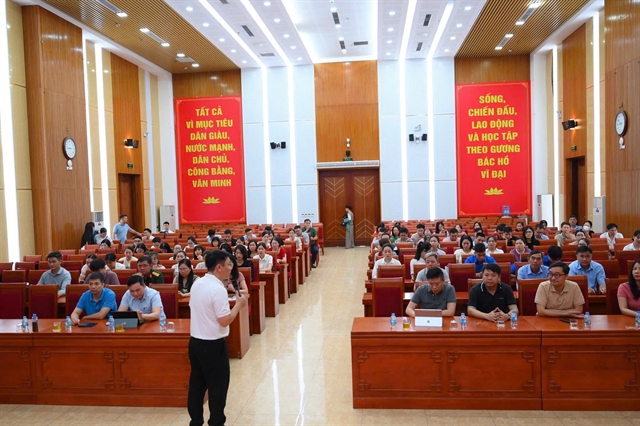 |
| Teacher Kiều Thành Chung at a class for senior citizens. VNS Photo Văn Bình |
“For elderly people like us, digital transformation comes with certain challenges, but it is truly wonderful,” she said.
“Learning about digital transformation helps us avoid scams and better understand everyday life. We feel very excited and encouraged.”
Another learner, Nguyễn Thị Bình, 73, said older people would often need more time and repeated practice to become familiar with new technologies.
“For me, the class is very useful. Elderly people learn more slowly,” she said.
“Young people may only need one or two sessions, but we need weekly classes. Sometimes when we cannot do something, we have to ask our children or grandchildren for help. We need to practise several times before we can remember.”
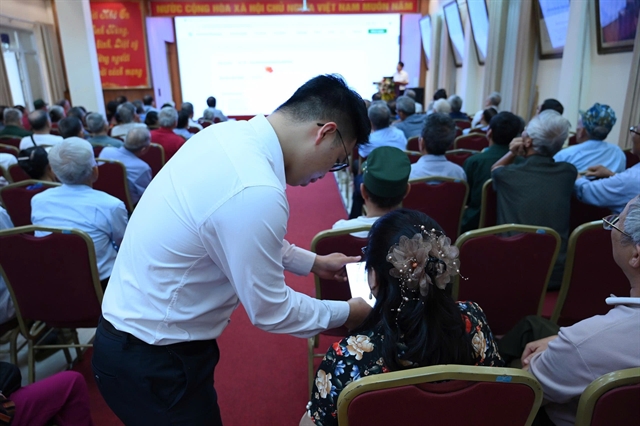 |
| Nam often offers close support to the elderly. VNS Photo Văn Bình |
Despite the challenges, many participants said they had already become more confident in using smartphones and digital services after attending the classes.
Hà said digital skills had made daily activities much simpler and more convenient.
“In the past, when going to the airport, I had to complete many procedures. Now, all I need is a mobile phone,” she said.
“When carrying cash to the market, I often had to count money repeatedly, but with smartphone skills, I can pay the exact amount simply by reading the number on the screen without making mistakes.”
Digital literacy classes for the elderly
Behind many of these classes is Lưu Hải Nam, a lecturer at the Hà Nội College of High Technology, who has become a familiar face among elderly learners across the city.
Together with his mentor Kiều Thành Chung, Nam launched community-based digital literacy classes for elderly residents in wards across Hà Nội in early 2025.
 |
| Teacher Nam at work. VNS Photo Lê Hương |
The lessons are designed to meet practical daily needs, from searching for information using AI tools such as ChatGPT and Gemini to accessing online public service portals and using the VNeID application.
Teachers and volunteers from the college also provide one-on-one support, helping elderly learners become more confident in using smartphones and digital technology in daily life.
Nam said he hoped technology could help bridge, rather than widen, the gap between generations.
“Technology is developing more and more rapidly, and I do not want the gap between generations to grow wider,” Nam said.
“Although they are older, I firmly believe that with their eagerness to learn, they can use technology even better.”
For Nam, the classes have also become personally meaningful as he has formed close relationships with many elderly participants.
“I feel very happy to have become closer to the elderly participants. They are like parents to me,” he said.
“When teaching them, they often say, ‘My son, I don’t understand this part or that part.’ I see myself as their child or grandchild, so I try to share and support them as much as I can.”
So far, the number of elderly learners has reached 3,000. The programme’s impact has been recognised by city authorities. Nam was awarded a Certificate of Merit by the Chairman of the Hà Nội People’s Committee for his contributions to implementing Directive No. 11/CT-UBND on the city’s digital transformation support campaign.
Looking ahead, Nam plans to expand the model by combining in-person classes with online instructional channels featuring short, easy-to-understand content tailored for elderly learners. Mobilising students as volunteers is also considered an important solution for expanding the initiative.
 |
| Teacher Nam considers himself a son and grandson of the elderly while helping them understand digital technology. VNS Photo Văn Bình |
As digital transformation continues to reshape public services and daily life in Việt Nam, initiatives such as these are quietly helping narrow the digital divide within communities.
For many elderly learners, digital skills are no longer simply about using smartphones or applications. They are about maintaining independence, staying connected and keeping pace with a rapidly changing society.
“Every day, society brings new things, so we must keep learning,” Bình said. “We have to learn every day to keep up.” VNS
Society
 Society
 Society
 Society
 Society
 Society
 Society
 Society
 Society
 Society
 Society
 Society
 Society
 Society
 Society