 Society

Việt Nam steps up fight against counterfeits, IP violations
1.
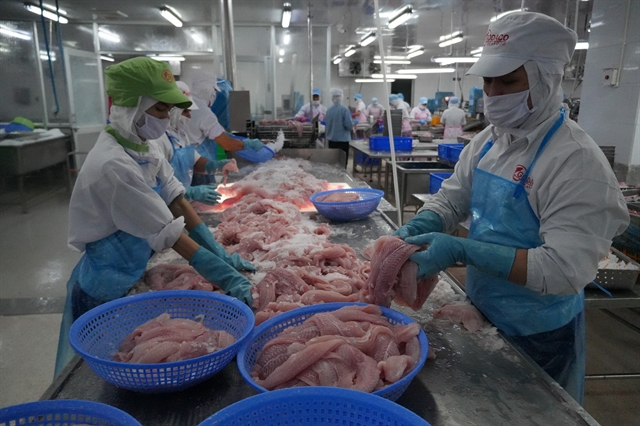 |
| Workers process pangasius fillets for export at a factory in the southern province of Đồng Tháp. — VNA/VNS Photo |
SINGAPORE — The demographic forces that powered Việt Nam’s economic rise over the past decades are fading and the country has a narrow window to find new drivers of growth before it risks getting stuck in the so-called middle-income trap, a senior economist warned on Tuesday.
Trần Quang Thanh, a senior research fellow at the Hà Nội-based Development and Policies Research Center (DEPOCEN), made the assessment at a regional conference hosted by the ISEAS - Yusof Ishak Instituteon sustainable development in Southeast Asia, outlining where Việt Nam stands and the structural reforms it must pursue to reach high-income status within a generation.
Using World Bank GNI per capita data as a reference, Thanh traced how economies such as South Korea, Japan, Singapore and Hong Kong transitioned from lower-middle to high-income status in roughly two decades, while many Southeast Asian peers, including Thailand and Indonesia, have taken considerably longer.
Việt Nam is expected to move into upper-middle-income status within the next year or two, but the journey from that point to high-income classification, from around US$4,500 to $14,000 per capita, represents a far more demanding leap.
Central to Thanh’s concern is demographics. Việt Nam’s old-age dependency ratio has risen faster than most regional peers at a comparable stage of development, reflecting a sustained decline in fertility rates. The country’s labour force to population ratio peaked around 2015 and has been declining since.
“The golden era of demographic dividends has ended,” he said, adding that with that engine largely exhausted, other sources of growth must be identified and developed.
On industrialisation, Thanh acknowledged steady gains in manufacturing value added per capita but noted that the figures remain modest by regional standards.
A structural concern is that roughly 40 per cent of Việt Nam’s manufactured exports contain imported intermediate goods, reflecting underdeveloped domestic supply chains.
Meanwhile, the country’s leading export category, electronics, scores below global benchmarks on product complexity indices, meaning Việt Nam is largely capturing lower value-added stages of production.
He also raised concerns over human capital utilisation. Despite a relatively strong human capital index, a significant share of skilled workers are employed in roles below their qualification level, suppressing labour productivity.
Brain drain compounds the issue. Data on International Mathematical Olympiad medalists showed that roughly 80 per cent of Vietnamese winners pursue undergraduate education abroad, among the highest rates globally, and most do not return permanently.
“We are net producing talents for other countries,” Thanh said.
On the policy front, he highlighted several government initiatives in response, including a revised foreign investment strategy emphasising technology transfer, expanded support for small and medium-sized enterprises, a national push on AI and semiconductor workforce development, major infrastructure investments, including a planned high-speed rail corridor and steps towards nuclear power generation to meet rising energy demand.
Jayant Menon, a visiting senior fellow at the ISEAS–Yusof Ishak Institute, broadened the discussion, arguing that crossing an income threshold is necessary but far from sufficient as a measure of development success.
“The journey, or how you get there, is just as important as the destination, because the destination will be shaped by it,” he said.
Drawing on regional comparisons, Menon cautioned against fixating on GNI per capita as the primary benchmark.
Indonesia recently crossed into upper-middle-income status but has experienced significant environmental degradation along the way. Sri Lanka held an upper-middle-income status as recently as 2020 before descending into debt problems.
Menon argued that Việt Nam’s future productivity gains will need to come increasingly from within-sector efficiency improvements as the growth contribution from rural to urban migration narrows. He called for greater economic diversification, steps to reduce business costs and reform of state-owned enterprises.
He also flagged land reform as underappreciated, particularly as a tool for managing inequality, a challenge he said will be sharpened by the rise of AI. Building economic resilience, he added, must also become a priority as climate, demographic and technological shocks grow more frequent and severe. — VNS
Society
 Society
 Society
 Society
 Society
 Society
 Society
 Society
 Society
 Society
 Society
 Society
 Society
 Society
 Society