 Society
MoIT to build system to flag unusual fuel price movements
1.
|
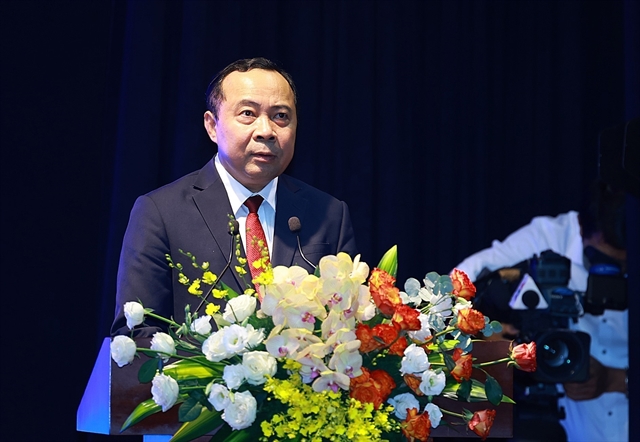
| Minister of Science and Technology Vũ Hải Quân speaks at the ceremony marking Việt Nam Science, Technology and Innovation Day and the national conference on strategic technology development on May 18 in Hà Nội. — VNA/VNS Photo |
HÀ NỘI — Việt Nam must fully unlock the resources embedded across its national innovation ecosystem if science, technology and innovation are to become true engines of development, Minister of Science and Technology Vũ Hải Quân said on Monday.
Speaking at a ceremony marking Việt Nam Science, Technology and Innovation Day (May 18) alongside a national conference on strategic technology development, Quân said the world is entering a new era of strategic competition in which technology is the decisive factor shaping national competitiveness, global standing and self-reliance.
He said that resources must be understood in the broadest sense – to include the intellectual capacity of scientists and experts, the investment capability and organisational strength of enterprises, the research and training potential of universities and institutes and the creativity of younger generations.
Institutional frameworks, data systems, infrastructure and international cooperation are also critical, with the State acting as a facilitator.
Major advances in artificial intelligence (AI), semiconductors, biotechnology, big data, new energy, quantum technology and smart manufacturing are reshaping the global economy, international supply chains and traditional development models, he noted.
In this context, science, technology and innovation are not only foundations for rapid and sustainable growth but also key drivers of labour productivity, national competitiveness and living standards, as well as essential conditions for self-reliance in an increasingly volatile world.
For Việt Nam, Politburo Resolution No. 57 on science, technology and innovation sets out a clear mandate: to escape the middle-income trap and become a developed nation, the country must achieve breakthroughs in science, technology, innovation and digital transformation.
Quân said the Ministry of Science and Technology is refining institutional mechanisms towards a controlled risk-acceptance approach while expanding autonomy for scientific organisations, reforming financial policies, developing the science and technology market, strengthening intellectual property protection and improving conditions for innovative enterprises, technology firms and start-ups.
The ministry is also restructuring how financial resources are allocated through reforms to national science and technology programmes and the development of innovation centre networks at both national and local levels.
Under the new orientation, 42 existing national science and technology programmes are expected to be consolidated into six groups: basic research programmes, national science and technology programmes, strategic technology deployment programmes, national innovation programmes, national digital transformation programmes and programmes aimed at strengthening national scientific, technological and innovation capacity.
Quân highlighted the development of strategic technologies as a central pillar aimed at concentrating resources on major challenges critical to Việt Nam’s technological self-reliance.
“This approach allows resources to be focused on areas with strong spillover effects while still ensuring balanced development across the broader science, technology and innovation ecosystem,” he said.
The ministry is also advancing governance reforms and digital management systems to improve transparency and reduce duplication in the administration of scientific tasks.
A key initiative is the development of a National Science and Technology Management Platform to integrate nationwide data on research projects, funding sources, scientists, research outputs and technology transfer activities.
Quân urged Vietnamese businesses to increase investment in research and development, technological innovation and digital transformation to achieve sustainable growth.
The Government, he said, will continue prioritising support for strategic technology sectors such as AI, semiconductors, biotechnology, big data, digital infrastructure, new energy technologies and smart manufacturing.
“These are not only economic opportunities but also matters of long-term national competitiveness and development security,” he said.
He added that universities, research institutes and the wider scientific community must remain the backbone of knowledge creation and high-quality workforce development, calling for more open and internationally integrated academic environments and stronger links between research, education and national development needs.
Quân also stressed the importance of fostering creativity and a spirit of contribution among young people, saying they will play a decisive role in the country’s future technological standing.
He said Việt Nam is at a major opportunity for breakthrough development but turning that potential into reality will require stronger mobilisation of resources across the entire innovation system.
“We need to create an environment where intellect is respected, creativity is encouraged and technology truly becomes a driving force for national development,” the official said.
He called for closer cooperation between ministries, local authorities, businesses, universities and research institutes in building a dynamic and effective innovation ecosystem.
At the conference, the ministry also outlined national priorities in developing core, foundational and strategic technologies to drive breakthroughs in growth, competitiveness and self-reliance.
Priority areas include AI, big data, cloud computing, the Internet of Things, semiconductor technology, blockchain, next-generation biotechnology, quantum technology, unmanned aerial vehicles and Vietnamese digital platforms.
The ministry said Việt Nam is shifting from fragmented research efforts towards a mission-driven model in which strategic technology projects are defined by clear outputs, technical targets, products and applications from the outset.
It added that research activities will be more closely linked with commercialisation and real-world deployment.
The Ministry of Science and Technology is also finalising implementation mechanisms, expanding research centres and key laboratories and addressing bottlenecks in finance, standards, testing, conformity assessment and commercialisation to accelerate the application of research outcomes. — VNS
Society
 Society
 Society
 Society
 Society
 Society
 Society
 Society
 Society
 Society
 Society
 Society
 Society
 Society
 Society