 Society
Vietnamese Prime Minister meets Cambodian National Assembly President
1.
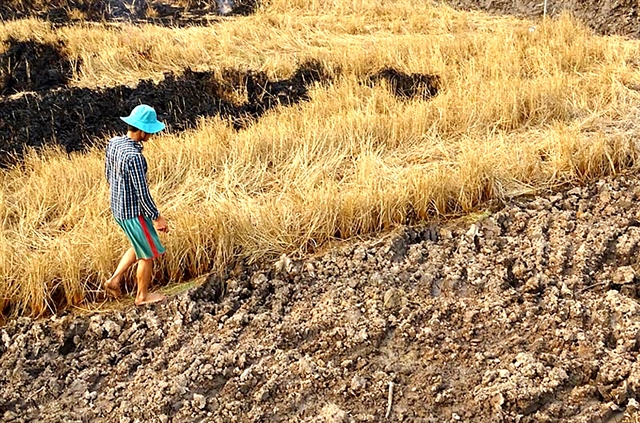 |
| A farmer inspects his dry and cracked rice field on the outskirts of HCM City as prolonged heat and water shortages threaten the summer-autumn crop. — Photo moitruong.net.vn |
HCM CITY — Prolonged heat in recent months has left many agricultural areas on the outskirts of HCM City facing severe water shortages, with reservoirs drying up, wells running dry and irrigation canals cracking under the sun.
Farmers are entering the summer-autumn crop season with growing concern as the water scarcity threatens rice fields, fruit orchards, and sugarcane and banana plantations.
The main summer-autumn rice crop is usually sown between May 15 and June 10, but many farmers have yet to prepare their fields because of insufficient water for irrigation.
Instead of the usual scenes of ploughing and soil preparation, many rice paddies now lie dry and cracked as the farmers wait for rain.
Water levels at reservoirs have fallen sharply, with several reaching dead storage levels and no longer able to provide irrigation water.
The shortage has raised fears of delayed planting, and lower yields and incomes.
Nguyễn Văn Hiệp, who cultivates one hectare of rice in Long Điền Commune, said he has never seen such a severe water shortage before.
He relies mainly on irrigation from the Sông Ray Reservoir, but supply is now being prioritised for household use, he said.
“The weather has been extremely dry, so the fields remain parched. We can only wait for rain before preparing the land and sowing seeds. If the drought continues, planting will be delayed and yields will suffer.”
Fruit growers are also struggling amid the peak dry season.
In Hòa Hội Commune, where many farmers are growing off-season longan crops, water shortages have driven up production costs.
Bùi Xuân Hùng, who has two hectares of the fruit nearing harvest, said he usually relies on two wells, but they have now run dry.
To keep the orchard irrigated, he spent VNĐ30 million (US$1,150) on installing power lines, pipelines and pumps to draw water from the Sông Hỏa Reservoir nearly a kilometre away, he said.
“Longan trees need regular irrigation during harvest season to maintain fruit quality and yields. Without enough water, the trees weaken and the fruit becomes smaller. Even though costs have increased significantly, we have to try and protect the orchard.”
Nguyễn Hữu Dũng, a farmer in Bàu Lâm Commune, is facing similar difficulties.
He had planned to plant four hectares of sugarcane, but has had to wait because of the water shortage.
At the same time, one hectare of unsold sugarcane from the previous crop has deteriorated in the prolonged heat.
Dũng said he has two wells to draw from but they now provide only around 10 minutes of water before running dry.
Unlike some neighbouring areas, sugarcane and banana plantations in Bàu Lâm Commune have no supply from nearby reservoirs.
Dũng said: “Every prolonged dry season brings concerns over water shortages. Since we cannot maintain production across large areas, we have decided to reduce sugarcane cultivation this year to limit risks.”
According to local residents, areas such as Bàu Hàm and Bàu Ngứa hamlets are major cultivation zones for bananas, sugarcane and cassava, but water supply there depends almost entirely on rainfall.
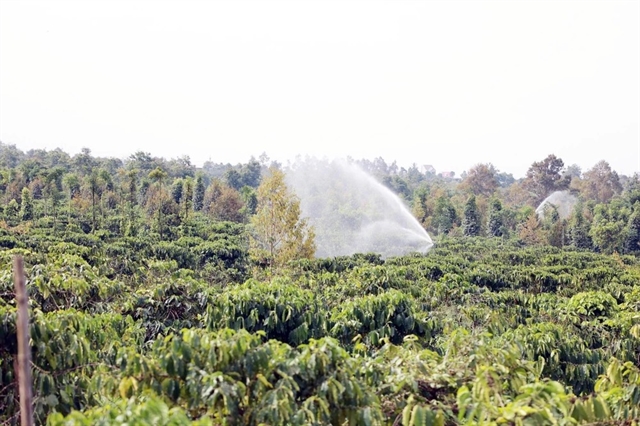 |
| Prolonged heat has caused water shortages, affecting agriculture on the outskirts of HCM City. — VNA/VNS Photo |
Although many households have shifted to crops better suited to local soil and climate conditions, this year’s drought has been particularly severe, leaving wells and irrigation canals depleted.
Local authorities are encouraging farmers to adopt water-saving measures and invest in modern irrigation systems to reduce losses.
Bùi Vĩnh Châu, chairman of the Farmers Association of Bàu Lâm Commune, said the locality is promoting water-efficient irrigation methods such as drip and sprinkler systems.
“In increasingly extreme weather conditions, changing cultivation methods is becoming essential. Continuing traditional flood irrigation will make it difficult to sustain production in the long term.”
According to the city’s agricultural sector, the risk of delays to the summer-autumn crop will rise sharply if rainfall remains low in the coming months.
Late sowing can reduce rice yields and quality while disrupting subsequent crop schedules.
In southern Việt Nam, the summer-autumn crop usually coincides with the rainy season. Delayed planting could push harvesting into periods of heavy rain and strong winds, increasing the risk of lodging and crop losses.
Authorities have advised rice farmers to prioritise short-duration varieties such as OM6976, OM4900, OM6162, and OM5451, which are more resistant to pests and diseases and have shorter growing periods, helping reduce pressure on water resources and minimise weather-related risks later in the season.
The city’s agriculture and environmental authorities have also instructed officials overseeing irrigation to work with local administrations to regulate water supply more efficiently and operate irrigation infrastructure more flexibly during the worst of the dry season.
Rotational water supply plans are already being implemented in several areas.
Alongside water management measures, farmers are also being encouraged to adopt low-cost, water-saving cultivation models to maintain productivity amid the increasingly unpredictable weather.
As water resources become scarcer, authorities said adapting through water-saving solutions, crop restructuring and changes in farming practices would be key to sustaining agricultural production. — VNS
Society
 Society
 Society
 Society
 Society
 Society
 Society
 Society
 Society
 Society
 Society
 Society
 Society
 Society
 Society