 Society
Việt Nam steps up fight against counterfeits, IP violations
1.
|
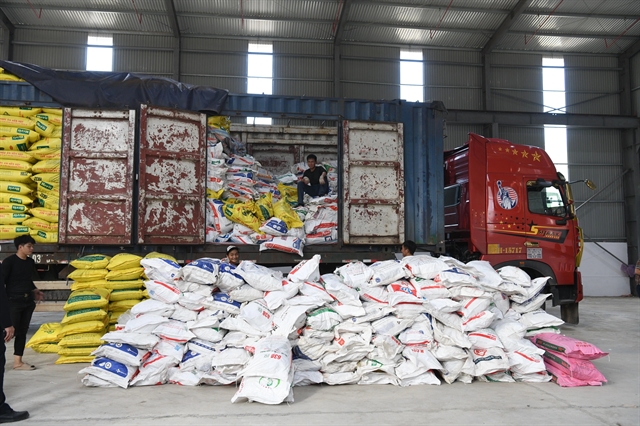
| The caffeine shipments are intercepted by authorities. — Photos courtesy of the police. |
HÀ NỘI — A highly-organised, cross-border transnational smuggling ring transporting caffeine into Việt Nam has been uncovered by the Ministry of Public Security’s Drug Crime Investigation Police Department (C04) and Điện Biên Provincial Police, authorities announced on Tuesday.
Among those arrested is Trần Phi Hùng, head of the Pharmacy Department at the National Hospital of Traditional Medicine, who is accused of smuggling more than 50 tonnes of caffeine.
The shipments were allegedly transported into Việt Nam, then through Laos and Myanmar for the manufacture of synthetic drugs.
Police said the suspects exploited legal differences between countries and loopholes in electronic customs clearance to conceal illicit activity through import-export operations.
Caffeine is regulated as a psychotropic substance in China. In Laos, it is classified as a drug precursor, with the sale or transport of 10kg or more can result in capital punishment.
However, in Việt Nam, caffeine is legally permitted for use in medicine, pharmaceuticals, food production and industry.
Investigators allege that Hùng, who holds a PhD in pharmacy and works as a department head at the National Hospital of Traditional Medicine, gradually built a large-scale trafficking network.
Using import permits issued to companies authorised to import caffeine for medical purposes, he allegedly arranged purchase contracts and worked with accomplices to identify buyers in third countries including Laos and Myanmar.
|
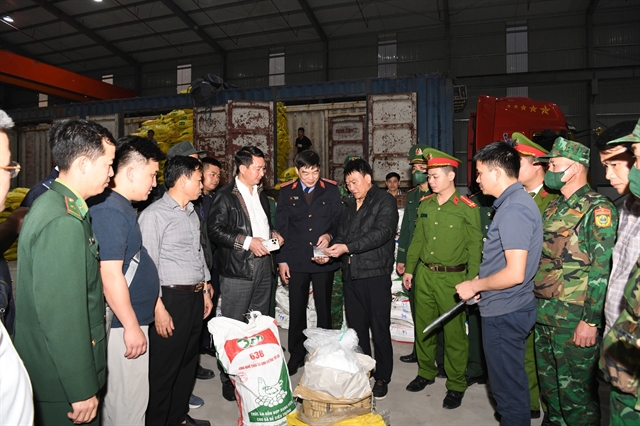
| Authorities inspect the caffeine shipments, which are concealed among ordinary declared goods. |
To disguise the operation, police said Hùng directed his son Trần Sĩ Hoàng and nephew Nguyễn Thành Đạt to establish shell companies that signed fraudulent caffeine trading contracts and issued false invoices to fictitious customers to obscure the movement of goods.
The caffeine was allegedly transported to a warehouse operated by T&T VINA Co Ltd, owned by Nguyễn Thị Thu, in Nghệ An Province, where suspects repackaged it and disguised shipments as cement or animal feed.
Authorities said the group exploited weaknesses in customs inspections to conceal caffeine among ordinary declared goods.
Proceeds from caffeine sales were allegedly transferred via Vietnamese intermediaries in Laos into accounts linked to Hùng’s acquaintances, then channelled back through front companies to legitimise financial flows.
Nearly 300 police officers mobilised
After nearly three months of investigation, police mobilised nearly 300 officers on February 27 to conduct simultaneous raids across Hà Nội, Hải Phòng and Điện Biên, Sơn La, Nghệ An and Hà Tĩnh provinces.
Authorities seized 19 tonnes of undeclared caffeine hidden among regular cargo at T&T VINA, which were intended for shipment through Laos to Myanmar.
To date, police said they have confiscated 50.7 tonnes of caffeine, six vehicles, 12 computers and 25 mobile phones, and frozen 60 bank accounts.
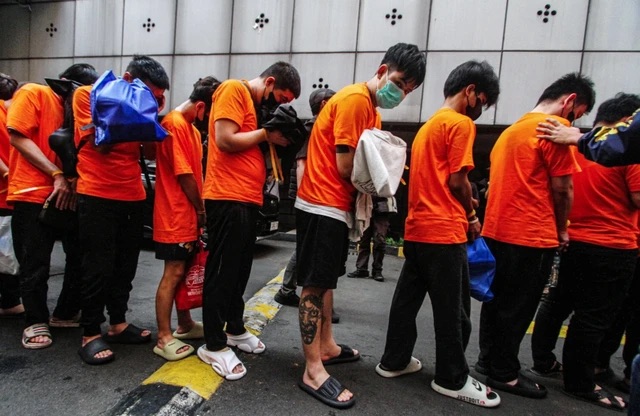
Ten suspects have been prosecuted, including Hùng and five others for smuggling, three for illegal invoice issuance and one for bribery brokerage.
Lao authorities have also arrested and charged six suspects for trading and transporting drug precursors under the country’s law.
The Ministry of Public Security said the operation represented a major success and awarded more than VNĐ300 million (US$11,400) in bonuses to 26 units involved in the case. — VNS
Society
 Society
 Society
 Society
 Society
 Society
 Society
 Society
 Society
 Society
 Society
 Society
 Society
 Society
 Society