 Society
Rural tourism needs to cash quantities over goods sold
1.
 |
| Deputy Prime Minister Phạm Thị Thanh Trà and many others have registered to donate her tissues and organs at the event. — VNS Photo Thanh Hải |
HÀ NỘI — Deputy Prime Minister Phạm Thị Thanh Trà was among those registering to donate tissues and organs at a ceremony marking Vietnam Organ and Tissue Donation Awareness Day (May 20), held by the Ministry of Health on Wednesday, underscoring growing national support for the life-saving initiative.
With the theme "Giving leaves a lasting legacy", the event aims to raise public awareness, promote understanding of tissue and organ donation after death and encourage wider community participation through media campaigns and outreach activities.
At the event, Deputy Prime Minister Phạm Thanh Trà expressed her belief that efforts to build a comprehensive medical system will continue to grow strongly, contributing to the development of a modern, humane Vietnamese health care system and the happiness of all people.
Deputy PM Trà emphasised that organ donation is the noblest act of humanity, reflecting the philosophy that giving leaves a lasting legacy.
“When one life ends, many other lives can continue. Each donated organ is a ray of hope, a new life is revived, and a family finds boundless happiness.
"I earnestly call upon cadres, soldiers, youth union members, business organisations, and every family and every Vietnamese citizen to join hands in spreading and promoting the organ donation movement with compassionate hearts, sharing and sacred national and fraternal love,” Trà said.
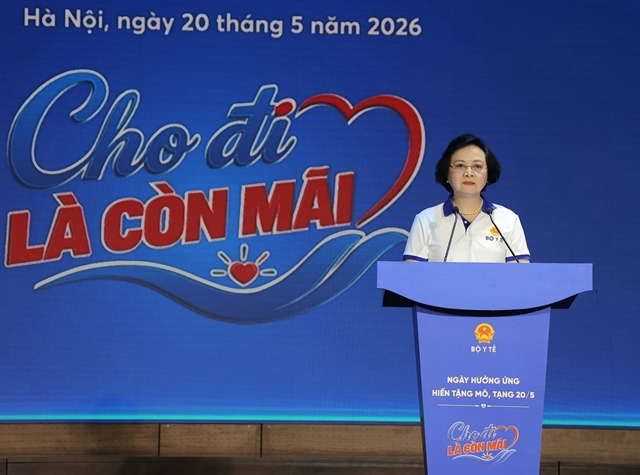 |
| Deputy Prime Minister Phạm Thanh Trà speaks at the event. — VNS Photo Thanh Hải |
Following the Government’s directive and in recognition of these compassionate acts, the Ministry of Health has designated May 20 each year as Vietnam Organ Donation Awareness Day to express gratitude to donors and their families.
The day also aims to gradually remove spiritual, customary and prejudiced barriers, honour organ donors and spread compassion and gratitude to those who have donated organs, the silent heroes and their families who have made the sacrifice to give life to others.
It is also an opportunity to express gratitude to doctors, medical staff, coordinators, volunteers and organisations that have contributed to the development of organ and tissue donation and transplantation.
It contributes to enhanced communication effectiveness, creating a focal point for management agencies, social organisations and the health care system to implement coordinated activities to promote and encourage people to register for organ donation.
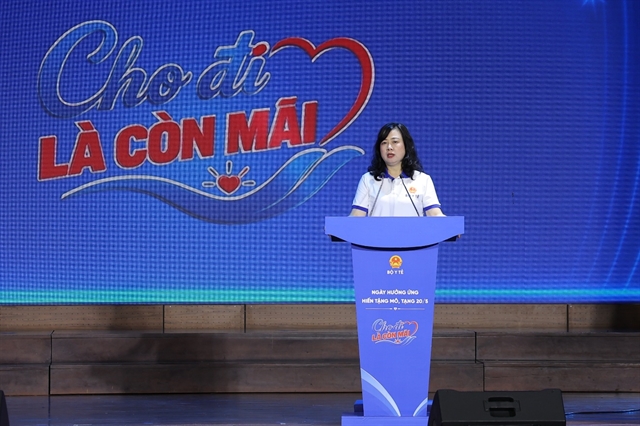 |
| Health Minister Đào Hồng Lan speaks at the event. — VNS Photo Thanh Hải |
Speaking at the event, Health Minister Đào Hồng Lan said the Vietnamese health sector is proud to have mastered the most difficult and complex organ transplantation techniques.
“The health sector has made significant efforts to develop the field of organ transplantation, demonstrated in many aspects such as mastering advanced techniques, expanding the organ donation and transplantation network and encouraging people to donate organs,” Lan said.
Statistics from the Health Ministry show that since the first successful kidney transplant in 1992, many complex techniques such as organ transplantation from brain-dead donors, multi-organ transplantation and simultaneous heart-liver transplantation have been successfully implemented.
Currently, Việt Nam's organ transplantation capabilities are considered to be on a par with those of many advanced countries in the region. By 2025, the country is expected to have 10,878 transplant cases, including 1,212 in 2024 and 1,368 in 2025. To date, there have been 286 cases of brain-dead organ donation nationwide.
The health sector has also focused on investing in infrastructure, training human resources and transferring technology to major hospitals across the country. From having only a few facilities performing organ transplants, the country now has 34 licensed hospitals for transplant operations.
 |
| Delegates launch the Vietnam Organ and Tissue Donation Awareness Day in Hà Nội on Wednesday. — VNS Photo Thanh Hải |
“Besides developing technology, efforts to change public awareness about organ donation have been intensified. The Ministry of Health has directed the National Organ Transplant Coordination Centre and other units to strengthen communication efforts, resulting in an increase in the number of brain-dead donors,” Minister Lan said.
In 2024, there were 41 cases of organ donation; in 2025, there were 66 cases and from the beginning of 2026 to the present, there have been 25 cases of brain-dead individuals donating organs nationwide.
The number of people voluntarily registering to donate tissues and organs after brain death is increasing. To date, 177,454 people have registered to donate tissues and organs after their death, according to the health ministry.
Lan stated that organ and tissue donation and transplantation in Việt Nam still face many challenges. Currently, the majority of donated organs come from living donors, accounting for 90 per cent of all transplant cases. Meanwhile, the supply of organs from brain-dead donors, a source that can save the lives of many patients simultaneously, remains very limited.
“The severe shortage of organs has led to a situation where dozens of patients die every day because they do not have the opportunity to receive timely organ transplants,” she said.
To promote the development of tissue and organ transplantation, Minister Lan said the health sector is committed to implementing many key tasks in a coordinated manner, especially perfecting institutional policies, improving medical skills and upholding medical ethics and perfecting the professional system.
Minister Lan also called on all Vietnamese people and the community, especially all healthcare workers, to be pioneers in registering to donate organs. — VNS
Society
 Society
 Society
 Society
 Society
 Society
 Society
 Society
 Society
 Society
 Society
 Society
 Society
 Society
 Society