 Society
Việt Nam has five Halal certification bodies recognised by Malaysia
1.
|
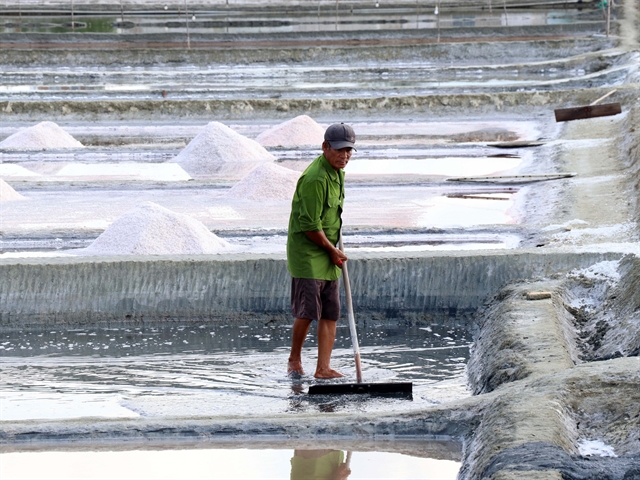
| Salt farmers harvest salt in Khánh Hải Ward of Khánh Hòa Province. — VNA/VNS Photo |
KHÁNH HÒA — With nearly 500km of coastline, abundant sunshine, strong winds and high salinity seawater, Khánh Hòa Province possesses favourable conditions for developing its marine economy, particularly the salt industry.
Following the merger of Khánh Hòa and Ninh Thuận provinces, the province’s total salt production area has expanded to more than 4,460 hectares, including over 1,440ha of traditional salt fields and around 3,000ha of industrial salt production areas.
Võ Văn Công, deputy director of the provincial Department of Agriculture and Environment, said Khánh Hòa remains among the country’s leading salt producing localities.
Traditional salt currently sells for around VNĐ1,200 per kilogramme, while industrial salt fetches VNĐ2,200-2,400 per kilogramme.
The province is home to nearly 1,100 salt farming households and around 2,900 workers engaged in the trade.
Salt production has long been associated with coastal communities, creating stable jobs and contributing significantly to local livelihoods.
During peak harvest season in May, salt fields in Khánh Hải, Nhơn Hải, Tri Hải, Phương Hải and Cà Ná communes are bustling with activity as farmers work under intense heat to collect crystallised salt from the fields.
Nguyễn Văn Tuấn, a salt farmer in Ninh Chử Ward, said prolonged sunny weather had boosted productivity this season.
His family harvests around two tonnes of salt per crop on each 1,000sq.m of land, up by more than 0.7 tonnes compared to the previous season.
With salt prices rising by around VNĐ400 per kilogramme year on year, his family now earns about VNĐ12 million ($460) per month from salt production, generating profits of approximately VNĐ9-10 million ($345-385) after expenses.
In Cà Ná Commune, salt farmers said the production season typically runs from December to August.
Traditional earthen salt fields require initial investment of more than VNĐ10 million ($385) per 1,000sq.m each season for land levelling and preparation, while tarpaulin lined industrial salt fields can require investment of up to VNĐ100 million ($3,850) per 1,000sq.m.
Many local residents said salt farming depends heavily on favourable weather conditions, with stronger sunshine accelerating evaporation and shortening harvest cycles.
Alongside traditional production, enterprises have expanded investment in industrial salt production and processing to increase added value.
At Thuận Nam, Cà Ná and Ninh Hải communes, BIM Group has developed more than 3,000ha of industrial salt fields combined with on-site processing facilities.
According to the company, the project contributes around 60 per cent of the country’s salt output annually.
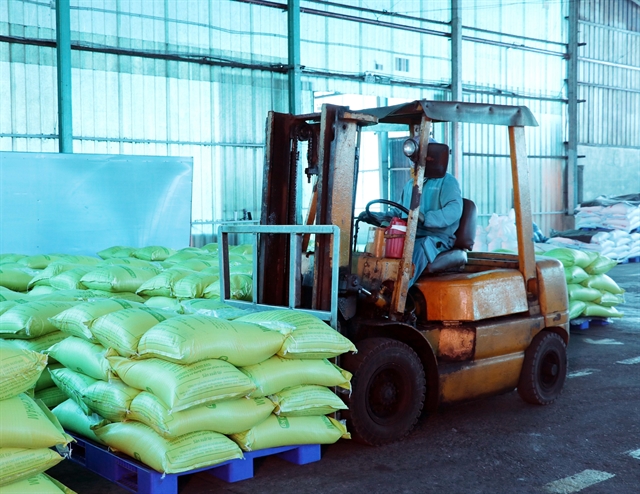
The group has also invested in refined salt and iodised salt processing plants to supply domestic markets and improve product value.
|
| Finished iodised salt products of BIM Group in Khánh Hòa Province are transported to market for distribution. — VNA/VNS Photo |
Improving quality and added value
Salt making has existed for generations in coastal localities such as Ninh Hải, Vĩnh Hải, Thuận Nam, Cà Ná, Ninh Thủy and Ninh Diêm.
In recent years, farmers have increasingly applied scientific and technical advances to improve productivity and product quality, particularly through expanding tarpaulin lined crystallisation fields.
Trần Thanh, director of Khánh Nhơn Salt Production and Trading Services Cooperative in Vĩnh Hải Commune, said favourable weather and high-quality output had pushed prices higher, with traders placing orders in advance to secure supply.
Traders in Phương Hải Commune said salt produced in southern Khánh Hòa is highly regarded for its high salinity and low impurity levels.
Farm gate prices have risen to VNĐ1.2-1.3 million ($46-50) per tonne depending on quality, among the highest levels recorded in recent years.
From the beginning of this year, Khánh Hòa has produced around 139,240 tonnes of salt, including 56,850 tonnes of traditional salt and 82,390 tonnes of industrial salt.
Salt consumption reached nearly 87,300 tonnes, with traditional salt accounting for more than 54,550 tonnes.
The province has also processed over 15,600 tonnes of refined and iodised salt, reflecting the sector’s transition toward higher value products.
Provincial authorities said Khánh Hòa has approved a project to improve salt production and processing value for the 2021-30 period, focusing on infrastructure upgrades, irrigation systems and large scale industrial salt projects.
The province is also encouraging enterprises to apply modern production technologies and diversify processed salt products to meet demand from the chemical industry and premium refined salt markets.
At the same time, local authorities are supporting cooperatives and investors in upgrading storage systems, improving quality testing capacity and strengthening product branding and trade promotion to expand consumption markets and improve incomes for salt farmers. — VNS
Society
 Society
 Society
 Society
 Society
 Society
 Society
 Society
 Society
 Society
 Society
 Society
 Society
 Society
 Society