 Environment

LANDMARK Launches ‘Destination CENTRAL’: A District-Wide Invitation to Explore the Dynamism, Luxury, and Soul of Central
1.
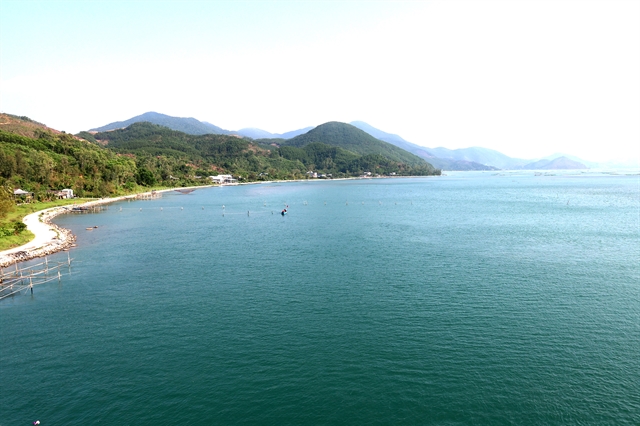 |
| The Tam Giang-Cầu Hai lagoon system, the largest brackish water lagoon complex in Southeast Asia, seen from the Tư Hiền estuary in Vinh Lộc Commune. VNA/VNS Photo Hải Âu |
The marine and lagoon economy has been identified as one of the centrally run city of Huế’s two strategic pillars and a key driver for the city’s current and future growth, alongside its heritage economy.
With more than 120km of coastline and the Tam Giang-Cầu Hai lagoon system, the largest brackish water lagoon complex in Southeast Asia, covering 216sq.km and stretching 70km along the coast, Huế holds enormous potential for marine and lagoon-based economic development.
Improved connectivity opens new growth opportunities
Huế City’s vast coastal and lagoon areas have long faced challenges due to fragmented terrain and frequent exposure to natural disasters, particularly during the storm and flood season.
Decades ago, before bridges were built, the eastern side of the Tam Giang-Cầu Hai lagoon system, where communities meet the sea, was once largely isolated from the rest of the region.
Residents travelling to the western side, where administrative centres and urban areas are located, had to rely on ferries crossing vast stretches of water.
To overcome these limitations, the city has in recent years invested heavily in transport infrastructure to strengthen both internal and regional connectivity across coastal areas and the Tam Giang-Cầu Hai lagoon system.
The old Thuận An Bridge in Thuận An Ward, put into operation in the early 1990s, was the first bridge spanning the Tam Giang lagoon. It was followed by a series of other bridges across the lagoon system, including Hòa Xuân, Trường Hà, Tam Giang and Thảo Long, effectively ending generations of dependence on ferries.
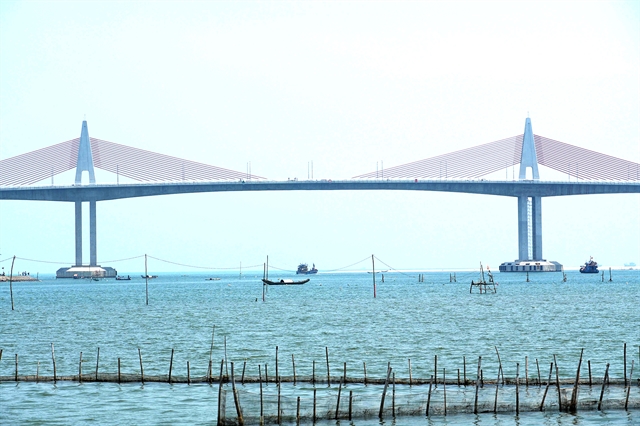 |
| The modern Thuận An sea-crossing bridge stands amid the unspoilt landscape of the Tam Giang lagoon in Huế City. VNA/VNS Photo Nguyên Lý |
The Tam Giang-Cầu Hai lagoon system opens to the sea through two major estuaries: Tư Hiền in the south and Thuận An in the north. Bridges built across these gateways have improved connectivity while unlocking new opportunities for urban, tourism and marine economic development.
The bridge spanning the Tư Hiền estuary, where Cầu Hai Lagoon meets the East Sea, was completed in late 2007. Measuring more than 915m long and 12m wide, with a 30-tonne load capacity, the bridge was built at a cost of more than VNĐ156 billion. It forms part of National Highway 49B, the coastal route linking with National Highway 1A at Chân Mây Tây.
Resident Phạm Đình Kha recalled that throughout the bridge’s three-year construction period, locals eagerly awaited its completion.
Once operational, the bridge unlocked the economic potential of coastal communities, facilitating trade, boosting the marine economy and creating new opportunities for thousands of local households.
The coastal road project, stretching nearly 7.8km, features the Thuận An sea-crossing bridge as its centrepiece. Built with an investment of VNĐ2.4 trillion, the bridge was technically opened to traffic on April 30 and is expected to be completed by June 30, 2026.
At 2.36km long, it is the longest sea-crossing bridge in central Việt Nam. Since its technical opening, the bridge has quickly become a popular check-in spot for visitors to the former imperial capital.
According to Lê Đình Phong, Chairman of the People’s Committee of Thuận An Ward, the bridge significantly shortens travel time between central Huế and the eastern coastal zone, while opening up around 1,500ha for urban development, attracting tourism investment and promoting marine economic growth.
Building on its coastal and lagoon advantages, the locality is prioritising marine services and tourism as key economic sectors to drive rapid and sustainable growth in the marine and lagoon economy.
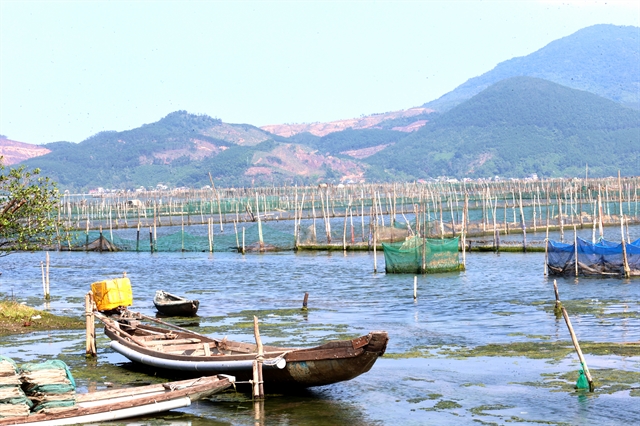 |
| An aquaculture planning area on the Tam Giang-Cầu Hai lagoon system in Vinh Lộc Commune. VNA/VNS Photo Kha Phạm |
Thuận An Ward is diversifying marine tourism services, particularly resort and experiential tourism, while investing in shopping centres, supermarkets and the modernisation of traditional markets, and developing brands for traditional local products.
The locality is also prioritising large-scale, modern infrastructure projects to improve connectivity between the urban core and surrounding areas.
Between 2026 and 2030, Huế plans to build three additional bridges crossing the Tam Giang lagoon system. These include a bridge linking Phú Vang Commune with Phú Vinh Commune, with investment capital of more than VNĐ1 trillion; Hà Trung Bridge connecting Phú Vang Commune with Vinh Lộc Commune, with investment of VNĐ950 billion; and Vĩnh Tu Bridge linking Quảng Điền Commune with Phong Quảng Ward, expected to cost more than VNĐ1.5 trillion.
Growth driven by seaports and logistics
At its fourth conference held in February this year, Huế City Party Committee outlined key development priorities, identifying the marine economy and heritage economy as the city’s two main growth drivers.
The marine economy is expected to become a key pillar of growth through the development of coastal urban areas, logistics, energy industries, seaports, and sustainable aquaculture and seafood processing.
The Chân Mây-Lăng Cô coastal area in the southeast has been designated as Huế’s marine economic hub, with a focus on logistics, the Chân Mây deep-water port, high-end resort tourism and high-tech industries.
Under Decision 1019/QĐ-BXD issued by the Ministry of Construction approving the detailed development plan for Huế’s port land and water areas for the 2021-30 period, with a vision to 2050, the city’s port system is expected to become a major hub for cargo transport, logistics services and international tourism.
Chân Mây is planned as a major port complex comprising seven berths and 11 wharves with a combined length of 3,320m, capable of handling between 8 million and 10.7 million tonnes of cargo annually and serving between 276,100 and 285,000 passengers. The port can accommodate vessels of up to 150,000 tonnes.
Chân Mây Port in Chân Mây-Lăng Cô Commune is continuing to expand with additional port infrastructure.
In January 2026, the city approved the investment policy for Berth No. 6 at Chân Mây Port, a project worth more than VNĐ928 billion covering over 15.5ha, including more than 13.2ha of land and nearly 2.3ha of water surface.
The project includes the construction of one berth for general cargo, container, bulk and liquid cargo vessels of up to 70,000 tonnes, along with two additional berths for vessels of up to 10,000 tonnes. Supporting infrastructure, warehouses, machinery and equipment will also be developed to facilitate cargo handling and import-export operations.
Phong Điền Port in Phong Phú Ward is planned to include two terminals with between six and 12 wharves stretching between 1,220m and 2,620m, with annual cargo throughput capacity ranging from 4.5 million to 8.5 million tonnes.
Huế authorities have proposed that the Ministry of Construction invest in Berths No. 1 and No. 2 of the Phong Điền Port area, with a total estimated investment of around VNĐ6.445 trillion.
Thuận An is also planned to include a port area with two wharves totalling 185m in length, capable of accommodating vessels of up to 5,000 tonnes and handling around 0.6 million tonnes of cargo annually.
By 2050, Huế’s seaport system is expected to continue expanding to meet average annual cargo growth of between 3.6 and 4.5 per cent.
Dr Trần Thị Hồng Minh, former Director of the Institute for Policy and Strategy Studies, said Huế had been steadily investing in transport infrastructure and major logistics projects.
The city’s transport infrastructure is relatively well synchronised, with a full network of road, rail, air and sea transport systems, according to Minh.
In particular, the completion of the Thuận An sea-crossing bridge will create a faster route connecting central Huế with the coast, boosting coastal urban development and port infrastructure.
Chân Mây Port is continuing to expand and has already become a destination for large international cruise ships, creating favourable conditions for tourism-linked logistics services.
At the same time, Phú Bài International Airport and the North-South Expressway provide Huế with favourable conditions to develop into a regional green logistics hub.
LEC Group has invested in a modern logistics centre in the Chân Mây-Lăng Cô Economic Zone to provide integrated warehousing, transport and logistics services.
The Chân Mây Logistics Centre spans nearly 40ha and includes hundreds of thousands of square metres of warehouses and storage yards, capable of meeting logistics demand both within Huế and beyond.
According to LEC Group Project Director Đỗ Thái Dương, improving the competitiveness and efficiency of logistics operations in Huế will require special incentives for the logistics sector, including tax and land rent reductions, as well as faster licensing procedures to attract major investors and create a more vibrant and interconnected logistics ecosystem in the region.
He also stressed the need to develop transport routes linking the Chân Mây-Lăng Cô Economic Zone with the La Sơn-Túy Loan Expressway to shorten transport time from the Central Highlands, southern Laos and northeastern Thailand to Chân Mây Port.
In addition, a transport route connecting Laos with A Đớt Border Gate and linking with the existing transport network to the Chân Mây-Lăng Cô Economic Zone would facilitate import-export activities from Laos and Thailand through Chân Mây Port and the logistics centre. VNS
Environment
 Environment
 Environment
 Environment
 Environment
 Environment
 Environment
 Environment
 Environment
 Environment
 Environment
 Environment
 Environment
 Environment
 Environment