 Environment
Power transmission to be separated from EVN to develop a competitive electricity market
1.
 |
| Deputy Minister of Agriculture and Environment Phùng Đức Tiến. — VNA/VNS Photo |
The reservoir aquaculture development plan for 2026-2030 aims to lift annual output to more than 260,000 tonnes by 2030, generating about VNĐ16 trillion (US$607.7 million) a year and creating jobs for over 80,000 workers. The plan is designed to unlock the potential of the country’s vast reservoir system while ensuring development remains controlled and within environmental carrying capacity, avoiding the pitfalls of spontaneous expansion.
Deputy Minister of Agriculture and Environment Phùng Đức Tiến spoke with Nhân Dân (The People) newspaper about the outlook and challenges for the sector.
How do you assess the potential and actual effectiveness of reservoir fisheries in Việt Nam?
Việt Nam has nearly 8,000 irrigation and hydropower reservoirs, with a total water volume of around 50 billion cubic metres. This represents a highly valuable resource with strong potential for multi-purpose aquaculture development.
Reservoirs offer abundant and diverse aquatic resources, along with large water surface areas suitable for farming a wide range of species. This allows for large-scale, concentrated production linked to processing, domestic consumption and exports, contributing to job creation and poverty reduction, especially in remote and disadvantaged areas.
In recent years, reservoirs such as Hòa Bình, Sơn La, Tuyên Quang and Thác Bà have seen the development of cage fish farming, generating tangible economic value. Stocking programmes to restore aquatic resources have also shown initial success, helping sustain natural catches.
However, the sector has yet to fully realise its potential. Production remains small-scale and fragmented, value chain linkages are weak, markets are unstable, and management still faces shortcomings.
The Ministry of Agriculture and Environment is therefore promoting a development model that is sustainable, multi-value and closely linked to community livelihoods and resource protection, while increasing added value through restructuring production and building value chains. Decision No. 707/QĐ-BNNMT, issued on March 2, 2026, sets the overall direction, targeting an annual value of VNĐ16 trillion by 2030 and providing a key basis for localities to reorganise production and better utilise water surface resources.
Protecting aquatic resources is critical for sustainability. How do you view current violations such as the use of explosives, electric shocks and illegal nets?
The 2017 Fisheries Law clearly prohibits destructive practices such as the use of explosives, electric shocks, toxins, illegal fishing gear and fishing in restricted areas or seasons.
Yet in reality, destructive methods like electrofishing and small-mesh nets still occur in some reservoirs. The reasons include weak enforcement, limited awareness among some communities, and the lack of sustainable alternative livelihoods. In addition, administrative sanctions have not always been strict enough to deter violations.
These practices not only deplete aquatic resources but also disrupt ecosystems and threaten the long-term livelihoods of local people. They must be addressed firmly to protect resources and ensure effective management of inland fisheries.
To tackle the issue, a comprehensive approach is needed: improving legal frameworks, strengthening enforcement, raising public awareness, enhancing coordination among authorities, and applying technology such as surveillance cameras and positioning systems.
At the same time, promoting co-management models is essential. Communities should be supported to participate directly in resource protection, with clear links between rights and responsibilities. Developing alternative livelihoods, such as cage farming, semi-natural aquaculture, vocational transition and combining aquaculture with eco-tourism, will also be key.
Ultimately, the shift must be from purely administrative control to community-based resource governance.
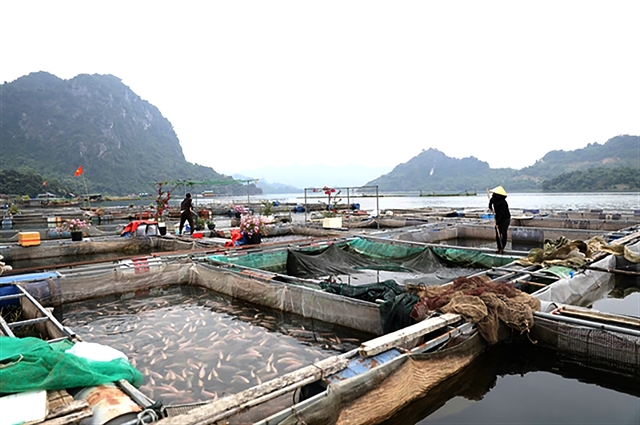 |
| A floating fish farm on Hòa Bình reservoir, Phú Thọ Province. — VNS Photo Đoàn Tùng |
How can the interests of communities and businesses be balanced to avoid conflicts?
Attracting business investment is necessary to improve efficiency and promote large-scale, market-oriented development. However, the guiding principle must be that businesses are the driving force, while local people remain the central stakeholders.
Clear zoning and planning are essential to define areas for aquaculture, exploitation and conservation, avoiding overlaps. Transparency in allocating and leasing water surfaces must also be ensured, with clear rights and obligations for all parties.
Partnership models should link businesses with local communities through cooperatives or collaborative groups, enabling benefit-sharing through purchase agreements and technical support. Co-management mechanisms should allow communities to monitor business activities, while regular dialogue helps prevent misunderstandings and conflicts.
The key principle is not to sacrifice local livelihoods for short-term growth, but to create shared, sustainable value.
What international lessons can Việt Nam apply in developing reservoir aquaculture?
International experience highlights several important lessons. First is ecosystem-based management, ensuring that exploitation does not exceed ecological limits or the carrying capacity of reservoirs.
Second is the importance of co-management, with communities directly involved in resource governance, improving compliance and effectiveness.
Third is the development of value chains, linking production with processing and markets, and focusing on increasing value rather than simply boosting output.
Finally, the application of science and technology is crucial, including high-quality breeding stock, appropriate feed, disease control, modern farming techniques and traceability systems.
Countries such as China, Laos and Cambodia have successfully implemented these approaches. Việt Nam will selectively adapt these experiences to its own conditions, particularly its multi-purpose reservoir management and community-based livelihood context.
How will legal bottlenecks in using reservoir water surfaces be addressed?
Any use of reservoir water surfaces must strictly ensure dam safety, environmental protection, water quality and ecosystem integrity, while not affecting the primary functions of reservoirs or water security.
The goal is to establish a controlled, multi-purpose framework that ensures safety, complies with the law, and unlocks the economic potential of water resources.
Reservoir aquaculture development is not just about increasing output, but about responsible water resource governance that supports livelihoods, protects the environment and promotes sustainable local development.
In the coming period, priorities include improving and harmonising the legal framework, strengthening decentralisation alongside accountability, revising regulations to ensure consistency, and establishing transparent mechanisms for allocating and leasing water surface use rights. — VNS
Environment
 Environment
 Environment
 Environment
 Environment
 Environment
 Environment
 Environment
 Environment
 Environment
 Environment
 Environment
 Environment
 Environment
 Environment