 Environment

European higher education week opens new opportunities
1.
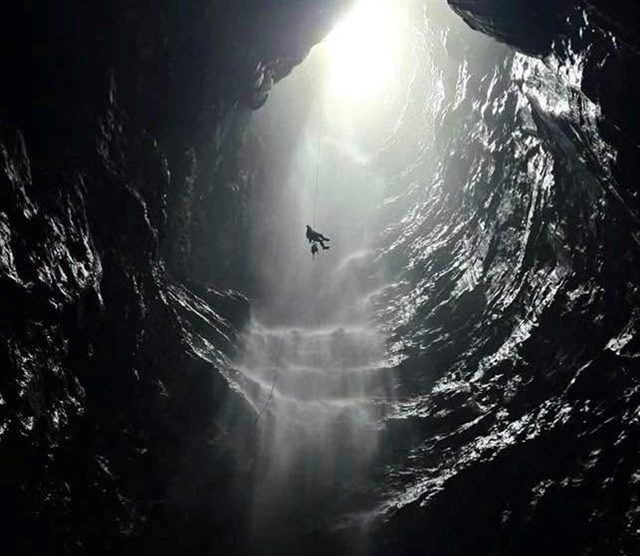 |
| Cha Nghéo cave was found with a naturally formed waterfall inside. |
HÀ NỘI — A large cave featuring an usually tall waterfall has just been discovered in the Phong Nha–Kẻ Bàng National Park in central Việt Nam, further cementing the UNESCO-listed site’s reputation as one of the world’s most remarkable karst landscapes.
The park’s management board confirmed on April 20 that a survey team had recently identified the cave – named as Cha Nghéo – during an exploration in a remote area. Initial assessments revealed a vertical depth of around 350m.
Inside, explorers encountered a stream of water cascading from above to the cave floor, forming a waterfall with an unusual structure rarely seen in other caves in the region.
While many caves in the area show evidence of underground water flow, scientists note that the formation of a waterfall hundreds of metres high within a cave is extremely rare – adding significant geological and scenic value to this latest discovery.
Experts said the survey is still ongoing, with large sections of the cave yet to be accessed. As a result, it is too early to provide a comprehensive evaluation of the cave’s scale, geological structure, or hydrological significance.
Authorities plan to conduct more detailed studies in the coming period, with a full scientific report and official announcement expected once the exploration is complete.
Often dubbed the “Kingdom of Caves”, Phong Nha–Kẻ Bàng National Park is home to more than 425 known caves, around 50 of which are open to tourism. Among its most famous is Sơn Đoòng Cave, located in the park’s core zone and renowned for its title as the biggest cave in the world, complete with an underground river system and its own climate. — VNS
Environment
 Environment
 Environment
 Environment
 Environment
 Environment
 Environment
 Environment
 Environment
 Environment
 Environment
 Environment
 Environment
 Environment
 Environment