 Environment
Rural tourism needs to cash quantities over goods sold
1.
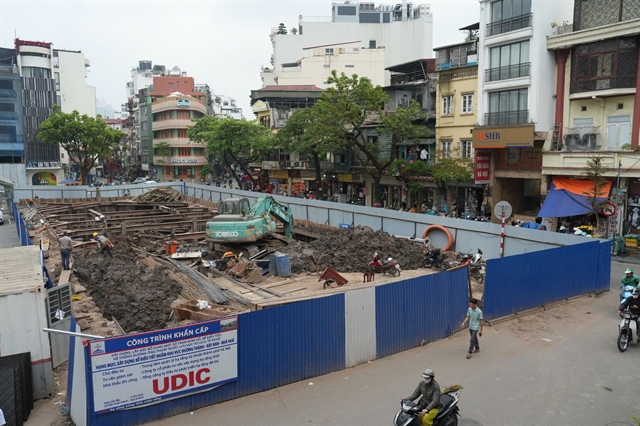 |
| Construction of an underground retention tank is under way in front of Hàng Da Market. — Photo nhandan.vn |
Hoàng Nhật & Hồng Vân
HÀ NỘI — Every rainy season, the streets flood. It has been that way for years in Hà Nội, where ageing pipes struggle to keep pace with heavier downpours and rapid urban growth.
In the dense, historic neighbourhoods near the Old Quarter, water has nowhere to go — and there is little room to install new pipes.
Now, city officials have found part of the solution: underground retention tanks that quietly absorb surging runoff when the skies open up, then slowly release the water once the storm has passed.
"In the overall drainage system of the capital, these underground tanks play an important role," Nguyễn Đức Hùng, deputy director of the Hanoi Urban Planning Institute, told Nhân Dân newspaper. "They help handle localised flooding quickly and take pressure off the existing sewer network."
 |
| Nguyễn Đức Hùng, deputy director of the Hanoi Urban Planning Institute. — Photo nhandan.vn |
The concept is not new — countries such as Japan, South Korea and Singapore have used large-scale underground storage systems for decades.
But for Hà Nội, it represents a meaningful shift in how the city manages stormwater.
The most visible project so far is a rainwater retention tank, about 2,500 cubic metres, being built beneath the five-way intersection in front of Hàng Da Market in Hoàn Kiếm Ward, about 6.5 metres underground.
It is a key proof of concept: if it works in one of the city’s most congested areas, it could be replicated elsewhere.
The Hàng Da project is notable not just for where it's being built, but how.
Instead of casting concrete on-site, engineers are using prefabricated modules manufactured off-site and assembled underground like building blocks.
Choosing the right approach
The approach moves most of the heavy construction work from the street to the factory, where quality can be controlled more precisely. It also allows multiple parts of the project to proceed simultaneously, rather than one step at a time.
The payoff is significant. The total investment is around VNĐ30 billion (US$1.40 million), said a representative of Hà Nội's Technical Infrastructure Management Centre, the project's investor.
Using precast components saves up to 30 per cent compared to conventional construction methods. This means less noise, less dust and less disruption in a neighbourhood that can't easily afford any of those things. It also leads to a project timeline short enough to wrap up by late April before the 2026 rainy season.
The contrast becomes clear when set against another retention tank going up at the same time near the Đuống Bridge in Phù Đổng Commune, a much less congested area on the city's outskirts.
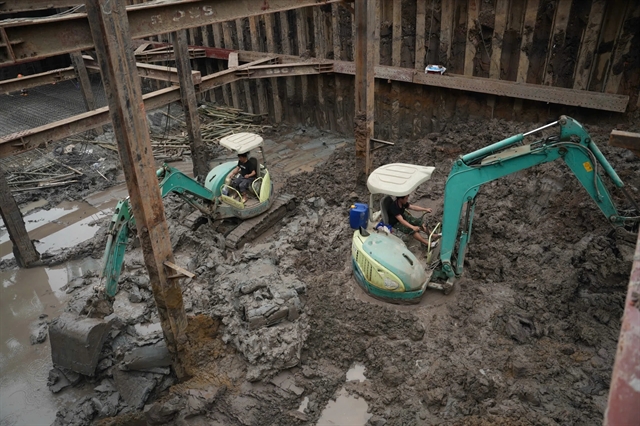 |
| Excavators prepare the construction site. — Photo nhandan.vn |
There, workers are using traditional cast-in-place concrete – digging, setting forms, installing rebar, pouring and waiting. The method is reliable and produces a solid, seamless structure, but it takes longer and places greater demands on the surrounding environment.
"The choice of technology has to match the conditions on the ground," said Đỗ Xuân Đức, a lecturer in climate change and sustainability science at Vietnam National University Hanoi. "Urban density, schedule and site logistics all matter."
Đức acknowledged the advantages of prefabricated construction in dense urban settings, but stressed that durability ultimately would come down to material quality and rigorous traceability throughout the supply chain.
Beyond the tanks
Hà Nội has a natural advantage: the Red River runs through the city, alongside a dense network of smaller waterways.
These waterways could be integrated into a comprehensive stormwater strategy — collecting, storing and reusing rainwater rather than simply draining it away.
"We should stop thinking of rainwater as a burden to get rid of. It's a resource. It needs to be managed, stored and reused," Đức said.
However, he noted that tanks alone would not be enough.
One of the city’s most persistent drainage problems lies in clogged pipes filled with silt and waste. No storage system can function effectively if water cannot flow.
Đào Ngọc Nghiêm, vice chairman of the Vietnam Urban Planning and Development Association, said the city's new master plan, which looks ahead 100 years and designates underground space for more than 40 per cent of the urban core, marked a fundamental shift in thinking.
 |
| Đào Ngọc Nghiêm (left), vice chairman of the Vietnam Urban Planning and Development Association. — Photo nhandan.vn |
Planning has shifted from static to dynamic space, allowing flexibility as the city evolves.
Under that framework, retention tanks like Hàng Da and Đuống Bridge are prototypes – “satellites” that could eventually connect into a broader underground network.
Whether that network gets built would depend less on engineering than on governance, said Hùng, the planning institute deputy director.
The city would need dedicated legal frameworks, real coordination across agencies and enough transparency for residents to hold officials accountable. How well the city attracts outside investment and manages the inevitable disputes along the way, he added, would matter just as much in the end.
Đức echoed the caution. Large underground structures would come with serious risks in the form of ground subsidence, long-term maintenance costs and geological surprises that demand thorough study before scaling up.
"A sustainable infrastructure system isn't just about how well any single project performs. It's about how everything connects," he said.
Hà Nội has set ambitious targets for itself: a city of culture and modernity by 2035, a global knowledge hub by 2045 and a high human development standard by 2065.
Achieving these goals will require infrastructure that is both resilient and adaptable.
For now, a concrete tank buried 6.5 metres beneath a market street marks a small but deliberate step in that direction. — VNS
Environment
 Environment
 Environment
 Environment
 Environment
 Environment
 Environment
 Environment
 Environment
.jpg) Environment
Environment
 Environment
 Environment
 Environment
 Environment
 Environment