 Economy



Sơn La holds second coffee festival, targeting stronger businesses in future
1.
|
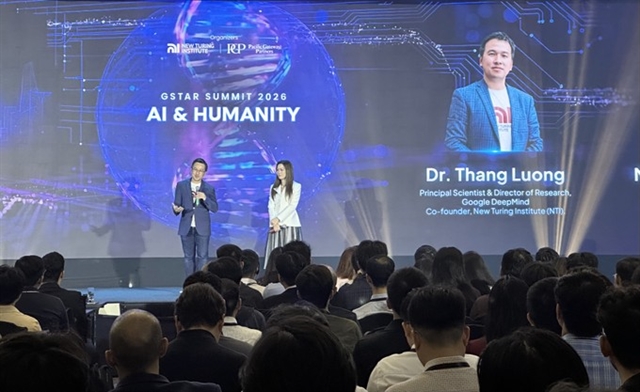
| Dr Thắng Lương, co-founder of the New Turing Institute (NTI), speaks at the GStar Summit 2026 forum in HCM City on Friday. — VNA/VNS Photo |
HCM CITY — Việt Nam, an emerging innovation hub, aims to build closer links with advanced research centres such as Silicon Valley and fast-growing Asia-Pacific markets, officials said at the GStar Summit 2026 on Friday.
More than 1,000 technology leaders, researchers and investors gathered in HCM City for the regional artificial intelligence (AI) forum that aims to strengthen global collaboration and advance human-centred AI development across the Asia-Pacific region.
Speaking at the opening ceremony, Bùi Hoàng Phương, deputy minister of Science and Technology, said AI had become a foundational technology with far-reaching implications for economic growth, governance and national competitiveness.
He said the event provided a platform for scientists, businesses and international organisations to exchange views on AI research, development and applications, supporting Việt Nam’s ambition to make AI a key driver of national growth.
“Việt Nam has identified science and technology, innovation and digital transformation as central engines for improving labour productivity, growth quality and national competitiveness,” he said.
He added that AI was one of the country’s strategic technologies, with Việt Nam aiming to rank among Southeast Asia’s top three countries for AI research and development by 2030.
The annual summit also aims to connect Việt Nam’s AI community with international networks as Asia emerges as a major centre for AI development, driven by a young workforce and rising cross-border investment.
This year’s event featured around 20 speakers from major technology firms and research institutions, including Google, Qualcomm, FPT, Grab and MoMo.
Thắng Lương, chief scientist at Google DeepMind and co-founder of the New Turing Institute (NTI), described the summit as a milestone for the Asia-Pacific AI ecosystem.
“By connecting leading global experts with innovators in the region, we are fostering collaborations that could redefine how AI serves humanity,” he said.
Ed H. Chi, vice president of Research at Google DeepMind, presented a keynote titled The Future of Universal Personal AI Assistants, outlining the next generation of AI systems designed to provide more personalised and adaptive support for users.
Meanwhile, Po-Shen Loh, professor at Carnegie Mellon University and former coach of the United States International Mathematical Olympiad team, shared his perspectives on education in the post-AI era, focusing on how learning systems must evolve alongside rapid technological advances.
Loh said that in the AI era, uniquely human qualities such as adaptability, empathy and ethical responsibility would become increasingly important.
Panel discussions focused on safe agentic AI, applications in healthcare and financial inclusion, and strategies for preserving languages in the digital era.
The summit also featured live demonstrations of AI solutions in healthcare, fintech and generative AI, while serving as a networking platform for businesses, startups, investors and research organisations.
The forum, themed AI and Humanity, was held under the patronage of the Ministry of Science and Technology and jointly organised by NTI and Pacific Gateway Partners.— VNS
Economy
 Economy
 Economy
 Economy
 Economy
 Economy
 Economy
 Economy
 Economy
 Economy
 Economy
 Economy
 Economy
 Economy
 Economy