 Economy



LANDMARK Launches ‘Destination CENTRAL’: A District-Wide Invitation to Explore the Dynamism, Luxury, and Soul of Central
1.
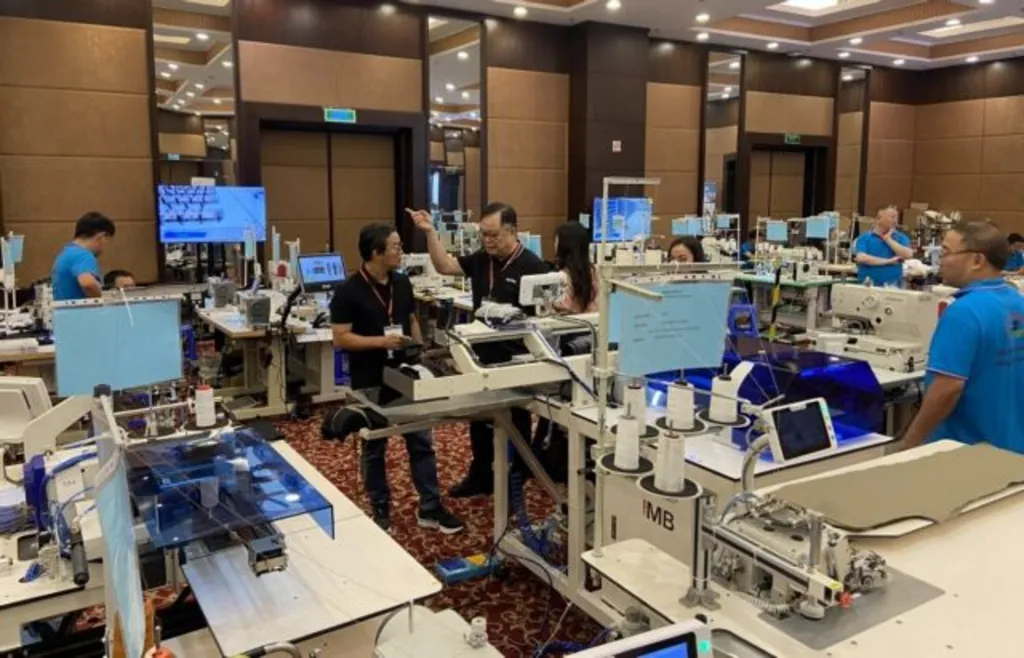 |
| Many textile and garment technology solutions were showcased and introduced at the forum on Industry 4.0 transformation in the textile and garment sector held on May 28. Photo vneconomy.vn |
HÀ NỘI — Rather than relying solely on low-cost labour or a fast-fashion model, Việt Nam’s textile and garment industry is entering a pivotal phase of digitalisation, automation, robotics and artificial intelligence (AI) adoption to address rising costs, retain global buyers and move towards a more sustainable smart manufacturing future.
Vũ Đức Giang, chairman of the Vietnam Textile and Apparel Association (VITAS), made the statement at a forum on Industry 4.0 transformation in the textile and garment sector held on May 28.
In 2025, Việt Nam’s textile and garment sector posted export revenues of US$46 billion, firmly maintaining its position as the world’s second-largest exporter. During the first four months of 2026, exports reached $14.4 billion, up 3.7 per cent year on year.
Behind those growth figures, however, lies a series of major challenges stemming from geopolitical tensions in the Middle East and Europe, placing the industry under what Giang described as triple pressure.
First, labour and production costs continue to rise, gradually eroding Việt Nam’s traditional competitive advantage. At the same time, changes in import markets are becoming increasingly demanding.
Although Việt Nam currently benefits from 17 next-generation free trade agreements (FTAs), from 2024 to 2026, there have been significant shifts in buyer behaviour.
Importing countries are introducing stricter requirements and rapidly moving away from fast fashion towards more sustainable and stable production models.
Labour mobility and intensifying competition for skilled workers during the first four months of 2026 have further complicated efforts to maintain stable production chains.
As international brands continue to pressure suppliers for annual price reductions while simultaneously demanding smaller orders, shorter lead times and stricter quality standards, Việt Nam’s textile industry has little choice but to adapt.
According to Giang, technology, digitalisation, automation, robotics and AI are now the only viable path forward.
A key question remains whether Vietnamese enterprises have sufficient financial capacity to invest in Industry 4.0 technologies.
Addressing this concern, the VITAS chairman said that while such investments would have posed a major challenge three years ago, the financial landscape had changed significantly by 2026, with Industry 4.0 technologies becoming far more affordable.
This shift is being driven by three key factors. First, the market is no longer dominated by only a handful of technology brands. Equipment manufacturers worldwide have entered the Industry 4.0 race, giving Vietnamese businesses a broader range of automation and robotics solutions suited to different budgets and scales of operation.
Second, the adoption of specialised machinery is helping manufacturers address chronic labour shortages.
One of the clearest examples can be seen in modern spinning mills, where processes ranging from raw cotton handling and carding to blending and packaging have been fully automated through robotics, significantly reducing dependence on manual labour.
A spinning factory with 50,000 spindles that once required 200 to 300 workers can now operate efficiently with just 30 to 40 personnel, thanks to Industry 4.0 technologies.
In the garment sector, robots are increasingly replacing manual labour in transporting goods and semi-finished products from cutting workshops to sewing lines, as well as handling factory cleaning operations.
Digital transformation solutions
Despite recognising the importance of Industry 4.0, many Vietnamese textile and garment companies continue to face challenges related to strategic direction, shortages of technology personnel, lack of integrated solutions and uncertainty about implementation roadmaps.
Doãn Thừa Quân, general director of Quân Bằng Co Ltd, said factories today urgently need technology partners capable of providing optimal solutions to improve production efficiency.
To meet that demand, technology providers at the forum introduced comprehensive digital ecosystems covering the entire production chain, from design to export.
Trần Trạch, co-founder of Smarga, presented a real-time smart management platform based on internet technology. Through a smartphone connected to applications such as Zalo or WeChat, factory managers can oversee operations via standardised digital workflows, including order management, production planning and execution.
The system is capable of automatically forecasting production progress and issuing early warnings when delivery delays are likely, helping companies almost eliminate late delivery issues.
Meanwhile, INA’s solution, introduced by deputy general director La Tân, focuses on optimising factory infrastructure through advanced automation equipment, including intelligent hanging conveyor systems that deliver products directly to sewing operators and unmanned material warehouses integrated with four-dimensional robotics systems.
Performance gains among INA’s existing clients have demonstrated the impact of these technologies. Sportswear brand Anta reported productivity increases of 25 to 35 per cent, lingerie manufacturers achieved gains of 20 to 30 per cent, while sportswear producers saw improvements ranging from 6 to 20 per cent.
Beyond machinery investment, the forum emphasised that Industry 4.0 transformation is not simply about purchasing equipment but requires a fundamental shift in corporate mindset and long-term strategic vision.
Successful transformation depends on balancing technology adoption with human capital development. Human resources remain central to the process, as companies cannot effectively operate advanced automation systems without a workforce capable of adapting quickly to new technologies.
To remain competitive in the global marketplace, VITAS recommended that Vietnamese enterprises proactively strengthen cooperation with global equipment manufacturers.
Diversifying export markets, partners and product portfolios while building sustainable supply chain linkages will provide a strong foundation for long-term growth.
According to the association, these internal reforms are essential for achieving the industry’s broader objective of raising Việt Nam’s textile and garment export turnover to between $48–49 billion in 2026. — VNS
Economy
 Economy
 Economy
 Economy
 Economy
 Economy
 Economy
 Economy
 Economy
 Economy
 Economy
 Economy
 Economy
 Economy
 Economy