 Economy


Data centre market faces energy challenges
1.
|
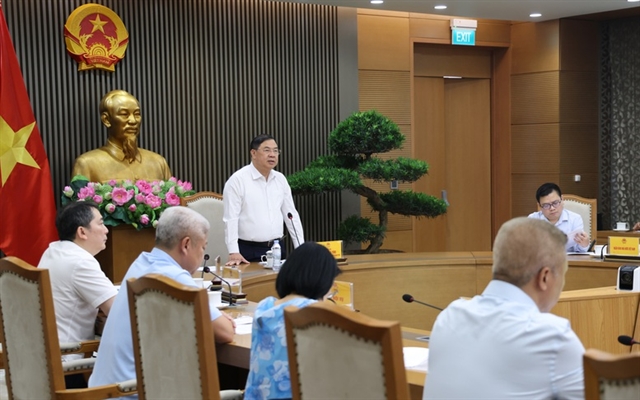
| Deputy Prime Minister Phạm Gia Túc at the meeting with the Vietnam Textile and Apparel Association (VITAS) and the Vietnam Leather, Footwear and Handbag Association (LEFASO) on May 29. — Photo baochinhphu.vn |
HÀ NỘI — Deputy Prime Minister Phạm Gia Túc on May 29 urged textile, garment and footwear industries to accelerate the adoption of science and technology, innovation, digital transformation and e-commerce to improve productivity and product quality, while expanding sustainable manufacturing practices that meet environmental, social and governance (ESG) standards.
Speaking at the meeting with the Vietnam Textile and Apparel Association (VITAS) and the Vietnam Leather, Footwear and Handbag Association (LEFASO), Deputy PM Túc also called on companies to develop circular economy models, including the recycling of textile by-products and discarded clothing into new products, as part of the country's broader green growth strategy.
“The State will provide necessary policy support, from land access to financing, for textile and footwear enterprises to develop technology, particularly in line with Resolution 57 on breakthroughs in science, technology, innovation and national digital transformation,” he said.
He cited statistics that the textile and garment industry currently accounts for around 10 per cent of Việt Nam's export turnover and 5 per cent of imports, employing about 1.8 million workers, while the leather,footwear and handbag sector employs another 1.5 million people,
He noted that rapidly changing global conditions and weaker consumer spending in many countries were putting pressure on manufacturers.
The Deputy PM stressed that the Government aimed to remove obstacles facing businesses and create favourable conditions for the two industries to contribute more to exports, double-digit economic growth and national development goals through 2030, while improving workers' living standards.
Solutions proposed
|
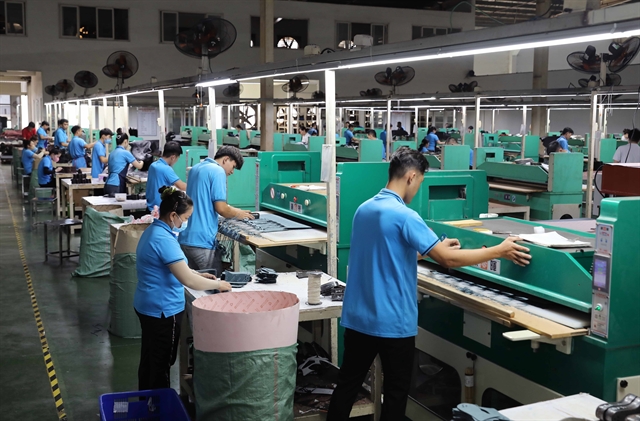
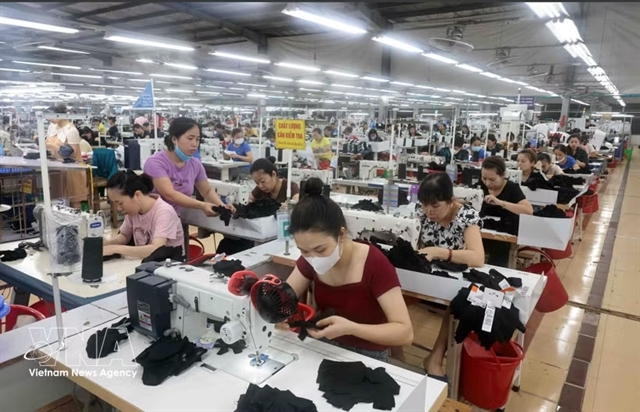
| Production at VIễn Thịnh Footwear Company in Tây Ninh Province. The Government would continue working with businesses to address bottlenecks, streamline procedures and prevent overlapping inspections. — VNA/VNS Photo Thành Phương |
According to VITAS’s President Vũ Đức Giang, Việt Nam's textile and garment exports exceeded US$46 billion in 2025, reaching 138 markets. Garments accounted for $38.7 billion of the total, while yarn exports generated more than $4.8 billion. Vietnamese manufacturers accounted for around 41-42 per cent of the export revenue.
The industry exported $17.8 billion in the first five months of 2026 and is targeting exports of $48-49 billion for the full year, Giang said.
He said that domestic manufacturers continue to face challenges including dependence on imported fabrics and accessories, underutilisation of tariff preferences under free trade agreements (FTAs), labour shortages and increasingly stringent sustainability requirements in export markets.
VITAS called for policies to attract high-tech and environmentally compliant investment into textile dyeing and finishing to strengthen domestic supply chains. The association also proposed reforms to value-added tax regulations and customs procedures, support for e-commerce exports and measures to reduce overlapping inspections.
LEFASO’s President Nguyễn Đức Thuấn said Việt Nam ranked second globally in footwear export value and third in production volume. The country's fashion and footwear industry includes about 10,000 manufacturers and more than 22,000 supporting-industry enterprises.
The industry’s local procurement rate has reached around 55 per cent while average monthly wages stand at VNĐ12-13 million ($460-500), he said.
Tuấn proposed the establishment of a national materials and accessories centre that would function as both an innovation hub and a solution to supply-chain bottlenecks by increasing domestic production of inputs.
Concluding the meeting, Deputy PM Túc said that the Government would continue working with businesses to address bottlenecks, streamline procedures and prevent overlapping inspections while maintaining effective oversight against trade fraud and violations of rules of origin.
He also called for stronger product and corporate branding, greater use of benefits available under new-generation FTAs, deeper participation in global value chains and expanded production of domestically sourced materials.
The Deputy Prime Minister urged businesses to invest more in workforce training, digital transformation and green production to enhance competitiveness and support the development of a sustainable, circular economy. — VNS
Economy
 Economy
 Economy
 Economy
 Economy
 Economy
 Economy
 Economy
 Economy
 Economy
 Economy
 Economy
 Economy
 Economy
 Economy