 Environment
Quy Nhơn Dialogue on Climate and Transition to provide platform for open discussion
1.
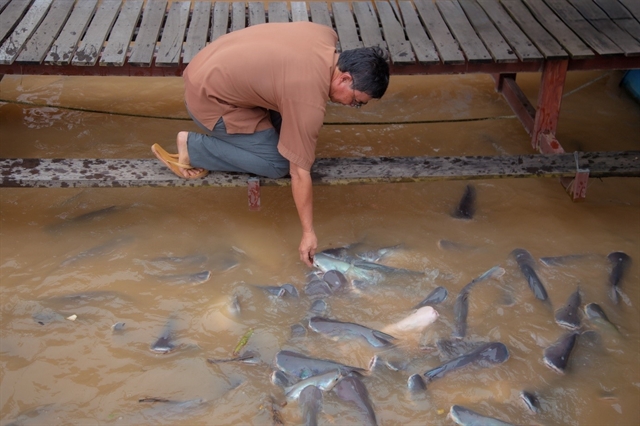 |
| Climate change and saltwater intrusion are making cage fish farming more difficult for farmers in Mekong Delta region like Lý Văn Bon. — VNA/VNS Photo |
MEKONG DELTA — The rapid transformation of river ecosystems is placing the Mekong Delta under growing pressure to rethink water resource governance, moving away from output-driven growth towards greater efficiency and sustainability.
At Cồn Sơn Islet in Cần Thơ City, Lý Văn Bon, a veteran fish farmer with nearly 30 years of experience, has observed stark changes in the Hậu River.
The most visible sign is the appearance of brackish and marine species in what was once a freshwater environment.
In cages used to raise specialty freshwater fish such as featherback and giant barb, Bon has found species like scat fish, goby and eel-like fish – typically confined to estuarine or coastal areas.
Their migration hundreds of kilometres inland signals significant changes in water conditions.
These environmental shifts are driving up production costs.
Previously fish farming costs were around VNĐ40,000 per kilogramme (US$1.60), but have now risen to VNĐ60,000-70,000 ($2.40–$2.80).
The main reason is the sharp decline in sediment flows, which has depleted natural food sources.
Farmers are now fully dependent on industrial feed, significantly increasing operating costs.
Saltwater intrusion is also accelerating the deterioration of aquaculture infrastructure.
Fish cages that once lasted up to five years now require major repairs after just three.
Metal components such as bolts and screws corrode rapidly in saline conditions, while wooden frames are weakened by barnacles attaching densely to the structure.
Maintenance costs have thus become a heavy burden, eroding farmers’ profits.
At a broader scale, the Mekong Delta receives an average annual volume of water of around 488 billion cubic metres, of which up to 97 per cent is surface water originating from upstream countries.
This heavy dependence makes the region highly vulnerable to upstream developments and climate change.
Recent data shows that dry-season flows at the Tân Châu and Châu Đốc stations in An Giang Province have declined by an average of 13 per cent, with a massive drop of up to 36 per cent recorded in 2015–16.
As a result, saltwater intrusion has penetrated deeper inland, while land subsidence has intensified.
Even Cần Thơ, located at the heart of the delta with a dense network of rivers and canals, is not immune.
The city is increasingly experiencing tidal flooding, drought, freshwater shortages during the dry season and worsening salinity intrusion.
Riverbank erosion and land subsidence are also becoming more severe amid rising water demand.
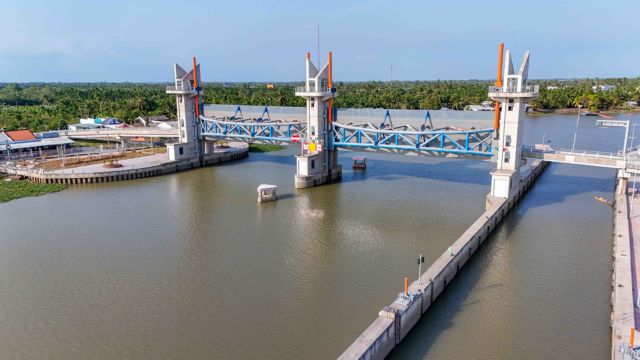 |
| The Rạch Mọp sluice gate in Nhơn Mỹ Commune, Cần Thơ City, helps prevent saltwater intrusion and protects some 10,000 hectares of agricultural land. — VNA/VNS Photo |
Local adaptation
In response, local communities have begun adapting their livelihoods. At Cồn Sơn, many fish farmers are shifting to species that can tolerate both freshwater and brackish conditions.
In agriculture, farmers are adjusting irrigation practices by closely monitoring tidal cycles, taking in water only when salinity levels are low.
However, Bon said these measures remain short-term adaptations rather than long-term solutions.
He also expressed concern over worsening water pollution caused by agricultural runoff.
Residual chemicals from farmlands are being discharged directly into the Hậu River, further degrading water quality.
To address the issue at its source, Bon suggested revising cropping calendars, particularly limiting rice cultivation during July and August to allow floodwaters to carry sediments back into fields.
This approach will naturally replenish soil nutrients, reduce fertiliser use and minimise the discharge of agrochemicals into waterways.
Controlling agricultural waste flows into river systems is critical to safeguarding water security, Bon added.
These challenges were highlighted at a recent workshop on water security in the Mekong Delta under climate change held in Cần Thơ City.
According to Associate Professor Dr Lê Anh Tuấn, senior advisor at the Dragon Institute of Cần Thơ University, the region is facing external pressures such as climate change, upstream hydropower development and potential water diversion projects and internal issues like over-extraction, pollution and low water-use efficiency.
Citing World Bank data, he said each cubic metre of water in Việt Nam generates only $2.37 in economic value, far below the global average of $19.42.
Notably, producing one tonne of rice requires 4,000-5,000cu.m of freshwater.
He said exporting low-value rice effectively means exporting water resources, while farmers continue to struggle with low incomes.
This underscores the need to shift from a production-driven mindset to a value-oriented approach.
Associate Professor Dr Nguyễn Phú Quỳnh, deputy director of the Southern Institute of Water Resources Research, said from a hydrological perspective that the Mekong Delta is subject to cumulative impacts from both external and internal factors.
The Mekong River Basin spans 795,000sq.km, but Việt Nam accounts for only 8 per cent of this area while bearing the full downstream consequences.
Upstream countries including China, Laos, Thailand, and Cambodia contribute the majority of flows, and their hydropower and water regulation systems have significantly altered natural hydrological patterns.
Meanwhile, excessive groundwater extraction within the delta is accelerating land subsidence, further reducing the region’s resilience to climate change and sea-level rise.
Experts at the workshop agreed that ensuring water security and sustainable development will require a fundamental shift in governance towards integrated, efficient and value-driven water management rather than an exclusive focus on agricultural output. — VNS
Environment
 Environment
 Environment
 Environment
 Environment
 Environment
 Environment
 Environment
 Environment
 Environment
 Environment
 Environment
 Environment
 Environment
 Environment