 Society
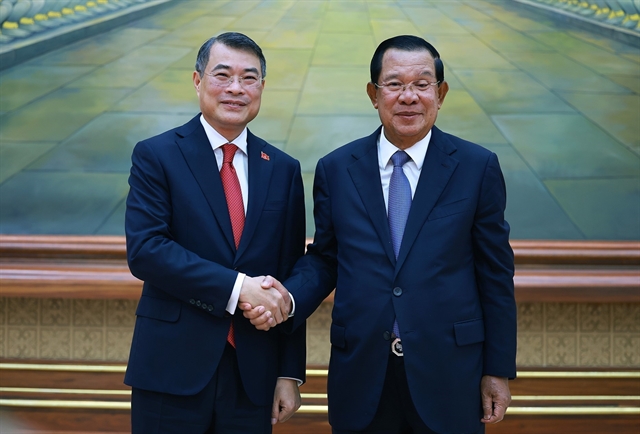
Vietnamese Prime Minister meets Cambodian National Assembly President
1.
|
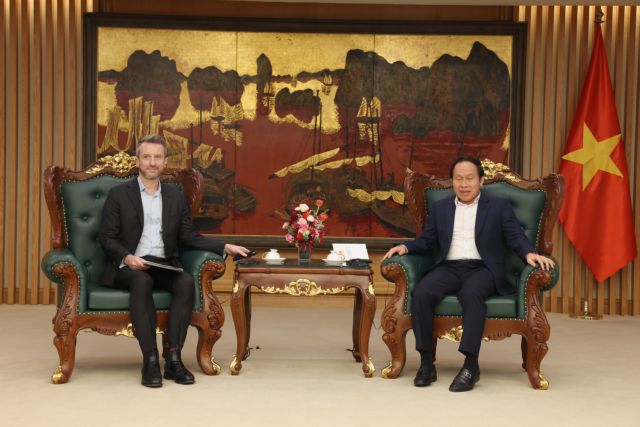
| Deputy Prime Minister Lê Tiến Châu and Deputy Vice-Chancellor of RMIT Melbourne and Chair of the Board of RMIT Vietnam Layton Pike during their meeting on Wednesday. — VNA/VNS Photo |
HÀ NỘI — The Vietnamese Government will extend all possible support to reputable international education establishments for stable and long-term operations in the country, Deputy Prime Minister Lê Tiến Châu told Deputy Vice-Chancellor of RMIT Melbourne and Chair of the Board of RMIT Vietnam Layton Pike during a reception in Hà Nội on Wednesday.
Châu praised RMIT’s contributions, particularly those of RMIT Vietnam, over the past 25 years in deepening Việt Nam – Australia education cooperation. He said Việt Nam considers quality workforce training one of its three strategic breakthroughs for the next growth phase.
With the Politburo recently issuing Resolution 71 on education and training breakthroughs, placing higher education at the centre of talent cultivation and sci-tech and innovation push, he called it a crucial political and legal foundation for both nations to step up collaboration in areas of shared demand, potential, and strength.
Pike, for his part, thanked the Vietnamese Government for backing RMIT Melbourne’s operations and partnerships. As the university plans to scale up investment in the country, he voiced hope for continued guidance from the Government, ministries, and local authorities, adding that RMIT Melbourne would work closely with relevant sides to complete legal procedures related to the university’s branch campus project.
Noting the substantial room for joint work in education and workforce training, Châu urged RMIT Melbourne to treat Việt Nam as a strategic partner and keep expanding investment in the country.
Future RMIT Vietnam campuses, he said, should be fully developed, especially in sci-tech, innovation, and digital transformation.
The host vowed to direct ministries, agencies, and local authorities to tackle issues related to RMIT Vietnam’s branch campus project and support the university during investment procedures.
He also encouraged RMIT Melbourne to partner with the Vietnamese Ministry of Education and Training to scale the flagship Empowering Educators with AI (EEAI) project, aiming to lift AI capabilities among teachers and education administrators nationwide.
Châu called on the university to broaden enrollment and develop new courses in priority fields, including artificial intelligence, data science, semiconductors, renewable energy, and digital economy, while expanding scholarships and student exchanges to improve Vietnamese students’ access to quality international education.
The Deputy PM also invited RMIT Melbourne to help Việt Nam with policy consultation, starting with a comprehensive review of the country’s legal and regulatory framework.
RMIT Vietnam should offer independent assessments from both academic and foreign investor perspectives to identify institutional and legal obstacles in sectors where the university excels, especially in education and training, and suggest reforms to help unlock development resources, he said. — VNA/VNS
Society
 Society
 Society
 Society
 Society
 Society
.jpeg) Society
Society
 Society
 Society
 Society
 Society
 Society
 Society
 Society
 Society