 Society

Vietnamese Prime Minister meets Cambodian National Assembly President
1.
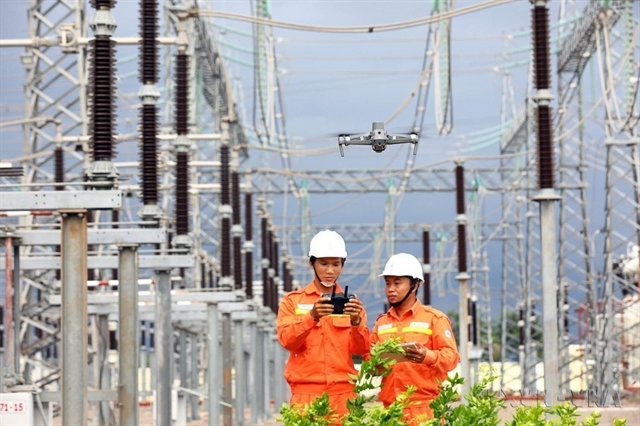 |
| Two engineers use an unmanned aerial vehicle to inspect a transmission line. — VNA/VNS Photo |
HÀ NỘI — Hà Nội's municipal government is seeking public comment on a draft resolution that would establish incentives to attract investment in three urban dimensions: underground infrastructure and both low- and high-altitude airspace.
The draft resolution defines urban space along a vertical axis. Underground space covers everything below the natural ground or water surface.
Low-altitude airspace stretches from that surface up to a defined ceiling elevation. High-altitude airspace, meanwhile, is governed by civil aviation law and national defence regulations.
For underground development, the city is proposing a package of incentives including land access support, financing assistance and a streamlined 'one-stop' permitting mechanism that would coordinate approvals across multiple city departments.
The low-altitude economy has drawn the most forward-looking set of proposals. Hà Nội would designate testing zones for unmanned aerial vehicles and other low-altitude services, operating under a controlled regulatory sandbox.
The city also proposes backing research, development, manufacturing and commercialisation of relevant technologies, with explicit support for start-ups, to reduce the financial risks borne by early movers in the sector.
Public-private partnerships would be encouraged to build out the supporting technical infrastructure and, over time, grow a broader low-altitude economic ecosystem.
Hà Nội's Department of Justice endorsed the low-altitude framework in its review, saying the combination of sandboxes, innovation support and public-private incentives would create a safe environment for technology testing while gradually building the infrastructure and market foundations consistent with the capital's digital transformation goals.
For high-altitude airspace, the city's priorities shift toward upgrading existing aviation infrastructure through digital technology investment, while expanding overall airspace capacity with an emphasis on safety.
The draft also includes mechanisms to encourage all sectors of the economy to invest in, operate and maintain aviation infrastructure. — VNS
Society
 Society
 Society
 Society
 Society
 Society
 Society
 Society
 Society
 Society
 Society
 Society
 Society
 Society
 Society