 Economy



Vietnamese community serves as important bridge in Việt Nam-India ties
1.
|
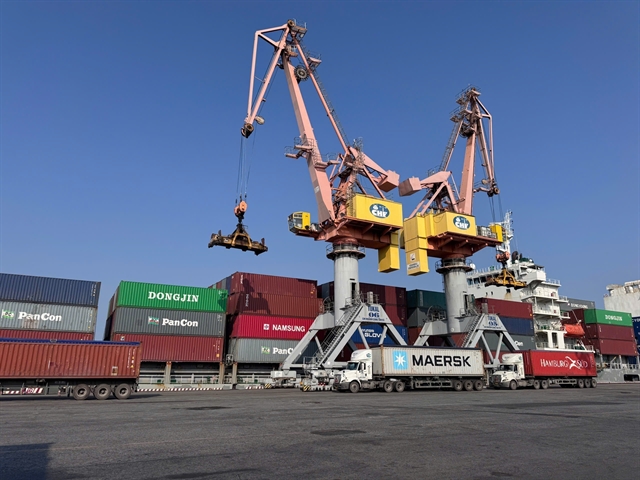
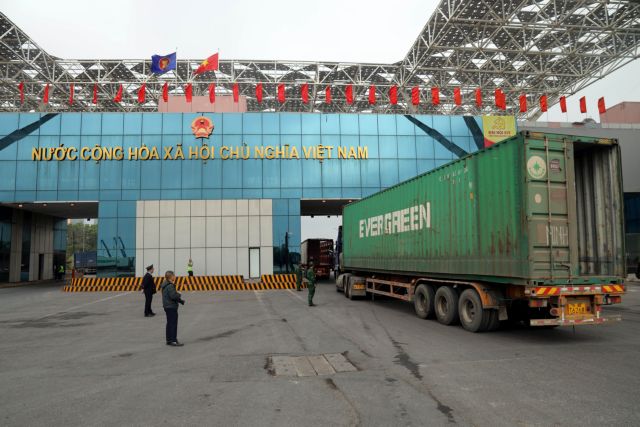
| Containers getting loaded at Hải Phòng Port. Việt Nam's unexpected trade deficit of US$13.8 billion in the first five months of 2026 reflects both a recovery in manufacturing and persistent weaknesses in domestic supply chains. — VNA/VNS Photo |
HÀ NỘI — Việt Nam's unexpected trade deficit of US$13.8 billion in the first five months of 2026 reflects both a recovery in manufacturing and persistent weaknesses in domestic supply chains, experts said at a forum on May 11.
Official statistics show that the country's total trade turnover in the same period reached about $445 billion. Imports surged more than 30 per cent year-on-year to $229.56 billion, causing the trade balance to swing into a deficit of $13.81 billion.
Speaking at the discussion session of the Việt Nam Investment Forum 2026 Summer Summit, Phan Đức Hiếu, a standing member of the National Assembly's Economic and Financial Committee, said the sharp trade deficit came as a surprise, although signs of a declining trade surplus had emerged in recent years.
Data has shown a clear recent trend: while total trade turnover has continued to grow, the trade surplus has gradually narrowed, Hiếu said, noting that the structure of imports and exports became more evident during 2024 and 2025.
The trade deficit, however, should not be interpreted solely as a negative signal.
Saigon-Hanoi Securities (SHS) Director General Nguyễn Duy Linh attributed the rise in imports to concerns over potential supply chain disruptions linked to the conflict in the Middle East, as well as efforts by businesses to stockpile materials ahead of possible changes to US trade policies.
The situation prompted companies to import larger volumes of raw materials as a precautionary measure, Linh said, adding that these imports will become inputs for production in the third and fourth quarters.
The increase can thus be considered a positive sign of an expanding production cycle, he said.
Still, the surge in imports has exposed a longstanding challenge for the economy when viewed alongside Việt Nam's strong performance in attracting foreign direct investment (FDI).
He cited statistics showing that newly registered FDI rose 10 per cent in the first five months of the year, the highest level in five years, with 83 per cent of the capital flowing into the manufacturing and processing sector.
Such strong investment inflows would normally be expected to stimulate the development of domestic supply chains.
But the large trade deficit suggests instead that local firms still lack the capacity to supply sufficient materials and components to foreign-invested manufacturers.
This shows that the impact of FDI on the domestic economy remains limited, Linh said.
The SHS director said the key challenge for policymakers is no longer attracting foreign investment, but improving the country's ability to absorb and use that capital effectively.
Experts called for the development of domestic value chains to reduce reliance on imported materials and components.
Focus should be on accelerating the development of supporting industries, promoting technological innovation and improving labour productivity to strengthen the economy's capacity to absorb investment.
It is also critical to nurture leading domestic enterprises capable of leading export supply chains in both domestic and international markets.
"The current trade deficit is both a sign of recovering production cycles and a warning that Việt Nam needs to address weaknesses in its domestic supply chains if it wants to achieve sustainable and self-reliant growth," Hiếu said. — VNS
Economy
 Economy
 Economy
 Economy
 Economy
 Economy
 Economy
 Economy
 Economy
 Economy
 Economy
 Economy
 Economy
 Economy
 Economy