 Sci-Tech

Top legislator meets with King of Thailand in Hà Nội
1.
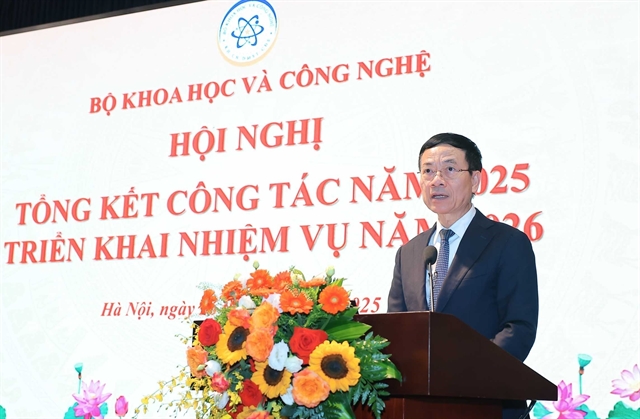 |
| Minister of Science and Technology Nguyễn Mạnh Hùng speaks at the conference. — VNA/VNS Photo Hoàng Hiếu |
HÀ NỘI — The year 2025 marks a milestone in institutionalising science and technology, innovation, and digital transformation as the three central pillars of national development, following the issuance of Resolution 57 by the Politburo and the enactment of relevant laws, said Minister of Science and Technology Nguyễn Mạnh Hùng.
Addressing a conference in Hà Nội on Friday, the minister said over the past five years, a new development conceptual framework has been established for the Ministry of Science and Technology through new concepts, approaches, and roles.
Marking the end of this period, 2025 represents a shift in development mindset, with the sector tasked to turn these concepts into tangible capabilities, concrete results, and measurable value for the country, Hung said.
Merging for breakthroughs
Reporting on 2025 outcomes, Deputy Minister of Science and Technology Bùi Hoàng Phương said that following its merger with the Ministry of Information and Communications, the Ministry of Science and Technology reorganised its units, cutting the number of direct units from 74 to 41.
With the implementation of Resolution 57, the science and technology regulatory framework has shifted from management to facilitation and innovation, providing a crucial foundation for science, technology, innovation, and digital transformation to drive real growth.
Within just 10 months since the merger, the ministry advised the Government to submit to the National Assembly the adoption of 10 laws and one resolution. In addition, it advised and submitted to the Government for promulgation of 23 decrees, 16 resolutions, 41 decisions, and one directive of the Prime Minister. The ministry has also issued 50 circulars to guide implementation, promptly removing bottlenecks in mechanisms and policies, creating a favourable legal framework, and meeting practical requirements.
This year, the sector’s economic scale and performance continued to grow robustly, with revenue approaching VNĐ5.5 quadrillion (US$209.2 billion), contributing VNĐ115 trillion to the state budget, and adding VNĐ1.4 quadrillion to the national GDP, up 25 per cent, 11 per cent, and 35 per cent year-on-year, respectively.
Việt Nam made significant strides in science and technology by issuing the List of Strategic Technologies and Strategic Technology Products for the first time. It launched a portal for scientific, technological and innovation initiatives, and a real-time online management system for science and technology tasks. The country ranked 44th out of 139 countries on the Global Innovation Index (GII), while its startup ecosystem was placed 55th out of 100 globally.
The year 2025 also marked a fundamental shift in Vietnam’s national digital transformation, with the development of digital infrastructure and data, national databases, and shared platforms, providing a solid foundation for a digital nation. Digital transformation played a decisive role in organising and operating the two-tier local government model.
Forming science and technology-driven growth model
In his remarks, Deputy Prime Minister Nguyễn Chí Dũng stated that establishing a new growth model must rely on promoting science and technology, innovation, and digital transformation to restructure the foundations, ensure rapid and sustainable development, and achieve the two 100-year national goals through historic decisions made early in the year.
He commended officials and civil servants of the Ministry of Science and Technology for successfully fulfilling the tasks assigned in 2025, saying that the ministry has effectively served as the focal point in implementing Resolution 57.
The Deputy PM urged the ministry to continue restructuring national science and technology programmes, focusing resources on core areas with breakthrough potential, particularly the six strategic technology product groups selected for immediate implementation. He also urged the ministry to leverage policies to attract and reward domestic and international experts to participate in major programmes and projects serving strategic technology sectors.
He stressed the need for the ministry to work with relevant stakeholders to effectively implement the National Foundation for Science and Technology Development and the National Technology Innovation Fund, and encourage the establishment of private research institutes and research and development (R&D) centres of domestic and foreign enterprises in Việt Nam. He advised the ministry to promote university- and research institute-based startups, and strengthen technology transfer activities for Vietnamese businesses.
He said the ministry must collaborate closely with the Ministry of Public Security and other relevant agencies to utilise data resources and ensure cybersecurity, information safety, and technical standards for the national digital infrastructure. He emphasised that science and technology development should be closely linked with digital transformation and Project 06 on population data, identification, and electronic authentication.
He said that the Government and the Prime Minister have full confidence in the sector’s intellectuals, scientists, and officials to carry out their crucial role in the country’s development. — VNA/VNS
Sci-Tech
 Sci-Tech
 Sci-Tech
 Sci-Tech
 Sci-Tech
 Sci-Tech