 Sci-Tech

Việt Nam, EU and Belgium seek deeper, practical cooperation
1.
 |
| Teachers at Phúc Hòa secondary school share their experience in applying digital transformation to teaching and learning. VNA/VNS Photo Danh Lam |
BẮC NINH — The use of the Department of Education and Training’s shared database system ensures that information on students, teachers and other staff is managed on a unified platform, making administration more efficient.
Digital transformation is not simply about introducing computers, software and online platforms into schools. It is gradually changing how education is managed, taught and delivered in Bắc Ninh Province.
From shared databases and electronic records to online admissions and artificial intelligence (AI), technology is helping schools improve management, providing teachers with additional tools and enabling students to take a more active role in acquiring knowledge.
From digital management to greater administrative efficiency
According to Nguyễn Văn Thêm, deputy director of the Bắc Ninh Department of Education and Training, the province’s education sector has undergone comprehensive digital transformation in recent years.
It is gradually moving away from isolated applications of information technology towards managing education, delivering lessons and providing educational services through digital platforms and data.
To date, all educational institutions have their own websites. School management systems, sector-wide databases, online admissions, cashless payments, online learning and digital examinations are also being increasingly adopted.
Online admissions are now available for preschool and grades 1, 6 and 10. Electronic school records have been introduced in general and continuing education, while data on students, staff and facilities are gradually being standardised, verified and connected to support management and administration.
At individual educational institutions, digital transformation is helping address practical management challenges.
Nguyễn Thanh Tuấn, principal of Phúc Hòa Secondary School, said that after three former schools were merged to form the new institution, it had to manage facilities located up to 6km apart. The Department of Education and Training’s shared database allows information on students, teachers and other staff to be managed on a unified software platform, making administration more efficient.
Phúc Hòa Secondary School has fully adopted electronic records. Grade books, school records and lesson plans are approved and digitally signed through the system. The school has also introduced blended learning, with some lessons conducted online, providing an additional channel for teachers, students and parents to exchange assignments, communicate and provide feedback.
At Yên Dũng 1 High School, digital transformation has been applied to both management and professional activities. The school has stepped up the updating and use of the sector’s database. Teachers have received training in using AI tools for teaching and management, while students have been taught how to use digital technology safely and effectively.
Chu Văn Thuận, deputy principal of Yên Dũng 1 High School, said the school had been digitalising documents ranging from grade books and school records to lesson plans and educational plans. Technology not only supports document storage but is also changing how work is organised at the school.
In 2026, Bắc Ninh provided training for more than 56,000 education officials and teachers, while more than 704,000 students and nearly 187,000 parents of preschool children received training and information through the learning management system. The education sector is preparing to introduce single sign-on, develop a shared repository of digital learning resources and expand the use of AI.
Thêm stressed the need to change awareness, management approaches and working methods across the sector. He said digital transformation must be linked to the responsibilities of agency and institution heads and measured through concrete results and practical effectiveness.
Expanding learning spaces and encouraging innovative teaching
While digital data is changing the way education is managed, technology is also bringing noticeable changes to teaching and learning in the classroom.
Thuận said that as AI continued to develop, students needed guidance on how to approach and use the technology effectively. Schools must also change their testing and assessment methods, moving away from questions that rely on rote learning towards those that assess students’ thinking skills. Technology can also help teachers better understand individual students’ abilities and select suitable teaching methods.
Ngụy Thị Hòa, a geography teacher at Yên Dũng 1 High School, said teachers previously had to spend considerable time designing lessons, preparing materials and developing teaching ideas. Technology and AI have made these tasks easier, giving teachers more time to care for and support their students.
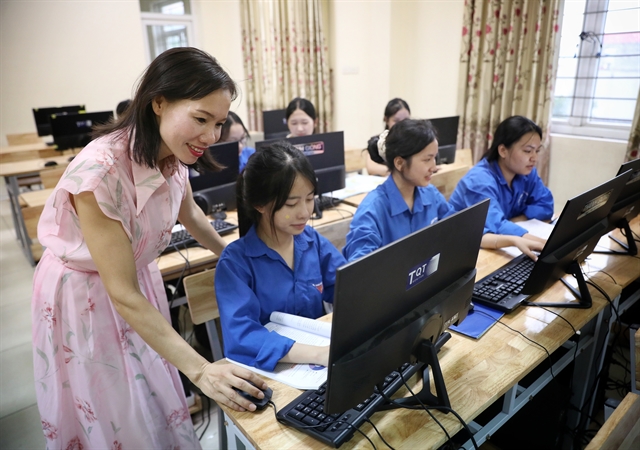 |
| Teacher Ngụy Thị Hòa guides the school’s geography team in applying technology to learning. VNA/VNS Photo Danh Lam |
Under the blended-learning model, students can study at home with the support of technology before presenting their findings, discussing ideas and solving problems in class. This gives teachers more opportunities to assess each student’s actual understanding and ability to apply knowledge, rather than relying solely on work generated by AI.
Despite the positive results of digital transformation, Bắc Ninh still faces several challenges.
At Yên Dũng 1 High School, for example, some teaching equipment remains inadequate or incompatible, while some teachers make only limited use of AI and other digital tools. Older teachers may find it difficult to adopt new technologies, while the financial circumstances of some students’ families can limit their access to digital devices.
Nguyễn Thanh Tuấn, principal of Phúc Hòa Secondary School, said that in rural areas, not every student had a personal device for online learning, and some had to share a phone with their parents. The school therefore had to work closely with families to arrange suitable study schedules.
In response to these challenges, Bắc Ninh’s education sector has identified improving educational quality and ensuring equal learning opportunities as the ultimate goals of digital transformation. It will continue to upgrade infrastructure, integrate software systems, develop shared databases and digital learning repositories, and expand electronic school records, online admissions and cashless payments. It will also focus on information security, personal data protection and the responsible use of AI.
Thêm stressed that students needed to develop the skills to master technology, think independently and use AI responsibly. They should know how to ask questions, verify information, identify inaccuracies, protect personal data, respect copyright and refrain from using AI to cheat in their studies.
From school administration to classroom teaching, digital transformation is gradually changing how Bắc Ninh’s education sector operates and delivers education.
However, further progress will require continued improvements to digital infrastructure, data systems and learning resources, together with stronger digital skills among education staff, narrower gaps in access to technology and robust data security. — VNS
Sci-Tech
 Sci-Tech
 Sci-Tech
 Sci-Tech
 Sci-Tech
 Sci-Tech
 Sci-Tech
 Sci-Tech
 Sci-Tech
 Sci-Tech
 Sci-Tech
 Sci-Tech
 Sci-Tech
 Sci-Tech
 Sci-Tech