 Sci-Tech
NA President sets June 2027 deadline for APEC projects, rules out delays, quality cuts and violations
1.
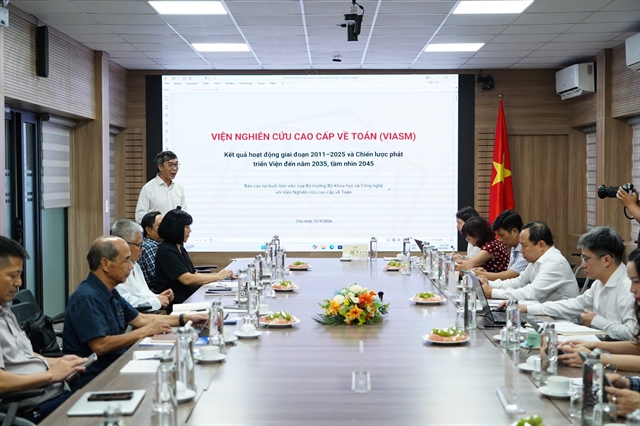 |
| Assoc. Prof. Dr Lê Minh Hà, Executive Director of the Vietnam Institute for Advanced Study in Mathematics, presents the Institute's activity report for 2011–2025 and its development strategy through to 2035, with a vision to 2045. Photo courtesy of the MST |
HÀ NỘI — The Minister of Science and Technology has outlined three major expectations for the Institute for Advanced Study in Mathematics, calling on it to become a leading national centre for fundamental research, a hub for nurturing and deploying scientific and technological talent, and a driving force in establishing mathematics as a foundation for strategic technologies.
Minister Vũ Hải Quân outlined the expectations during a working session with the institute on September 13.
At the session, Associate Professor Dr Lê Minh Hà, the institute's Executive Director, presented a report on its activities from 2011 to 2025 and its development strategy to 2035, with a vision to 2045.
According to Hà, the institute focused during this period on mathematical research, high-level human resource development and building connections among universities, research institutes and research groups in Việt Nam and abroad.
Alongside fundamental research, it has gradually expanded into applied mathematics, data science and interdisciplinary research, attracting scientists from Việt Nam and other countries.
These activities have laid the foundations for the institute to identify priority research areas, build on its strengths and make greater contributions to science and technology in the coming period.
Quân praised the institute’s performance, saying it had successfully fulfilled its original mission of advancing mathematics education and research in Việt Nam.
He endorsed its three proposed transitions: moving from breadth to depth; shifting from receiving international support to proactively leading international co-operation; and restructuring its workforce to develop research fields in which Việt Nam can take the lead and achieve high rankings in Asia.
Based on the institute’s strategy for 2026–35 and vision to 2045, the Minister outlined three major expectations.
First, the institute must become a leading national centre for fundamental research.
“In the next five to ten years, several genuinely strong research groups must be established,” Quân said. “When the international community mentions a particular field of research, it should think of Việt Nam, and when it thinks of Việt Nam, it should think of the Institute for Advanced Study in Mathematics.”
Second, the institute must become a centre for nurturing and effectively deploying scientific and technological talent.
Third, in line with Resolution 57, mathematics must become a foundational capability supporting strategic technologies and fields such as artificial intelligence, data science, digitalisation, urban development and climate modelling.
The Minister also called for scientist evaluation mechanisms tailored to the specific characteristics of individual research fields.
“The same set of criteria cannot be applied to every research discipline,” Quân said.
The Ministry of Science and Technology will work with the institute to develop criteria appropriate to the particular nature of mathematical research. In addition to scientific publications, assessments should consider the impact, effectiveness and practical contributions of research.
Quân said investment in the institute was not merely investment in a research institution, but also investment in talent, knowledge infrastructure and Việt Nam’s capacity for scientific and technological self-reliance.
The three expectations are intended to guide the institute into a new phase of development, with a focus on outstanding fundamental research, scientific and technological talent, and the role of mathematics as a foundation for strategic technologies. — VNS
Sci-Tech
 Sci-Tech
 Sci-Tech
 Sci-Tech
 Sci-Tech
 Sci-Tech
 Sci-Tech
 Sci-Tech
 Sci-Tech
 Sci-Tech
 Sci-Tech
 Sci-Tech
 Sci-Tech
 Sci-Tech
 Sci-Tech