 Economy

NA President sets June 2027 deadline for APEC projects, rules out delays, quality cuts and violations
1.
|
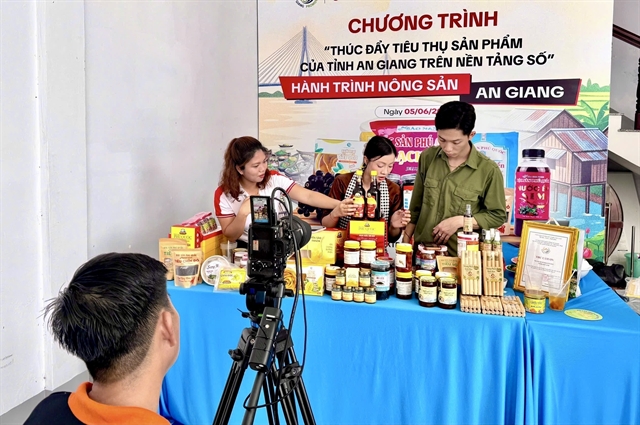
| A livestream sells An Giang Province’s OCOP products and specialities at the programme “Promoting the sales of An Giang products on digital platforms” held in Tịnh Biên Ward on June 5. — VNA/VNS Photo |
AN GIANG — After completing the day’s production of tilapia fish cakes, Trần Thị Kim Lam spends time responding to customers online.
The deputy director of the Thuận Phát Shrimp, Crab and Rice Services Co-operative in An Minh Commune, An Giang Province, carefully responds to each inquiry.
One customer asks how the product should be stored, another wants to know where the raw materials come from, while others seek advice on preparation or provide feedback after receiving their orders.
Selling products on e-commerce platforms is not simply a matter of posting a few pictures and waiting for orders, she says.
“We have to tell the story of the co-operative’s fish cake-making craft, explain the source of raw materials and the processing methods, and advise and care for customers so that they trust us and come back.”
The co-operative’s tilapia fish cake has been recognised as a three-star product under the country’s One Commune – One Product (OCOP) programme.
Lam’s experience reflects a broader shift among OCOP producers in the Cửu Long (Mekong) Delta province, where digital platforms are becoming increasingly important for promoting and selling local products.
To help OCOP producers expand their businesses, the province is seeking to combine digital transformation with product development, brand building and market promotion.
The efforts are in line with the implementation of the Politburo’s Resolution No. 57, issued in December 2024, on breakthroughs in science, technology, innovation and national digital transformation.
|
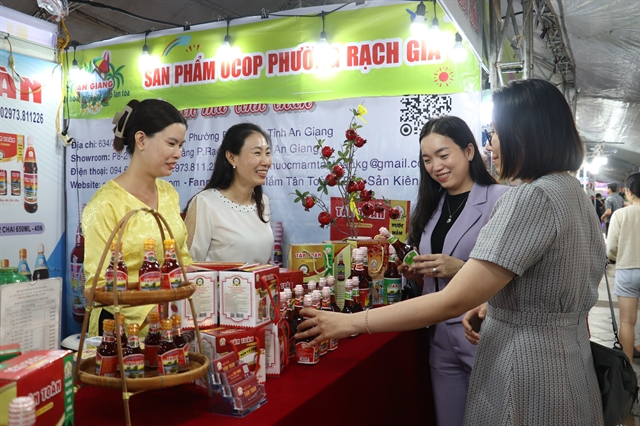
| Visitors view OCOP products at an event called “Rạch Giá Tourism and Culinary Festival combined with a trade promotion fair for OCOP products – An Giang 2026” held in Rạch Giá Ward from May 22 to 31. — VNA/VNS Photo |
Nguyễn Duy Linh Thảo, deputy director of the An Giang Department of Industry and Trade, says the province will step up efforts to promote OCOP products on digital platforms, helping producers expand their markets and strengthen the digital economy.
Selling products on e-commerce platforms will help increase brand value and ensure transparency about product origins, she says.
The approach also reflects changing consumer habits, particularly among young people, who are increasingly shopping online.
The province will continue to help businesses and residents improve their online sales skills and promote local agricultural brands more professionally, she adds.
The province has 613 products rated three stars or higher under the OCOP programme, produced by 337 economic entities.
These include 14 five-star, 65 four-star, and 534 three-star products.
Many products, including rice, palm sugar, palm nectar, fish cakes, meat floss and processed seafood, are of good quality but still sold mainly through traditional channels.
The province aims to make all OCOP products available through modern distribution channels and e-commerce platforms by 2030.
Improving quality
For producers, however, putting a product online is only part of the process.
Phạm Văn Nhớ, director of the Thanh Thanh Agricultural Services Co-operative in Vĩnh Bình Commune, saw an opportunity to turn dried shrimp into a branded local product.
After learning processing techniques, he began producing dried shrimp himself in 2021. Several unsuccessful batches resulted in losses of about VNĐ90 million (US$3,500) before he eventually succeeded.
He gradually refined the process and promoted the product at trade fairs and directly to traders at Bình Điền Wholesale Market in HCM City.
In late 2021, Nhớ and eight local households established the co-operative to standardise production and secure supplies of raw materials.
The co-operative later registered its trademark and joined the OCOP programme.
In early 2023, Thanh Thanh dried shrimp was recognised as a three-star OCOP product.
Recognition under the OCOP programme has increased the product’s competitiveness and value, Nhớ says.
“More partners and customers have learned about the product, helping expand the market.”
The co-operative now supplies dozens of tonnes of dried shrimp to the market each year, provides jobs for about 20 workers and creates an outlet for shrimp produced by local farmers.
|
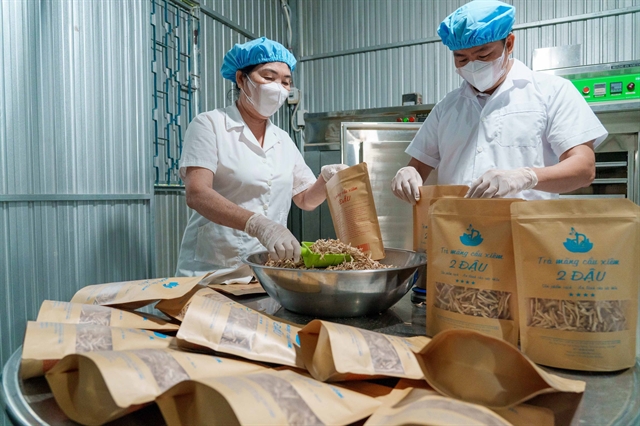
| The four-star OCOP product 2 Đậu Soursop Tea is produced at the 2 Đậu Soursop Tea Production Establishment in Giồng Riềng Commune. — VNA/VNS Photo |
Lê Hữu Toàn, director of the An Giang Department of Agriculture and Environment, says the province is strengthening communications and training to improve the implementation of the OCOP programme.
It plans to promote digital transformation by digitising product dossiers, evaluation procedures and traceability systems, while linking OCOP databases with e-commerce platforms and online sales channels, he says.
“These activities will help businesses, co-operatives, and household producers promote and sell OCOP products, meet distributors, and expand their markets.”
However, producers still face difficulties raising money to buy machinery and technology, while some have yet to make full use of digital marketing and e-commerce.
The province aims to have at least 50 new products rated three stars or higher by the end of 2026, including five four-star products.
Lê Văn Phước, deputy chairman of the province People’s Committee, says agricultural products remain a focus of the province’s development strategy, closely linked to agricultural restructuring, the development of rural industries, and eco-tourism.
“Digital transformation and the circular economy are a pair of solutions for promoting sustainable rural economic development, while preserving biodiversity and maintaining the landscape.”
In the 2026–30 period, the province aims to have at least another 250 OCOP products rated three stars or higher, including five five-star national products, he says.
“Having all OCOP products available on modern sales channels and e-commerce platforms by 2030 is not simply a change in distribution channels, but a change in management thinking.
“Digital transformation will be applied throughout the process, from management and supervision to promotion and trade development.”
The province is also strengthening trade promotion through fairs, exhibitions, and buyer-seller matchups, and helping OCOP producers enter supermarkets, shopping centres, and e-commerce platforms.
Alongside online sales, the strategy includes product traceability, digital product data, livestreaming, and other online channels.
Producers are also receiving support to invest in machinery and equipment, improve packaging, develop trademarks, and expand into new markets.
As An Giang seeks to make all its OCOP products available through modern distribution channels and e-commerce platforms by 2030, the challenge will be to ensure that local producers have the technology, skills and production standards to turn their products’ local identity into lasting market value.
For producers such as Lam and Nhớ, the shift to digital platforms therefore involves more than finding another place to sell their products.
It requires them to understand consumers, communicate directly with buyers, build trust, and establish a recognisable brand based on product quality. — VNS
Economy
 Economy
 Economy
 Economy
 Economy
 Economy
 Economy
 Economy
 Economy
 Economy
 Economy
 Economy
 Economy
 Economy
 Economy