 Economy

NA President sets June 2027 deadline for APEC projects, rules out delays, quality cuts and violations
1.
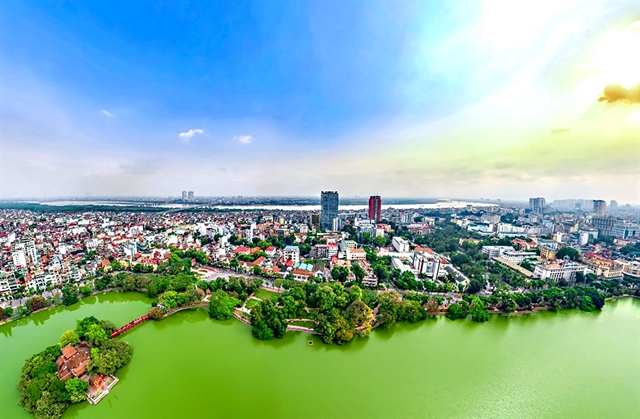 |
| A panoramic view of Hà Nội's political centre. The city continues to attract strong interest from foreign investors. — VNA/VNS Photos |
HÀ NỘI — Hà Nội attracted an estimated US$4.07 billion in foreign investment in the first nine months of 2026, reaching 90.4 per cent of the city's full-year target, according to data released by the Hanoi Financial Department.
The figure includes $676 million in newly registered capital, $691 million in additional capital and $2.7 billion from foreign investors' capital contributions and share purchases.
The city licensed 500 new foreign-invested projects in the first nine months, with registered capital of $676 million, up 78 per cent in number and 138 per cent in value from the same period in 2025.
The department said the figures reflected continued strong interest from new foreign investors in Hà Nội, with newly registered capital more than doubling from a year earlier.
In September alone, the city licensed 50 new projects with total registered capital of $103.93 million, up 208 per cent in number and about 10.1 times in value from the same month last year.
The department said the surge was largely driven by two real estate projects, which together accounted for $93.7 million, or about 90 per cent, of the month's new capital. The other 48 projects were relatively small, averaging about $210,000 each.
Foreign investors also increased capital in existing projects. There were 16 existing projects increasing their levels of capital by $198 million in September, including three in the processing and manufacturing sector worth $189 million.
For the first nine months, 113 operating projects added $691 million, with the relatively low year-on-year comparison partly reflecting a nearly $3 billion one-off real estate capital increase recorded in the same period of 2025.
According to the department, capital contributions and share purchases remained the largest component of Hà Nội's foreign investment inflows. There were 281 such transactions worth $2.7 billion through September, accounting for about 66.4 per cent of total investment attracted during the period.
Disburshment of foreign investment reached an estimated $46 million in September, nearly 2.9 times the amount recorded a year earlier. Cumulative disbursed capital reached about $1.36 billion in the January-September period, equivalent to 84.9 per cent of the city's annual target of $1.6 billion.
By sector, professional, scientific and technical activities accounted for the largest share of the city's foreign investment, with $2.24 billion, or 55.2 per cent of total capital, largely driven by major capital contribution and share purchase transactions.
Real estate business came second with $394 million, followed by information and communications with $352million, wholesale and retail trade with $247 million, manufacturing and processing with $232 million, and water supply and waste treatment with $220 million.
The foreign investment structure showed a shift in capital flows towards high-tech, innovation, digital services and research and development, alongside a gradual decline in the share of land- and labour-intensive projects, in line with the city's strategy of attracting higher-quality foreign investment, according to the department.
Obstacles remain
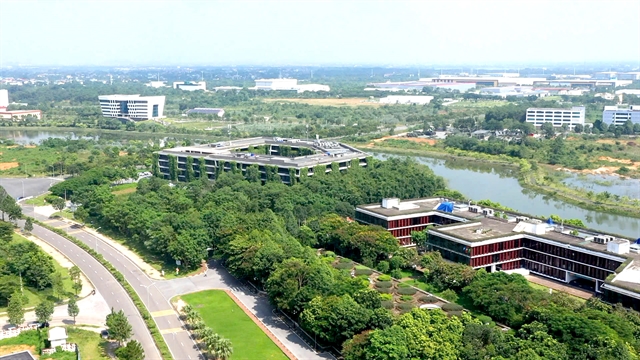 |
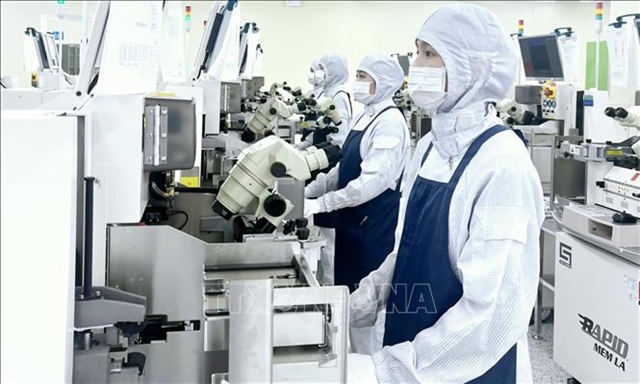
| Hòa Lạc High-Tech Park in Hà Nội. High-tech projects in the city's high-tech zones and industrial parks are targeted to attract at least $500 million in foreign investment by the year-end. |
However, the city still faces constraints in attracting large-scale high-tech projects, the department said.
Despite investment promotion efforts and cooperation agreements with major global technology companies, no new large-scale high-tech projects had been registered in Hà Nội as of the reporting date.
The supply of clean land ready for development remains limited, with many industrial parks, digital technology zones and digital parks still undergoing investment preparation or site clearance.
Foreign investors also face difficulties accessing land for projects outside industrial and high-tech zones because of restrictions related to land-use rights transfers and investor selection through auctions and bidding.
To better facilitate foreign investors, the department called for mechanisms to facilitate their access to land for projects outside high-tech parks and industrial zones, helping address legal obstacles affecting land-based foreign-invested projects.
It also proposed stronger inter-ministerial coordination to promote foreign investment in hi-tech sector and help the city connect with major global technology companies, including AMD, Intel, Samsung and Nvidia, through overseas diplomatic network.
The department urged authorities to update and publish the list of sectors subject to foreign-investor market access restrictions based on the Vietnam Standard Industrial Classification (VSIC).
At the same time, it proposed clearer guidelines on investment support from the investment support fund for high-tech projects, R&D centres, semiconductor and artificial intelligence projects, as well as specific incentives for projects in the Hòa Lạc High-Tech Park and Hanoi Biotechnology High-Tech Park.
$433 million more by year-end
Hà Nội is targeting about $4.5 billion worth of foreign investment in 2026, roughly double the annual average of $2-2.2 billion recorded in previous years.
The figure recorded in the first nine month means that the city needs to attract about $433 million in investment by year-end.
The city expects the services sector to attract an additional $250 million-$300 million in the final three months of the year, while high-tech projects in high-tech zones and industrial parks are targeted to bring in at least $500 million.
The department said the $4.5 billion target remained within reach, with the completion of procedures for the submitted land-use projects expected to be a key factor. — VNS
Economy
 Economy
 Economy
 Economy
 Economy
 Economy
 Economy
 Economy
 Economy
 Economy
 Economy
 Economy
 Economy
 Economy
 Economy