 Economy
Uruguayan parliament highlights Việt Nam’s role, bilateral cooperation prospects
1.
|
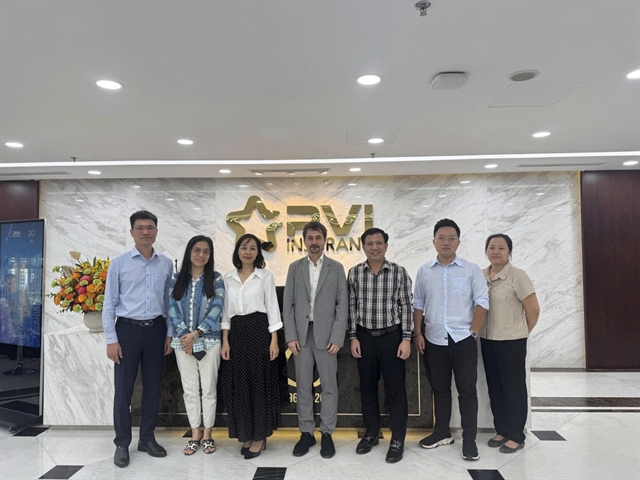
| The delegation included representatives from the World Bank, Vietnam Social Security and PVI Insurance. — Photo courtesy of PVI |
HÀ NỘI — The rise of the sharing economy is creating a growing group of workers who do not fit neatly into existing social insurance categories. Experience from PVI Insurance suggests that unstable incomes are among the main barriers to maintaining social insurance contributions, while greater flexibility in contribution arrangements could help address the gap.
A changing labour market
Việt Nam’s labour market is seeing a growing share of non-traditional work, driven by ride-hailing, technology-enabled delivery and e-commerce platforms. The shift has created a group of workers whose employment status does not fit easily into existing social insurance arrangements.
They are neither salaried employees with formal labour contracts who are covered by compulsory social insurance nor fully independent self-employed workers (such as street vendors, shoe shiners or traditional motorbike taxi drivers) covered by voluntary insurance. This “third category” of workers faces particular challenges in accessing and maintaining social protection.
Their work and income are closely linked to technology platforms and can vary significantly depending on the volume of orders and other market conditions. Although they share revenue with platforms, they may lack adequate protection when they fall ill, suffer an accident or are no longer able to work.
This has raised a policy question in Việt Nam and other countries: how should platform workers be covered by social insurance, and what type of mechanism would allow them to remain within the social safety net over the long term?
Income instability a key barrier
The issue has also drawn attention from the World Bank, which is advising the Vietnamese Government on social insurance policy.
Among more than 500 service organisations nationwide supporting Vietnam Social Security in expanding participation, PVI Insurance was selected by World Bank as the sole organisation for in-depth consultation on its experience with “third-category” workers.
Through its provision of voluntary social insurance and health insurance collection services for this group, PVI Insurance has built practical experience and data on their participation and contribution patterns. Through its work with this group, PVI Insurance has identified income instability as one of the main challenges to maintaining regular contributions.
Demand for social protection among ride-hailing drivers and online sellers remains significant, with the company reporting interest in its insurance products and relatively high renewal rates.
However, workers’ earnings can fluctuate considerably. A worker may earn around VNĐ10 million (US$385) in one month but only VNĐ5 million in another due to weather conditions, fewer orders or other factors affecting demand.
Under current regulations, voluntary social insurance participants choose a contribution level and payment method when they join the scheme. For workers with irregular incomes, this can encourage them to choose a lower contribution level – for example, one based on an income of VNĐ3 million – or make contributions monthly rather than for longer periods such as three, six or 12 months.
While such choices reduce the immediate financial burden, they can also result in lower accumulated benefits and make continued participation more difficult when incomes fall.
|
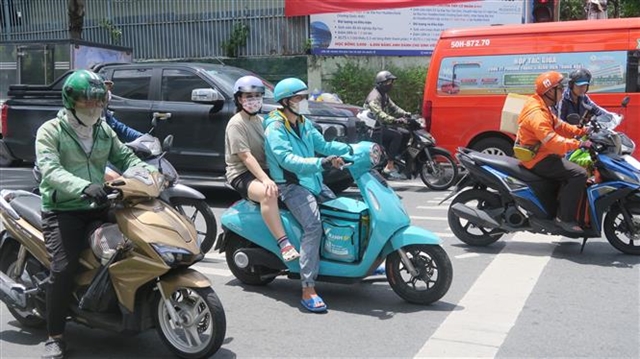
| Ride-hailing drivers and passengers travel through a busy street in HCM City. The growing platform economy is creating a “third category” of workers facing new challenges in accessing social protection. — VNA/VNS Photo |
Testing solutions in the market
While broader policy options are still being studied, PVI Insurance has developed a practical model to address the initial financial barrier facing self-employed and platform workers. During certain periods, the company uses its own resources to subsidise part of the cost for workers enrolling in social insurance and health insurance for the first time.
The approach is designed to encourage first-time participation and help workers become familiar with the benefits of social protection. Once the initial barrier is reduced, workers who see the value of the schemes are more likely to continue contributing in subsequent cycles, with PVI reporting relatively high renewal rates.
The experience provides an example of how market-based initiatives can test approaches to expanding social protection among workers outside traditional employment arrangements while broader policy options are being considered.
According to the World Bank, PVI Insurance’s experience is consistent with international approaches to bringing workers in the platform economy into the social safety net.
The discussions between PVI Insurance and the World Bank have also focused on how practical experience and market data could inform policy recommendations.
One issue is the need for greater flexibility in contribution arrangements. A mechanism allowing platform workers to adjust their contribution levels or payment periods in line with changes in monthly income could make continued participation more feasible.
Another is State support during periods when workers’ incomes fall sharply. Such support could help workers maintain contributions and protect their longer-term retirement and health insurance benefits.
Internationally, countries are taking different approaches, including requiring technology platforms to share insurance contributions with workers or maintaining voluntary schemes supported by Government subsidies. Whichever model Việt Nam adopts, the practical data and experience that PVI Insurance has accumulated from working directly with “third-category” workers can provide a useful reference for policy design.
As the sharing economy expands, the challenge is no longer limited to defining the employment status of platform workers, it also involves finding workable ways to extend social protection to a workforce whose incomes and working patterns are increasingly flexible. — VNS
Economy
 Economy
 Economy
 Economy
 Economy
 Economy
 Economy
 Economy
 Economy
 Economy
 Economy
 Economy
 Economy
 Economy
 Economy