 Talk Around Town

Shorter Trips, Familiar Ways to Pay: How Airpaz Supports Flexible Booking with 100+ Payment Methods
1.
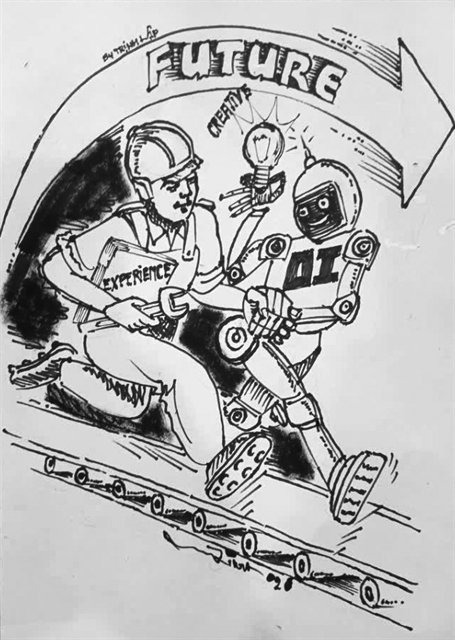 |
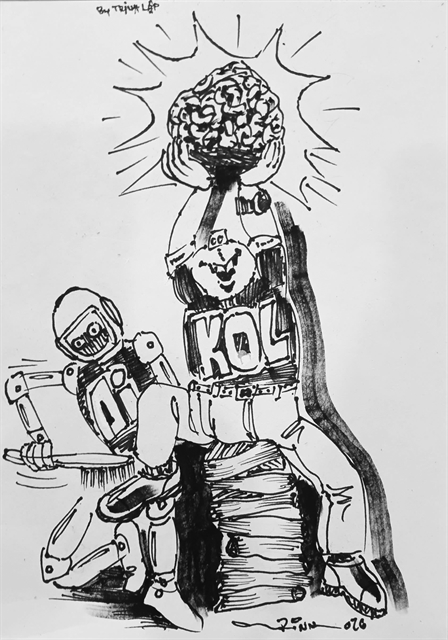
| Illustration by Trịnh Lập |
By An Phương
From marketing and finance to journalism and design, few jobs today remain untouched by technology.
As Việt Nam places science, technology, innovation and digital transformation at the centre of its development strategy, young workers in HCM City are facing a question that goes beyond what degree to pursue: what should they learn to stay relevant in a rapidly changing economy?
Technology is no longer confined to the technology sector. It is increasingly becoming part of how people work across a wide range of professions.
“A marketer can use AI to analyse consumer behaviour, a designer can generate and refine ideas with digital tools, while a journalist can use technology to process large amounts of information,” Mạnh Cương, 32, a freelance marketing professional, told Việt Nam News.
“The tools may differ, but the shift is similar: technology is becoming embedded in how we work, rather than simply being a sector we work in,” he said.
For Việt Nam, this transformation aligns with broader national ambitions. The Party's Politburo issued a resolution on science, technology, innovation and digital transformation in December 2024, known as Resolution 57, identifying science, technology, innovation and digital transformation as key drivers of national development.
Yet, knowing technology is pervasive also brings pressure.
“I am pleased with the positive changes AI brings, but I wonder if young people are now expected to become ‘technology experts’,” Cương added. “In a city where market competition is already intense, knowing how to use AI is no longer a bonus, it is becoming a baseline expectation.”
Crucially, Việt Nam’s tech-driven ambition does not mean every young worker needs to learn to code. What matters is whether professionals can adapt to an increasingly automated economy and leverage these tools to strengthen their core expertise.
For Minh Trí, 26, who works at a renowned agency, the impact is already tangible in his daily work.
“Tasks that used to take three or four days can now be processed in less than a day,” Trí said. “In the past, creating a marketing asset involved manual compilation. Now I can combine different elements much more efficiently and take on a wider range of work.”
Having worked in the creative industry for about five years, Trí has seen these changes first-hand. While he sees new technology as largely beneficial, he said it had also raised expectations in a fast-paced market like HCM City.
“Being able to complete a task quickly is no longer enough. We are increasingly expected to deliver more in less time,” he said.
However, speed alone is not the ultimate metric.
Phương Nghi, 27, an influencer marketing specialist, noted that AI is only as effective as the person driving it.
“What matters is not just what AI can do, but how we use it. People who treat AI as a thinking assistant gain a massive advantage,” Nghi said.
“But accepting raw AI output without fact-checking creates real risks. Workers still need a solid foundation of domain knowledge, the critical ability to evaluate information and the responsibility to stand behind their final work.”
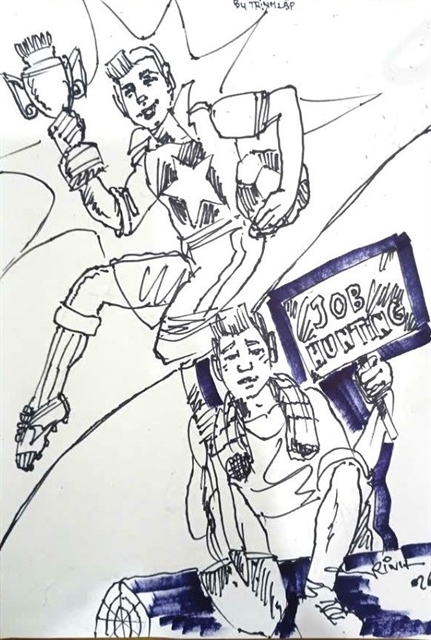
Across these industry perspectives, one reality emerges, on which all agreed: AI may not take away young people's jobs, but it could change who gets hired.
Skills gap
The rapid adoption of digital tools has also highlighted a persistent disconnect between formal education and workplace expectations.
While foundational knowledge remains essential, many young workers find themselves playing catch-up, learning digital literacy, data evaluation and how to work effectively with AI only after entering the job market.
“Individual effort alone might not be enough. I have had to take additional courses in information technology, big data and AI on my own,” Cương said.
"Young people should be introduced to these areas while still at university so they do not miss out on opportunities simply because they did not have access to this knowledge early enough.”
To keep pace with the goals of Resolution 57, educational institutions and vocational training centres face growing pressure to update their curricula, moving beyond basic IT skills towards digital problem-solving across disciplines.
But the question is not simply how much technology young people should learn. It is also what kind of professionals they should become.
For Nghi, technological progress should not mean discarding what previous generations have already learned.
“Innovation does not mean discarding the past. We still need core values, practical experience and the lessons learned from previous generations. What matters is knowing how to adapt those lessons to a changing environment,” she said.
This may be particularly important for young people entering a labour market where the tools they learn today could change within just a few years.
Trí sees this as part of a pattern that has accompanied every major technological shift.
“Gen Z today is facing a major shift in technology. It may sound intimidating, but in some ways, it is not so different from what millennials experienced when the internet first became part of everyday life,” he said.
“Every generation faces its own challenges and changes. What we are seeing today may feel overwhelming, but change is inevitable. The important thing is to learn how to adapt to it.”
That adaptability may be one of the most important skills young workers can bring into the labour market.
If AI can increasingly perform individual tasks, memorise information and speed up routine processes, competing with technology on those terms alone may be a losing strategy. Instead, young professionals need to understand their field, ask the right questions, evaluate information, make decisions and take responsibility for the results, while using technology to extend what they can do.
In other words, entering the workforce today may require learning not just how to use a tool, but how to keep learning when the tool changes.
For Việt Nam, the transition towards a technology-driven economy will therefore depend not only on producing more people with technical skills, but also on developing a workforce capable of adapting those skills to different professions and changing circumstances.
For young professionals navigating HCM City’s fast-moving job market, staying relevant is no longer simply about speed, memorisation or knowing a particular software programme. It is about combining technology with knowledge, judgement, creativity and a willingness to keep learning.
AI may change the tasks people perform, and perhaps even who gets hired. But for those entering the workforce, the more enduring advantage may be the ability to learn, adapt and use every new tool to become better at what they do.
In an economy shaped by rapid digital transformation, perhaps the most important thing young people need to learn is not how to compete with machines, but how to keep growing alongside them. — VNS
Talk Around Town
 Talk Around Town
 Talk Around Town
 Talk Around Town
 Talk Around Town
 Talk Around Town
 Talk Around Town
 Talk Around Town
 Talk Around Town
 Talk Around Town
 Talk Around Town
 Talk Around Town
 Talk Around Town
 Talk Around Town
 Talk Around Town