 Talk Around Town

Artists explore memory and change in Hà Nội exhibition
1.
 |
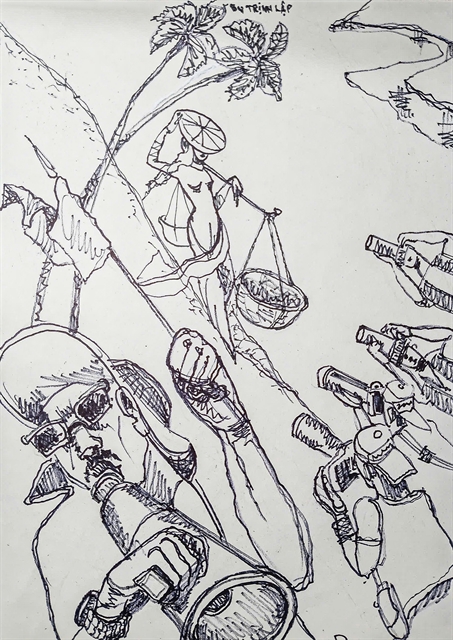
| Illustration by Trịnh Lập |
By Thanh Nga
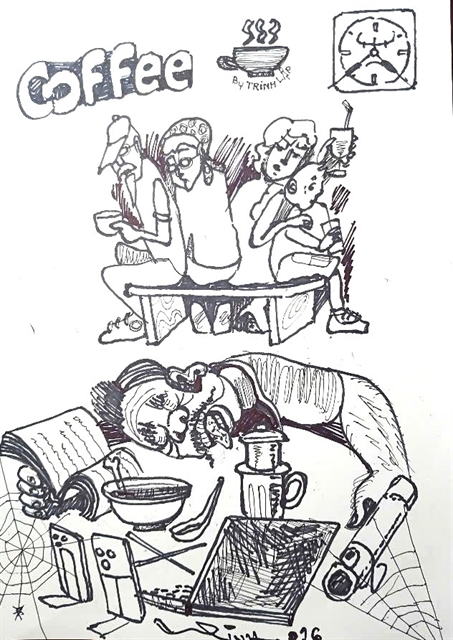
Spending hours working from cafés has become a familiar sight in Việt Nam’s cities, as flexible working continues to reshape daily routines. From students attending online classes to freelancers meeting deadlines, many now treat cafés as convenient, informal workspaces.
The trend reflects changing work habits and the growing popularity of remote work, particularly after the pandemic. However, it is also raising concerns about how shared commercial spaces are being used.
In both Hà Nội and HCM City, it is increasingly common to see customers occupying tables for extended periods, sometimes from morning until late evening. Cafés are often chosen for their air-conditioned comfort, stable internet connection and relatively relaxed atmosphere, which many believe can boost creativity and productivity.
Nguyễn Thị Duyên, a 23-year-old office worker in Hà Nội, works from cafés three or four days a week, often for up to eight to 10 hours at a time. “It’s a good environment for creative tasks or meeting clients,” she said.
However, she also acknowledged the drawbacks. “Noise, music and people moving around can be distracting. If I stay too long, my productivity is not always as high as expected.”
In HCM City, Huỳnh Thiên Ân, a 28-year-old property broker, said cafés would serve as a flexible alternative to a traditional office. His work does not require a fixed workplace, allowing him to meet clients and handle business tasks throughout the day.
“It’s convenient and comfortable,” he said, adding that he usually orders more drinks or invites clients to help support the café.
Despite such awareness among some customers, café owners say the growing number of long-stay patrons is placing pressure on operations. Many report cases where customers occupy seats for hours while making minimal purchases, reducing table turnover and limiting opportunities to serve new guests, particularly during peak hours.
In recent months, the issue has been widely discussed on social media and among business communities. Some cafés have responded by restricting access to power outlets, limiting Wi-Fi usage or applying additional charges for extended stays. While these measures are intended to manage costs and maintain business efficiency, they have also drawn mixed reactions from customers.
A recent incident in HCM City, in which a group of customers reportedly stayed for nearly 10 hours while ordering only one drink, attracted public attention after the café imposed a surcharge. The case highlighted the ongoing tension between customer expectations and the need for businesses to remain financially sustainable.
In the view of Dr Phạm Thị Thúy, a sociologist at the National Academy of Politics, cafés are, first and foremost, business establishments that must cover operational costs such as rent, electricity, water and staff salaries.
“Applying additional charges for extended stays is reasonable, provided that policies are clearly communicated in advance,” she said. She also emphasised that mutual understanding and respectful behaviour from both customers and business owners would be essential to avoiding unnecessary conflicts.
Financial expert Lâm Minh Chánh shared a similar view, noting that the growing “stay-all-day” habit could create long-term challenges for café owners. “When customers occupy space for many hours with minimal spending, it increases operational costs while reducing opportunities to serve other customers,” he said.
According to Chánh, this imbalance could affect the sustainability of small and medium-sized cafés in particular.
Experts also point out that relying heavily on cafés as workspaces may not always benefit individuals. The lack of privacy, frequent distractions and an informal setting can reduce productivity and blur the boundaries between work and leisure. Over time, this may make it more difficult for workers to adapt to more structured or professional environments.
Rather than discouraging the trend entirely, observers suggest that a more balanced approach is needed from both customers and business owners.
Customers are encouraged to be mindful of how they use café spaces, including limiting the duration of their stay, making purchases that reflect their usage and avoiding occupying tables during peak hours. Such small adjustments can help maintain a more comfortable environment for all.
For café owners, clearer communication is seen as essential. Posting guidelines on seating time, minimum spending or additional charges can help manage expectations and reduce misunderstandings. Transparency in policies may also help avoid negative reactions from customers.
Some businesses have begun experimenting with hybrid models, such as coworking cafés, where designated areas are reserved for work-related activities and charged accordingly. This approach allows cafés to accommodate remote workers while preserving space for other customers seeking a more traditional café experience.
As flexible working continues to grow, the use of cafés as "mobile" offices is likely to remain part of urban life in Việt Nam. Finding a balance between personal convenience and shared space will remain an ongoing challenge for both customers and businesses. — VNS
Talk Around Town
 Talk Around Town
 Talk Around Town
 Talk Around Town
 Talk Around Town
 Talk Around Town
 Talk Around Town
 Talk Around Town
 Talk Around Town
 Talk Around Town
 Talk Around Town
 Talk Around Town
 Talk Around Town
 Talk Around Town
 Talk Around Town