 Talk Around Town
Việt Nam extends anti-dumping duties on polyester filament yarn for five years
1.
 |
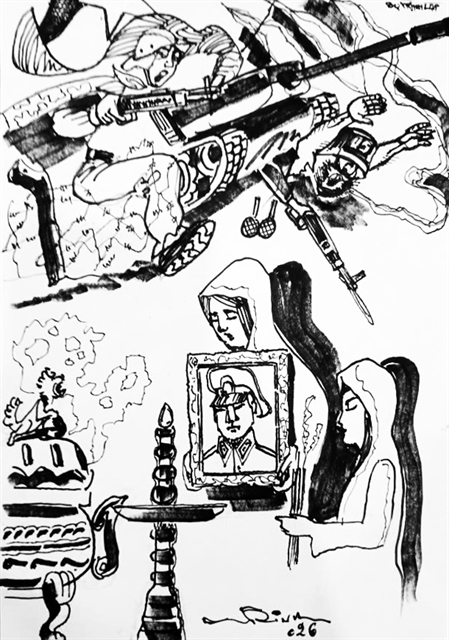
| Illustration by Trịnh Lập |
Nguyễn Mỹ Hà
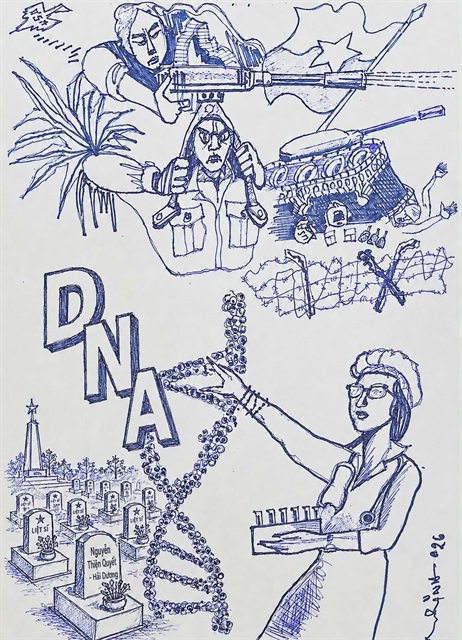
Every year, the period from July to August is a sombre time, as it is when we remember those who laid down their lives so that we can live in peace today.
War Invalids and Martyrs' Day on July 27 marks the date, but activities begin long before it.
Around this time last year, Nguyễn Hoàng Quân, 65, received a notice from his local police officer asking him to fill out an official form detailing the close relatives of his long-lost uncle, who died in 1952 at the Ba Lay Post battle against the French in what they called the First Indochina War, but we name it Anti-French Resistance, in the northwestern region.
He would have to provide information about his uncle’s mother, his grandmother, or his brothers or sisters who shared the same mother. The list went on to include the daughters of his uncle’s grandmother’s sisters, which he found highly complicated and difficult to understand.
The clan discussed the matter at length and finally convinced his cousin, the daughter of the war martyr’s younger sister, to be on the list and would be eligible for DNA testing. Her sample would then be added to the National Gene Bank to be matched with other genetic samples collected from war cemeteries around the country.
The cousin in HCM City has been waiting ever since, but she has not yet been called to provide her sample.
The family had six sons and a daughter. Four of the sons joined the Việt Nam People’s Army, and one died in battle, while three others returned with shrapnel and bullets still lodged in their bodies.
According to the death announcement, Quân’s uncle was wounded during a battle. He was later taken to a field clinic but did not survive. His grave was on a hill three kilometres from the Ba Lay Post.
Following this year’s 500-day campaign to search for, recover and repatriate the remains of fallen soldiers nationwide, the family hopes that one day they will find their uncle’s grave and be able to light incense for him.
Over the years, his brothers made numerous trips to search for his grave, based on the information in the announcement, but without success.
Many graves were moved to the Mộc Châu War Martyrs Cemetery, but his did not bear his name.
Among the thousands of unidentified graves, the family sought help from a spiritual shaman, who told them the exact row and number of the grave.
The brothers went to that grave and tried to light some incense sticks, but they would not catch fire. According to superstition, this was a sign that the soul of the person buried in the grave did not accept them because he was not a member of their family.
Being engineers and architects, the brothers did not believe in superstition. However, they had grown up seeing their mother set aside a bowl of rice at every meal in the hope that her son would one day return. He never did, and she died 42 years later.
The story of this family reflects the circumstances faced by families searching for the remains of more than 300,000 fallen soldiers whose graves are unknown, as well as the remains of 175,000 others who have not been found or repatriated in all the wars that followed the struggle to end French occupation.
Much effort was made by the military during and after the wars. In peacetime, many war veterans went out on their own to bring home their comrades.
Many families that had searched for their brothers for years without success had to resort to the help of spiritual shamans or fortune tellers. Some were told to dig in certain places and found bones, which later proved to be false because they were not human bones.
False documents were forged to claim compensation. When police discovered the deception, the perpetrators were brought to trial and faced legal penalties.
Bringing them home
Now, with the help of DNA technology, the nationwide search and documentation process at the National Gene Bank is expected to eliminate false matches.
In June, the Ministry of Public Security began a nationwide campaign to collect DNA samples from maternal relatives of fallen soldiers. According to the ministry, this year’s campaign aims to collect samples from relatives of 300,000 fallen soldiers.
Deputy Minister of Public Security Senior General Nguyễn Văn Long reiterated the campaign’s profound humanitarian importance, assigning local police officers to assist all families in providing samples and incorporating the information into VNeID, allowing families to receive updates online as well.
On the gravestones of unknown soldiers, the words “Vô Danh” (No Name) have been replaced with “Liệt sỹ chưa biết tên” (War martyr whose name has not been identified), after journalist Trần Văn Hiền in Nghệ An Province wrote a heart-wrenching poem in 1999.
“Xin đừng gọi anh là liệt sỹ vô danh,
Anh từng có tên như bao khuôn mặt khác,
Mẹ sinh anh tròn ngày tròn tháng,
Cha đặt tên anh chọn tuổi, chọn mùa”
(Please don’t call him nameless,
He used to have a name like the others,
Mother gave birth to him on the due date,
Father named him, choosing the finest age and season)
“Hundreds of thousands of men and women who went to the battlefront did not go without names: they were regular soldiers, volunteers or transporters for the frontline," Hiền said of how he came to write the poem.
“When I visited the cemetery and saw the stones inscribing the word ‘Unknown’, I realised how thoughtless we were. It is our duty to find the war martyrs’ names. They were the best men and women of their generation who stood up to the nation’s call.”
The 27-verse poem painted a portrait of a liberation fighter devoted to his or her country. It concludes by honouring the sacrifices they made to liberate Việt Nam from foreign aggression and reunify the country.
After the poem was published, a documentary titled No One Is Unknown was broadcast on national television by VTV. The War Veterans Association wrote to the Ministry of Labour, War Invalids and Social Affairs, asking it to reconsider how fallen soldiers were referred to. More than 70,000 graves were repainted with the words “War martyr whose name has not been identified”.
During his lifetime, President Hồ Chí Minh repeatedly said that “the blood of fallen soldiers has made our revolutionary flag shine bright red. Their sacrifices have helped our country achieve independence and bear the fruits of freedom”.
What journalist Hiền wrote 27 years ago is slowly becoming true. At a ceremony launching the collection of DNA samples from soldiers’ families, three soldiers had their birth names restored. One of them was Nguyễn Thiện Quyết from former Hải Dương Province, whose grave is located in Đức Cơ Town of Gia Lai Province.
The other two are Đoàn Văn Khải in Ninh Bình Province and Nguyễn Trọng Cát in Thanh Hoá Province, whose graves are located in Ngã Bảy-Phụng Hiệp War Martyrs Cemetery in Cần Thơ Province.
For his part, Nguyễn Hoàng Quân hopes that his cousin in HCM City will be called to provide a sample for DNA testing and that this enormously meaningful campaign will fulfil the family’s long-held hope of identifying their uncle sometime next year. — VNS
Talk Around Town
 Talk Around Town
 Talk Around Town
 Talk Around Town
 Talk Around Town
 Talk Around Town
 Talk Around Town
 Talk Around Town
 Talk Around Town
 Talk Around Town
 Talk Around Town
 Talk Around Town
 Talk Around Town
 Talk Around Town
 Talk Around Town