 Talk Around Town

Singapore DPM calls for stronger ASEAN through Singapore-China cooperation
1.
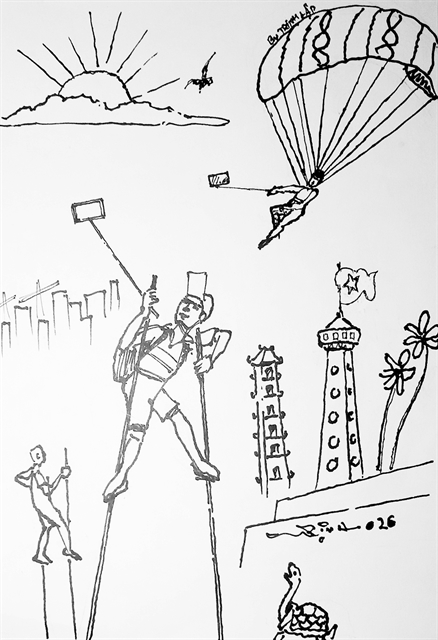 |
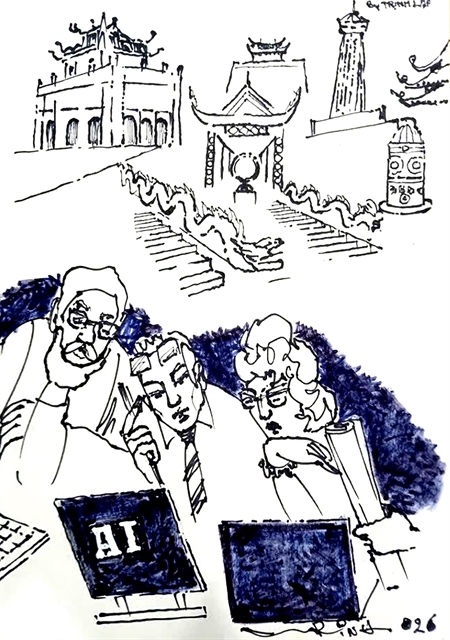
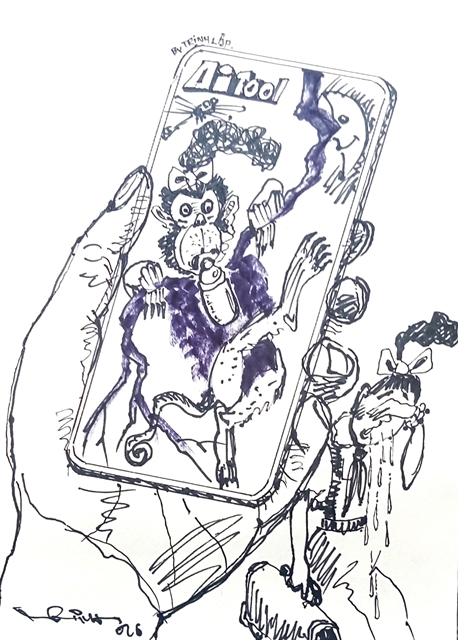
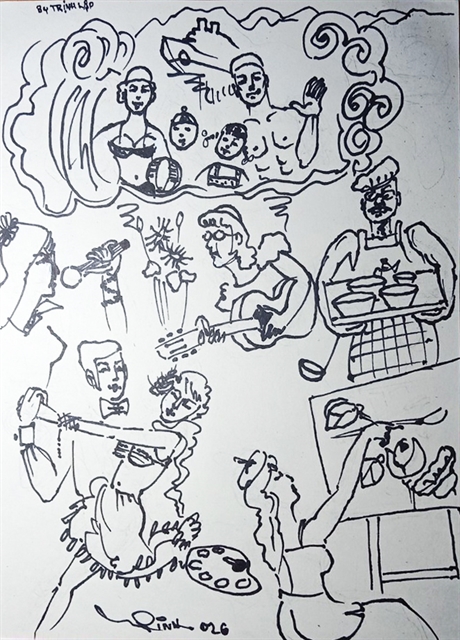
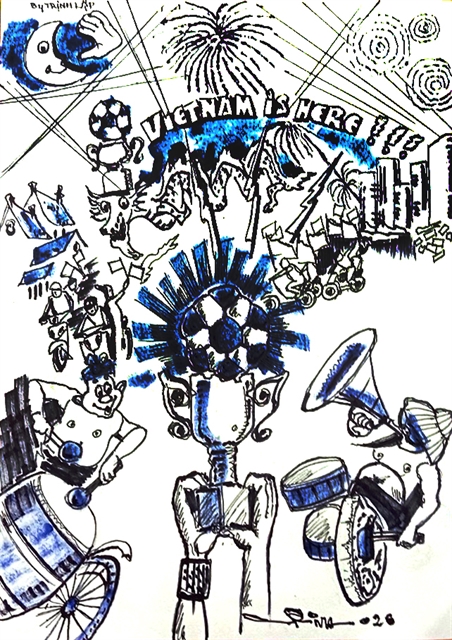
| Illustration by Trịnh Lập |
Anh Đức
More than 80 years ago on September 2, 1945, President Hồ Chí Minh stood before a sea of people in Ba Đình Square, Hà Nội, and opened the Declaration of Independence of the Democratic Republic of Việt Nam with the immortal words: "All men are created equal. They are endowed by their Creator with certain inalienable rights, among these are Life, Liberty, and the pursuit of Happiness."
The words, which President Hồ quoted from the United States Declaration of Independence by Thomas Jefferson, mean that all people on earth have the right to live, to be free and to be happy.
Eight decades later, the struggle goes on — in one of those inalienable rights: the pursuit of happiness. But it is not against colonial rule that young people around the world are fighting, but a scrolling, glowing screen that tells them, every waking minute, that they are not enough.
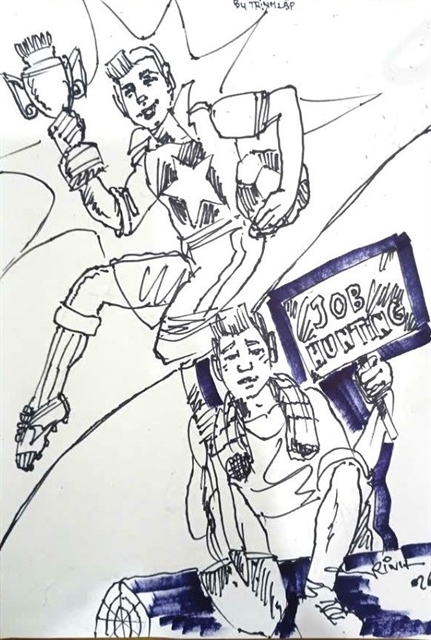
In early March, a video clip of a food deliveryman sitting on a kerb weeping in Hà Nội went viral. The caption — a simple unfinished thought, translated roughly as "What if your whole life is never brilliant?" — had no complex scientific wording, no self-help jargon. Just an exhausted young man and a question that refused to stay quiet.
The video attracted more than half a million interactions, and 50,000 comments from people sharing their own experience and empathy to the young deliveryman.
I paused the video after seeing the young man cry, because it was too emotional. It is still rare to see a man cry, as many of us are taught by our fathers to hold our emotions inside. That teaching is now somewhat obsolete and, to a certain extent, toxic, but it shows the weight of the pressure — enough to make a young man break from it and stay true to his feelings.
A close friend of mine had been working a regular job for five years, earning a modest salary. Last week he was given a chance to double his salary elsewhere, in the context that he is going to marry soon and would need more funds in the future. The interview went well; the employers gave him an offer, which he accepted after some consideration.
He prepared for his final week of work and even said his goodbyes to colleagues, only for the employers to call and apologise, saying they had chosen a different candidate at the last minute.
My friend broke down and called me on the phone, uttering the phrase "What if my life is never brilliant?" while sobbing uncontrollably. He wanted that job so badly, believing it could be his big break — a step forward that might solve many of his future financial worries. But it never came, and in the cruellest way.
The race is not just emotional, but material too. According to Hà Quang Hưng, deputy director of the Department of Housing and Real Estate Market Management at the Ministry of Construction, to buy an average 70-square-metre apartment in a major city, a young person would need 20 to 25 years' worth of income. The cost of marriage — ceremonies, jewellery, photography and banquets — can easily reach VNĐ350–400 million (US$13,500–15,500), enough to cover several years of child-rearing expenses.
No wonder the average age of a first marriage rose from 24.1 in 1999 to 27.2 in 2023, and in big cities it even exceeded 30 years old, according to a 2024 report from Việt Nam's General Statistics Office.
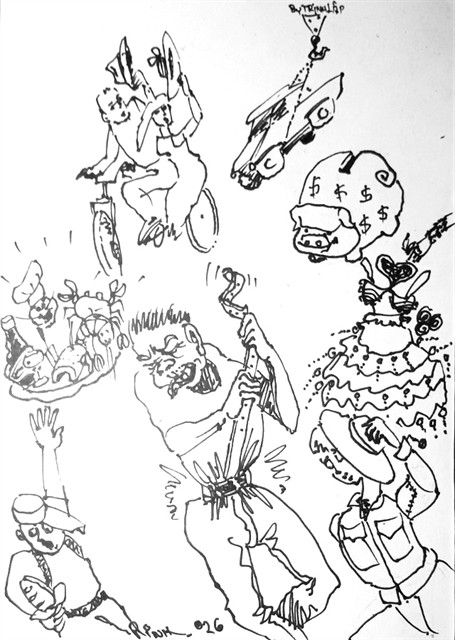
But on social media, videos and posts of lavish houses and celebrity weddings pop up like moths, as people look on and scroll in awe of a perhaps unattainable reality.
But is it really? Are we destined to accept the truth and be nihilistic? That there is no point in trying to keep calm and carry on?
One of my favourite movies is The Pursuit of Happyness, starring Will Smith as real-life millionaire investor Chris Gardner. It tells the story of Gardner's rags-to-riches experience.
Gardner was never born into wealth. Deep into his late twenties, he invested in medical supplies and became a salesman. The products, however, did not sell well, and with a declining marriage and a son to care for, as well as tax problems, Gardner went homeless.
Yet Gardner did not give up. He saw a stockbroker on Wall Street and sought to become a stockbroker himself to be happy. After trials and tribulations, he landed an unpaid internship at a firm, aced the stockbroker licence exam, and earned his happiness. Gardner then founded his own firm, sold his stake in the company and became a millionaire.
In my opinion, Gardner's happiness perhaps did not come from wealth or social status. His source of joy and motivation was his son Christopher, who was the light that guided him and told him to go on, even in the darkest days when they had to sleep in a public restroom.
“A long walk to Wall Street is how others described my life. But when I look back at the journey from homelessness to prosperity, I hold one thing dearer than all else: my commitment to my son,” Gardner wrote.
Let's be frank: life is not a smooth road with roses on the sidewalks. Everybody is fighting their own battles in chasing happiness. Yet in the pursuit of the future, we tend to forget the gift of the present.
Another favourite movie of mine is Invictus, which introduced me to the namesake poem, recited by the great Nelson Mandela during his imprisonment at Robben Island. The poem became my spiritual motto, which I always thought of when hardships came.
"I am the master of my fate/I am the captain of my soul," read the final two lines of William Ernest Henley's poem.
Your life is defined by how you react to it. Despite what the outside circumstances throw at you, only you can change it. You can make your life brilliant with every moment that you are living in it. And what you define as a brilliant life is also important.
The deliveryman on the kerb never answered his own question. And perhaps that is the point. The pursuit of happiness does not require a destination. Happiness is a choice: live each day with intention, and you may find it has been there all along.-- VNS
Talk Around Town
 Talk Around Town
 Talk Around Town
 Talk Around Town
 Talk Around Town
 Talk Around Town
 Talk Around Town
 Talk Around Town
 Talk Around Town
 Talk Around Town
 Talk Around Town
 Talk Around Town
 Talk Around Town
 Talk Around Town
 Talk Around Town