 Talk Around Town

Somerset Diamond Bay Garden Phnom Penh appoints Jamila Nsouli as General Manager ahead of planned November opening
1.
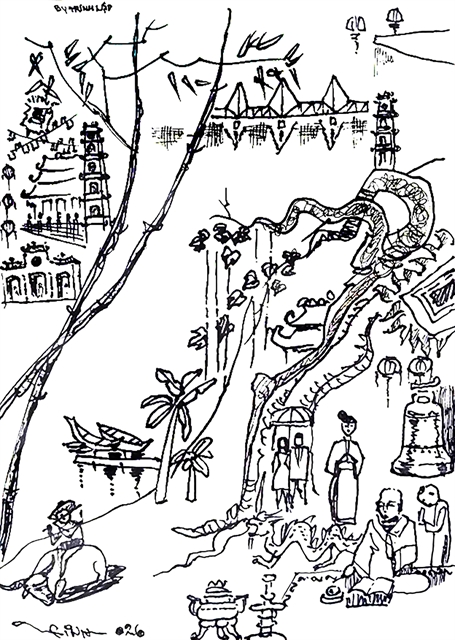 |
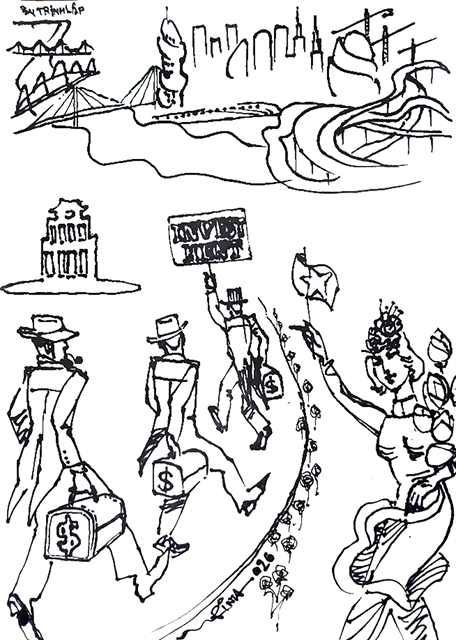
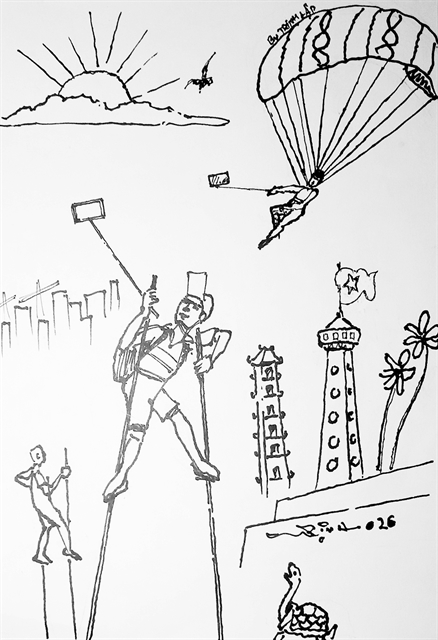
| Illustration by Trịnh Lập |
by Nguyễn Mỹ Hà
As the enormous Red River Boulevard project gets underway in Hà Nội, land clearance is still ongoing in the communities alongside the river in the capital.
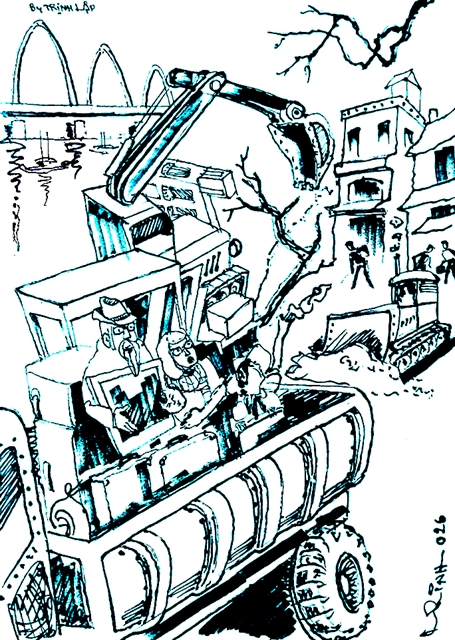
Just a few days ago, one family tried to preserve their 100-year-old gate and ship it to the owner of a retreat on Côn Đảo Island to reinstall it there. However, they weren't able to do so as planned, because the whole gate was too big to move more than 2,000km south and over the sea to the island. Instead, the gate was cut into pieces to be incorporated into several other structures.
The gate was the last item of a dismantling process in which the family tried to preserve as much as they possibly could from their ancestral home.
The grandmother of the family refused to accept that they would all have to move, waiting until the family's altar house was dismantled to agree to be evacuated.
"I'm glad that parts of my family's old house will be restored in different parts of the country," said Nguyễn Thu Hà, the daughter of the family, who graduated from Hà Nội's Architecture College.
Hà made a series of video clips of their old family home to keep the memories alive for their children's children.
"The top of the gate is going south to Côn Đảo," she said. "We had to have the gate cut into several segments to be sent to different places. The old well went to another person, and we're moving our family altar house to a new spot to be re-erected."
Plans are still going ahead for the massive Red River Boulevard project.
In communities alongside the river, people are hanging on to what they believe could make their pleas heard, with some even asking for help from the village gods. In the past, the ancient gods were very real for residents, and are believed to have founded the villages or taught villagers a traditional craft.
"Our ancestors have lived here for a long time," said Trần Thị Huệ, a resident of Hồng Hà Ward, as she stood in the large red-brick yard of the communal house.
"The project will build a new park here," she noted, "and I disagree that local residents currently living here will not be benefiting from any of the new growth."
Proponents of the boulevard project boast about new, well-planned urban centres that can help Hà Nội keep up with other modern world cities. The project is taking inspiration and learning from urban planning models in cities such as Shanghai and Seoul.
Without these planned projects, Hà Nội is already a beautiful city, with both traditional and modern urban areas. Its many tree-lined boulevards help keep streets cool during summer. What Hà Nội needs more of are green shade trees along the streets and in residential areas.
Hà Nội authorities may be in charge of planning the city, and the section of the Red River within their responsibilities. But what they do will likely have a big impact on the river's current and the accumulation of alluvial silt on the riverbed. If a new park is to be erected, it will definitely be layered with alluvial soil.
Architect Tô Kiên, currently a senior research scientist at Kumamoto in Japan, used to teach in Singapore and has extensively studied the Miracle on the Han River in Seoul, South Korea, one of the main inspirations for the Red River project.
The Han River 'Miracle' is a story of how a well-planned project can help lift a city and its economy from the ashes of war. In Seoul, the project helped make the city a metropolitan centre with advanced technology and economic growth, at the cost of a suppressed labour force, social inequality, extremely high living costs and unequal access to public education.
"I have spent many days on field trips by the Han River in Seoul," Kiên wrote in a social media post about the project. "I rode my bicycle alongside the Han River across seemingly endless public spaces, which were well-planned with a clear management strategy."
Today people walk, cycle, play sports and live in houses around the river in harmony. Yet they had to readjust to rapid development at a high cost.
Back then, the approach to manage floods was to build hard embankments alongside the river. For 20 years, the river current was mostly tempered, floods were kept under control, transportation was improved and both sides of the river grew rapidly. The local population rose from under 100,000 to close to a million people. Land prices rose by several dozen times Seoul's average.
Hà Nội city authorities can certainly learn from the Han River example, especially as the project shares some significant similarities with the Red River. The question is whether they are willing to take lessons from the example, or not.
The world has seen Seoul grow from an impoverished, flood-ravaged town in the 1950s, into a modern, 21st-century megacity. Updated flood-control technology and irrigation systems have been designed to make sure Seoul remains in complete command of risks from the Han River. But nature always has its own way to give us hard-learned lessons.
For a long time, not only in Seoul, but around the world, people were made to believe technology can control nature. It's quite an arrogant way of thinking. We are just a part of the vast, intricate systems governed by nature, and can only learn to live according to its rules.
"I remember the night of August 8, 2022, when the city was submerged in a massive downpour that left parts of the city flooded for days," Kiên wrote. "Streets turned into rivers and Gangnam, the symbol of wealth and modernity, was also submerged in water. This is when the other side of growth showed."
Even before the notorious flood of 2022 struck, the river was given more room to breathe, with softer and more eco-friendly embankments replacing the hard ones so that when floodwaters rise, they flow more naturally.
Meanwhile, a new policy allows some of the original local riverside population to get special offers to buy homes and move back to the area. Though it's late, it shows an improvement in wealth distribution, with resources gained in part from the economic growth spurred by the project.
For our Red River Boulevard, it's not yet too late to listen to people's wishes. Growth must not be paid for with continuing social unfairness or by forcing locals away from the land they lived on. Residents can work alongside the country's top scientists, architects and social activists to agree on a better plan.
Certain lines should not be crossed, not only to protect the residents of Hồng Hà Ward today, but also the river that has shaped our country and our civilisation for thousands of years.
A popular saying that has accompanied Việt Nam's successes in the past notes: " No matter how easy a task may be, it cannot be achieved without the people. No matter how difficult it may be, it can be accomplished when the people unite and take action."
This mentality has proved successful during wartime and other times of hardship; now, it will definitely work once again. — VNS
Talk Around Town
 Talk Around Town
 Talk Around Town
 Talk Around Town
 Talk Around Town
 Talk Around Town
 Talk Around Town
 Talk Around Town
 Talk Around Town
 Talk Around Town
 Talk Around Town
 Talk Around Town
 Talk Around Town
 Talk Around Town
 Talk Around Town