 Economy



Top leader proposes Việt Nam, Poland step up sci-tech ties
1.
 |
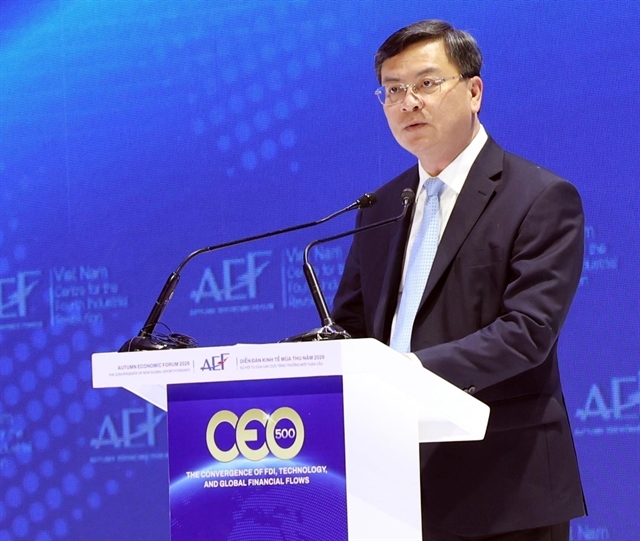
| Panelists at the Vietnam Green Finance Summit 2026 in HCM City on August 6. — VNS Photo |
HCM CITY — Mobilising private and international capital will be crucial to closing Việt Nam's green financing gap as the country pursues net-zero emissions by 2050, speakers told the Vietnam Green Finance Summit 2026 in HCM City on Thursday.
Held with the theme "Where Green Capital Meets Investment Opportunity", the summit was organised by the Vietnam International Financial Centre in HCM City (VIFC-HCMC), Nam A Bank, FiinGroup and the Global Green Growth Institute (GGGI) Vietnam and attracted more than 200 participants, including representatives of Government agencies, international financial institutions, development banks, investment funds, businesses, and financial experts.
Speaking at the summit, Hà Huy Cường, deputy general director of Nam A Bank, said the event came at a pivotal moment as Việt Nam seeks to build an international financial centre capable of connecting regional and global capital flows while supporting the country's net-zero commitment.
He said the green transition requires a financial ecosystem that is deep, transparent, and resilient enough to turn climate ambitions into investment opportunities.
"Green finance is no longer a choice. It is an imperative for Việt Nam's long-term prosperity and for the sustainability of our planet."
He said the country faces two major challenges: climate change continues to weigh on economic growth and achieving net-zero emissions would require investment equivalent to a large share of GDP each year.
"The required capital cannot come from public investment alone. It requires participation from investment funds, banks, financial institutions, businesses and private-sector partners across the value chain."
Associate Professor Nguyễn Hữu Huân, vice chairman of the executive board of VIFC-HCMC, cited World Bank estimates showing that Việt Nam would require about US$368 billion in additional investment by 2040 to achieve climate-resilient growth and meet its net-zero commitments.
At the same time, adaptation finance needs in developing countries through 2035 are estimated to be 12-14 times current international public finance flows, while the cost of capital for clean energy projects in emerging markets remains at least twice that in advanced economies and China, he said.
"The opportunity lies not only in issuing green financial products, but also in lowering the cost of capital and building a pipeline of investment-ready projects.
"VIFC-HCMC does not stop at merely 'green-labelling' financial products. It positions itself as the nucleus for transforming climate projects into investable assets that can be measured, guaranteed, capitalised, and traded across borders to the most rigorous international standards."
The centre is designed to channel international capital into Việt Nam through a transparent and secure ecosystem, directing funding to green projects in HCM City and across the country.
"Our vision is for VIFC-HCMC to become Southeast Asia's green and transition finance hub for emerging markets by 2030, where hard-to-finance climate needs are transformed into transparent, commercially viable assets capable of mobilising cross-border capital," Huân said.
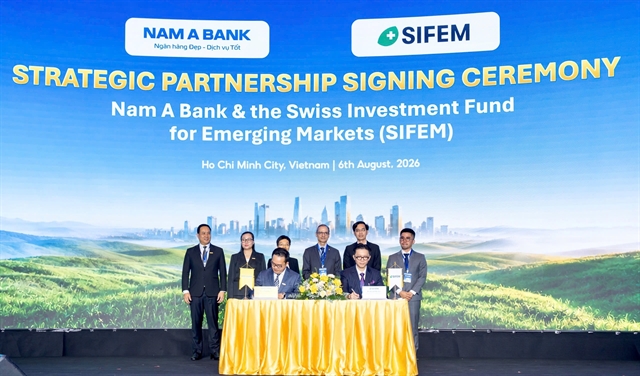 |
| Representatives of Nam A Bank and the Swiss Investment Fund for Emerging Markets sign a partnership agreement at the Vietnam Green Finance Summit 2026. — Photo courtesy of the bank |
Private capital key to closing financing gap
Paul Xavier, operations officer at the International Finance Corporation, said green finance has evolved from a niche market into a mainstream source of global investment.
He said Việt Nam's green finance market has expanded steadily, supported by strong policy backing, growing banking activity, and rising investor interest.
Outstanding green credit was nearly VNĐ780 trillion at the end of 2025, up 14.6 per cent year on year and accounting for 4.2 per cent of total outstanding credit.
Green lending recorded average annual growth of 22-23 per cent between 2017 and 2025, with commercial banks providing about 88 per cent of the outstanding green credit.
Financing remained concentrated in green agriculture and renewable energy, while cumulative green bond issuance exceeded $1.5 billion during 2020-25.
He said Việt Nam's ambitious climate targets, rapid economic growth, rising demand for green infrastructure, and high exposure to climate risks presented significant opportunities for sustainable investment.
However, with public investment accounting for only about 2 per cent of GDP each year, mobilising private capital would be essential to bridge the country's estimated $368 billion climate financing gap.
He identified five priorities for accelerating sustainable finance: transition finance, sustainable infrastructure, SME finance, digital finance, and sustainable capital market development.
He also highlighted the need for continued regulatory reform, including developing a national green taxonomy, strengthening financial sector capacity, and expanding innovative financing instruments.
"Capital markets can complement public finance by adding liquidity and converting climate goals into tradable instruments, such as carbon credit markets."
Several strategic tie-ups were announced at the summit to strengthen Việt Nam's green finance ecosystem.
Nam A Bank signed a deal with the Swiss Investment Fund for Emerging Markets (SIFEM), paving the way for greater long-term foreign investment in green transition and sustainable development projects in Việt Nam.
FiinGroup presented a letter of intent to VIFC-HCMC to cooperate on developing market infrastructure and the financial services ecosystem at the centre.
FiinRatings, a FiinGroup subsidiary and strategic partner of S&P Global, also joined GGGI in announcing plans to support the development of Việt Nam's sustainable finance ecosystem. — VNS
Economy
 Economy
 Economy
 Economy
 Economy
 Economy
 Economy
 Economy
 Economy
 Economy
 Economy
 Economy
 Economy
 Economy