 Economy


A turning point for Việt Nam's concert era
1.
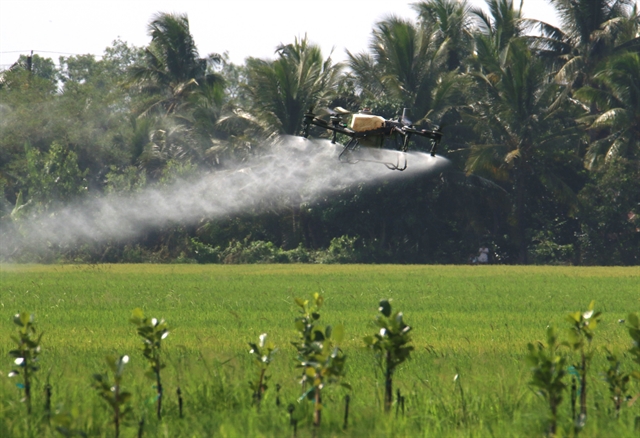 |
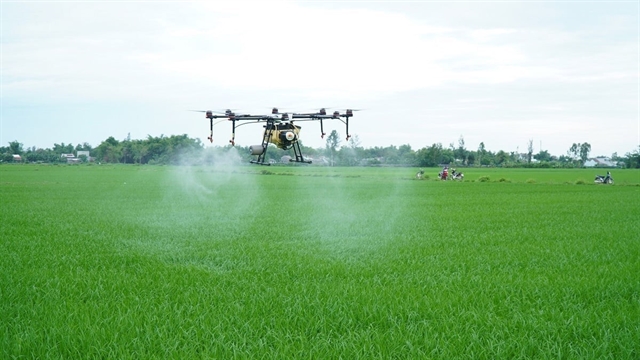
| A drone used to apply fertiliser to rice fields in Cần Thơ City. — VNA/VNS Photo |
HÀ NỘI — Việt Nam is seeking to develop a broader low-altitude economy ecosystem, moving beyond drone manufacturing to applications, data services and supporting infrastructure, as unmanned aerial vehicles (UAVs) create new opportunities in agriculture, logistics, energy, transport and other sectors.
Nguyễn Văn Thuật, deputy director of the Department of Economy and Digital Society under the Ministry of Science and Technology, spoke at a forum on developing the low-altitude economy and promoting space technology applications in Việt Nam on October 2.
The low-altitude economy was based on an ecosystem of aircraft operating from the ground to altitudes of around 1,000–3,000 metres, depending on how individual countries define it. China, for example, sets the upper limit at 3,000 metres.
According to MarketsandMarkets, the global UAV market could reach approximately US$40 billion by 2030. However, this represents only part of the potential market. Including services in agriculture, logistics and traditional industries, the global low-altitude economy could be worth around $488 billion by 2035, Thuật said.
China is among the fastest-growing markets. In 2025, it had more than three million registered UAVs and approximately 45 million flights. Its ecosystem spans UAV design, manufacturing, maintenance, physical infrastructure, charging stations, frequency infrastructure, low-altitude airspace management systems and flight services. This has also enabled the emergence of companies operating large drone fleets to provide services.
Việt Nam, by comparison, remains at an early stage of development. The country's low-altitude economy is forecast to grow by around 13 per cent annually, potentially reaching $500 million by 2035.
Thuật said Việt Nam's strategy should focus not only on producing equipment, but also on developing the wider ecosystem and participating more deeply in the low-altitude economy's value chain.
"UAVs themselves do not directly create value. Value lies in the flights, the data collected and the ability to exploit that data to solve real-world problems," he said.
UAV applications could span agriculture, electricity and energy, transport, dike management and healthcare. However, developing these applications would require more than technological capabilities.
Việt Nam currently lacks a dedicated regulatory framework for the development of the low-altitude economy, according to Thuật. While institutional and regulatory development is important, he stressed that the country should not wait until the entire legal framework is completed before allowing the sector to develop.
Instead, businesses would need controlled environments and mechanisms to test technologies and gradually bring new models into practical use.
Standards and radio frequency allocation would also require attention. Under Decision 1493, Việt Nam has identified 10 strategic technology groups, with implementation divided into the 2026–2030 and 2031–2035 periods and an emphasis on mastering strategic technologies and products.
Thuật also highlighted the need for coordinated workforce development, from school students and university students to doctoral researchers, engineers and specialists.
Outstanding students are eligible for support of VNĐ1 billion annually for three years to support study, research, international publications and academic exchanges. For professionals, the objective is to train and attract talent with international competitiveness and skills aligned with market and technology needs.
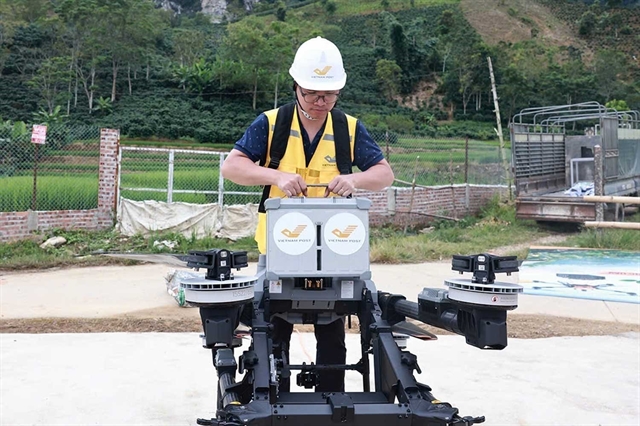 |
| A UAV operator installs batteries on a vehicle. — VNA/VNS Photo |
Bùi Thế Duy, alternate member of the Party Central Committee and president of Việt Nam National University Hà Nội (VNU), said the low-altitude economy would integrate advanced UAV technologies with applications in logistics, agriculture and smart transport, creating new opportunities to bring emerging technologies into everyday life.
VNU had developed training and research activities in UAV design and manufacturing, and was working to establish UAV pilot training centres for agriculture, search and rescue, transport and logistics.
At its Hòa Lạc campus, the university was also working with logistics and automation groups to establish research centres and laboratories focused on research, training and the localisation of low-altitude economy technologies.
Duy cited practical applications already emerging in Việt Nam, including UAV delivery of essential medical supplies and pilot zones in several localities and industries. In rural areas, adoption advanced rapidly, particularly in agriculture.
Many durian orchards in the Central Highlands now use UAVs, with workers receiving pilot training and drones carrying out regular irrigation and spraying operations, according to Duy.
During recent storms and floods, UAVs were also used to search for and locate stranded people and deliver food and essential supplies. — BIZHUB/VNS
Economy
 Economy
 Economy
 Economy
 Economy
 Economy
 Economy
 Economy
 Economy
 Economy
 Economy
 Economy
 Economy
.jpg) Economy
Economy