 Economy

HCM City seeks US$19 billion in foreign investment in 2026
1.
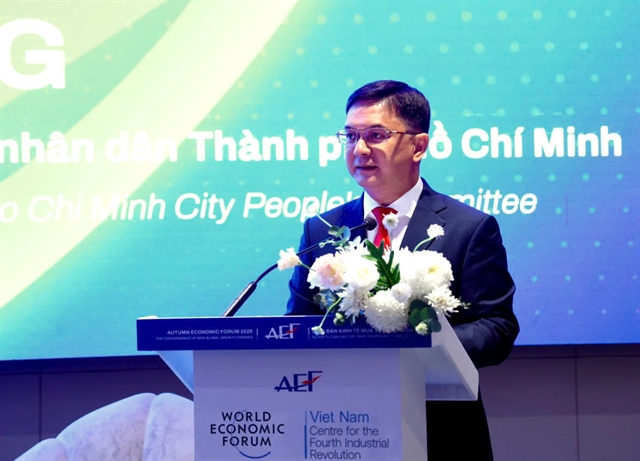 |
| Nguyễn Mạnh Cường, deputy chairman of the HCM City People’s Committee, speaks at the Việt Nam–India Future Technology Forum in HCM City on October 26. — VNS Photo |
HCM CITY — HCM City and India are seeking closer cooperation in artificial intelligence, semiconductors, digital infrastructure, research, and high-quality human resource development, building on growing ties and a new partnership between HCM City and Mumbai.
At the Việt Nam–India Future Technology Forum held in HCM City on October 26 as part of the 2026 Autumn Economic Forum, speakers called for closer links between universities, research institutions, technology companies, and investors to turn shared ambitions into practical projects.
Nguyễn Mạnh Cường, deputy chairman of the city People’s Committee, said technological competitiveness increasingly depended on the ability to research, master, and apply technology to address development challenges, rather than simply gain access to it.
“No country, city, or enterprise can independently develop all technological capabilities.”
He emphasised the importance of international cooperation as AI, digital infrastructure, semiconductors, and automation for transforming production and business operations.
“For HCM City, the priority is not simply to adopt new technologies, but to turn knowledge and collaborative resources into domestic capabilities, boost productivity, improve workforce quality, and strengthen local businesses’ positions in regional and global value chains.”
He said the establishment of a friendship and cooperation relationship between HCM City and Mumbai in May laid the foundation for collaboration in trade, investment, education, research, urban planning, infrastructure, green growth, and digital transformation.
The city’s expansion following its merger with Bình Dương and Bà Rịa–Vũng Tàu in July 2025 also created opportunities for Indian partners.
Now with more than 6,772 square kilometres, 14 million people, and accounting for 23.5 per cent of national GDP, HCM City combines financial and commercial services with industrial production, high-tech manufacturing, seaports, and logistics.
The city is developing a technology ecosystem focused on AI, semiconductors, integrated circuits, data and computing infrastructure, and digital technologies for urban management.
It also seeks to attract research and development centres, build a skilled workforce, and establish facilities to test emerging technologies.
Cường identified three priorities for bilateral cooperation: training skilled workers through university–business partnerships, conducting research and transferring technology to meet industry needs, and connecting innovation ecosystems to commercialise research.
Turning partnerships into practical projects
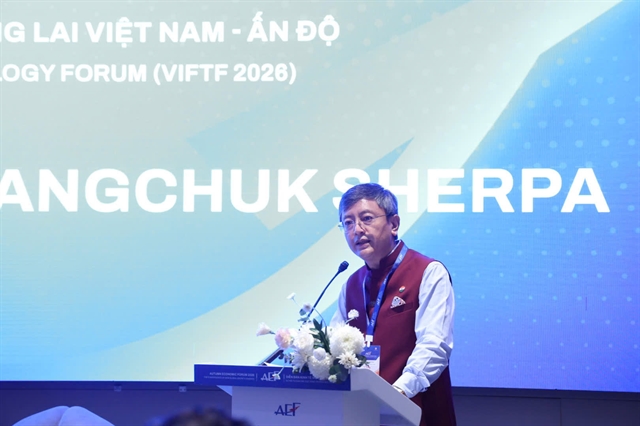 |
| Tshering Wangchuk Sherpa, Ambassador of India to Việt Nam,highlights the need to expand cooperation in information and communications technology, innovation, science and technology at the Việt Nam–India Future Technology Forum in HCM City on October 26. — VNS Photo |
Tshering Wangchuk Sherpa, India's ambassador to Việt Nam, urged the two countries to build on their Comprehensive Strategic Partnership, established a decade ago, and translate mutual trust into tangible outcomes.
“The road ahead for us needs to be built on new domains such as ICT, Innovation and Science and Technology.”
He noted that these priorities aligned with both countries’ policies and Việt Nam’s Resolution 57 on science, technology, innovation, and digital transformation.
He proposed connecting the startup ecosystems of HCM City and Mumbai, linking the Indian Institute of Technology Bombay with a counterpart in HCM City, and organising student exchanges and joint research programmes.
India is also considering establishing a co-innovation centre at the Hanoi University of Science and Technology in partnership with IIT Delhi, he said.
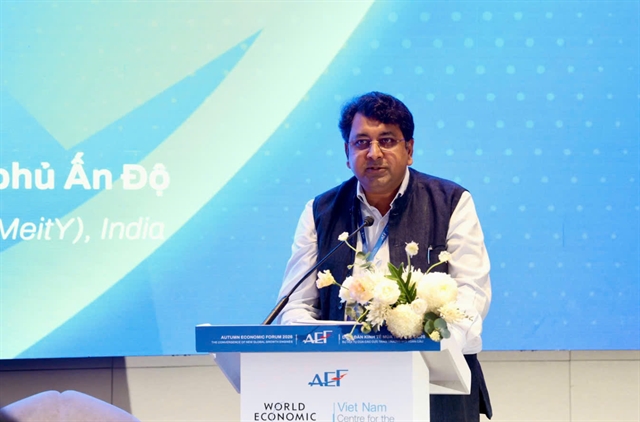 |
| Ajit Kumar, joint secretary at India’s Ministry of Electronics and Information Technology, speaks about the complementary strengths of India and Việt Nam and opportunities for deeper technology cooperation at the Việt Nam–India Future Technology Forum in HCM City on October 26. — VNS Photo |
Ajit Kumar, joint secretary at India’s Ministry of Electronics and Information Technology, said there IS considerable scope for cooperation.
“India and Việt Nam possess complementary strengths that offer a strong foundation for deeper collaboration. India’s expertise in digital public infrastructure, software development, artificial intelligence, semiconductor design, and digital services, together with Việt Nam’s growing manufacturing capabilities and dynamic electronics ecosystem, creates significant opportunities for joint innovation and technology-led growth.”
He identified AI, digital public infrastructure, semiconductors, sixth-generation mobile communications (6G), advanced materials, and critical minerals as promising areas.
“Joint research, industry partnerships, startup exchanges, and collaborative product development can help transform these opportunities into practical outcomes.”
He also called for greater engagement between companies, research institutions, and innovation ecosystems to facilitate knowledge sharing, technology development, and access to new markets.
Cooperation in semiconductor design and electronics manufacturing could also strengthen supply chains and technological capabilities, he added.
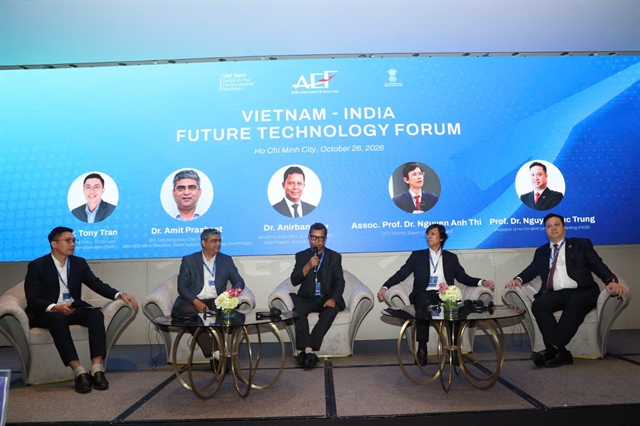 |
| A panel discuss at the Việt Nam -India Future Technology Forum in HCM City on October 26. — VNS Photo |
Participants at the forum referred to skills shortages and the need to help businesses move beyond experimental AI projects to wider adoption.
They called for closer university–industry partnerships, shared technology-testing facilities, and cooperation in cybersecurity, data governance, and technical standards.
Anirban Roy, an advisor to a State Bank of Vietnam, ADB programme, and Ernst & Young, identified account aggregation, open finance, digital lending for small and medium-sized enterprises, and AI-related cybersecurity as potential areas for cooperation.
He suggested Việt Nam could draw on India's experience in enabling customers to share financial data securely and using alternative data to improve access to working capital and invoice financing.
Nguyễn Đức Trung, president of Ho Chi Minh University of Banking, called for closer university–business cooperation to better prepare graduates for employment.
The university also hoped to learn from Indian experts, and conduct joint research in AI and innovation, he said.
Assoc. Prof. Dr. Nguyễn Anh Thi, CEO of Citares and an expert at the HCM City Centre for the Fourth Industrial Revolution, said Việt Nam's open economy and integration into global supply chains offered investment opportunities.
A strong science, technology, and innovation ecosystem is essential for attracting high-tech investment, and more bilateral exchanges could help businesses understand each other's markets, he said.
Indian companies entering HCM City should work with local partners familiar with its business environment and innovation ecosystem, he added. — VNS
Economy
 Economy
 Economy
 Economy
 Economy
.jpg) Economy
 Economy
 Economy
 Economy
 Economy
 Economy
 Economy
 Economy
 Economy