 Society

National Assembly President meets Polish Prime Minister
1.
|
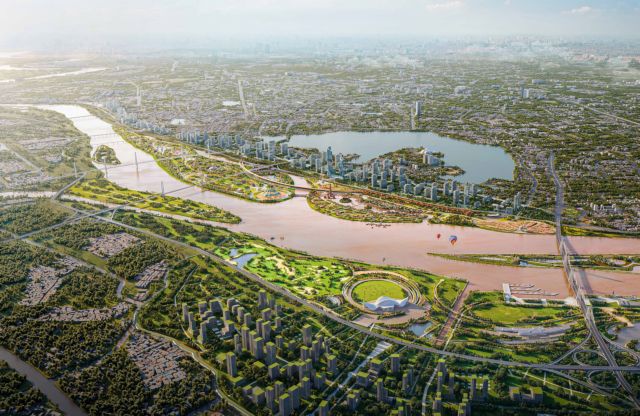
| An artist's impression of the Red River scenic boulevard. — VNA/VNS Photos |
HÀ NỘI — Under Hà Nội's master plan with a 100-year vision, the city has, for the first time, proposed developing an 80km scenic boulevard along the Hồng (Red) River, transforming it into the capital's primary ecological, cultural and landscape axis while placing residents' quality of life at the centre of future development.
Speaking at a seminar on Thursday hosted by Vietnam News Agency on the Red River scenic boulevard project, architects said the project's success will depend on connecting local communities, preserving historical and cultural heritage and ensuring urban development remains in harmony with the river.
According to the proposed investment policy, the project will cover approximately 11,418ha across 16 communes and wards along the Red River.
The project area is currently home to approximately 70,474 households, with a total population of 247,431 people.
Trần Ngọc Chính, chairman of the Việt Nam Urban Planning and Development Association, said creating spaces that connect people and link the two banks of the river is, in essence, about shaping an integrated urban architectural landscape, building bridges spanning the river, connecting parks, green space, water surface and developing recreational and public leisure areas.
“The ultimate purpose of this master plan is to improve the quality of life for residents,” he said.

|
| Trần Ngọc Chính, chairman of the Việt Nam Urban Planning and Development Association. |
Chính said along the 80km stretch of the project from Mễ Sở Bridge to Hồng Hà Bridge, there are numerous riverbanks, sandbars and midstream islets that could be developed into parks, green spaces, waterfront areas and cultural centres. These would serve as venues for cultural exchanges for Hà Nội, people from across Việt Nam and international visitors, while also providing spaces for physical exercises.
Hà Nội currently lacks sufficient green and waterfront public spaces, he said, adding that this project aims to significantly expand such areas, creating more venues for leisure, recreation and social interaction, while, more importantly, strengthening the connection between the two banks of the Red River.
What he concerns most is how to make better use of the river and lakes around for culture and tourism.
“The Red River is not only a waterway but also a historic and cultural river. Developments along the Red River should prioritise its historical and cultural values in which Hà Nội’s values are preserved while creating public spaces where people can gather, relax and engage in cultural and social activities,” he said.
Many of the world's major cities have successfully integrated their rivers into urban life, such as the River Thames in London, the Moskva River in Moscow, the Han River in Seoul and the Huangpu River in Shanghai, he said.
In Việt Nam, rivers such as the Hương (Perfume) River and the Hàn River have also benefited from effective planning and management. Hà Nội can learn from these examples in protecting the river's landscape, he said.
Phạm Thanh Tùng, chief of the office of the Việt Nam Association of Architects, said cities around the world are increasingly embracing river-oriented development.
He cited Paris, where an 11km riverside expressway along the Seine was removed and converted into public recreational space, including urban beaches.
Sharing opinions with Chính, Tùng said the planned 80km corridor along the Red River could serve as a living museum of Hà Nội. Stretching across 16 communes and wards, it encompasses countless traditional craft villages, historical sites and cultural stories.
“Why not view this corridor as a living museum that preserves and showcases the city's heritage?” he said.

|
| Phạm Thanh Tùng, chief of the office of the Việt Nam Association of Architects. |
He stressed that the project passes through communities whose social ties have been built over decades.
"If resettlement is treated simply as land clearance and financial compensation, only the economic issue is addressed," he said.
"When an entire community is relocated, equal attention must be paid to preserving its culture and social relationships."
While compensation fulfils an economic obligation, ensuring relocated communities continue to thrive and enjoy a better quality of life amounts to what he described as a "social contract".
Residents, he said, should be encouraged to participate in the project rather than being viewed merely as those affected by it.
Tùng proposed empowering riverside communities to become storytellers for visitors, adding: “AI can recite facts, but no one can tell the stories of a place with greater authenticity or emotion than the people who have lived there.
"Residents could share the history of Bát Tràng pottery village, the traditions of Nhật Tân peach blossom village, and the many other cultural stories rooted along the Red River.”
They could become community tour guides, operate homestays and serve as custodians of traditional craft villages, ensuring that the cultural heritage of the Red River continues to be passed down, he said.
In this way, the Red River project would become not only a symbol of 21st-century Hà Nội, reflecting modernity, but also a living cultural museum of local communities where they can play an active role, he said. — VNS
Society
 Society
 Society
 Society
 Society
 Society
 Society
 Society
 Society
 Society
 Society
 Society
 Society
 Society
 Society