 Society

Interest rates on certificates of deposit keep rising
1.
 |
| Participants attend the workshop to implement the 2026–2035 National Action Plan on Breast Cancer in HCM City on August 6. — Photo courtesy of the organiser |
HCM CITY — The 2026–2035 National Action Plan on Breast Cancer has been brought to health leaders nationwide through two recent workshops held by the Administration of Maternal and Children's Affairs under the Ministry of Health, in Hà Nội on July 30 and in HCM City on August 6.
Roche Pharma Vietnam accompanied both workshops, continuing its commitment, which began with the Memorandum of Understanding signed with the Administration of Maternal and Children's Affairs in July 2025, with a focus in the next phase on treatment quality and patients' access to innovative therapies.
According to health experts, breast cancer is the most commonly diagnosed malignancy among women in Việt Nam, with 24,563 new cases and approximately 10,000 deaths recorded annually.
More than 60 per cent of patients are still identified at an advanced stage (III–IV), leaving five-year survival at approximately 74 per cent, below the level attained in many developed countries. Late-stage detection not only diminishes the effectiveness of treatment, but also imposes a substantially higher cost of care on patients' families and on the health system.
 |
| Director General of the Administration of Maternal and Children's Affairs Dr Đinh Anh Tuấn, speaks at the workshop. — Photo courtesy of the organiser |
Speaking at the workshop in Hà Nội, director general of the Administration of Maternal and Children's Affairs Dr Đinh Anh Tuấn said that the National Action Plan sets out very specific targets, not only for screening, but for the quality of treatment and care that patients receive.
"A plan only becomes meaningful when it reaches every locality, every health facility and every woman. These two regional workshops are an important step on that journey," Tuấn said.
"We greatly value the partnership of our domestic and international partners, and we look forward to continued close collaboration so that every Vietnamese woman has timely, high-quality and equitable access to screening, diagnosis and treatment.”
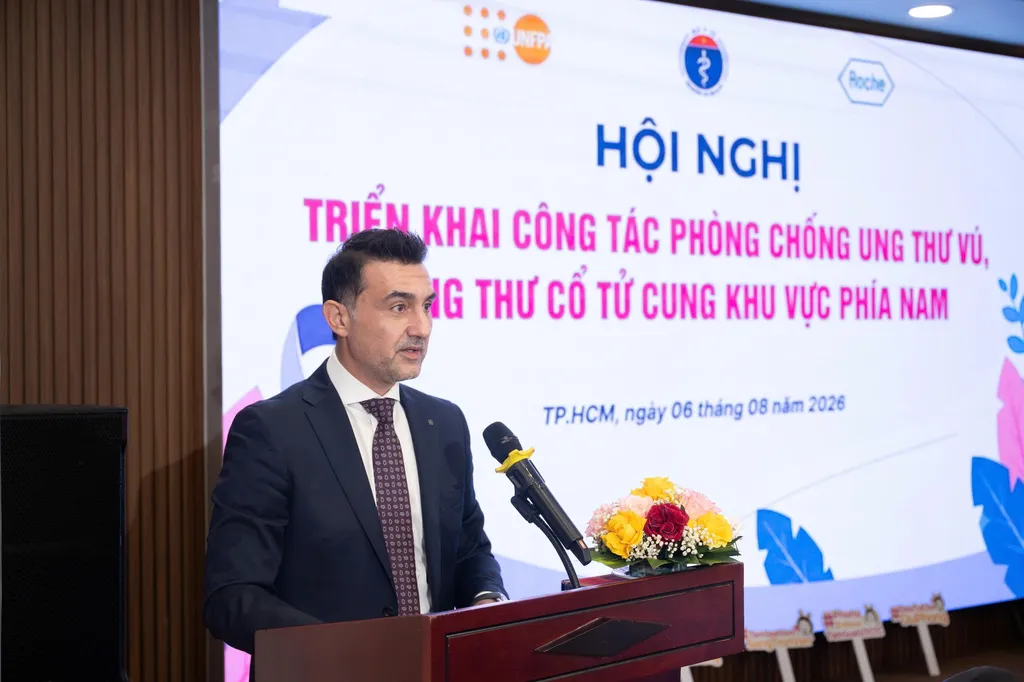 |
| general manager of Roche Pharma Vietnam Burak Pekmezci, speaks at the workshop. — Photo courtesy of the organiser |
At the southern regional workshop, general manager of Roche Pharma Vietnam Burak Pekmezci said that raising awareness and routine screening can shift the paradigm of breast cancer treatment.
However, he added: "Diagnosing cancer early only saves a life if it is followed by timely treatment. That is why, in the phase ahead, Roche Pharma Vietnam's contribution focuses on strengthening clinical capacity, expanding access to innovative therapies and ultimately, improving treatment outcomes for the patients.”
Following the two regional workshops, provinces and cities will develop and carry out their own breast cancer plans in line with local conditions. This marks the transition from a policy instrument to measurable change within individual hospitals and communities, in pursuit of a shared objective: that every Vietnamese woman, in every region, is screened early, diagnosed promptly and treated to the highest standard the health system is able to provide.
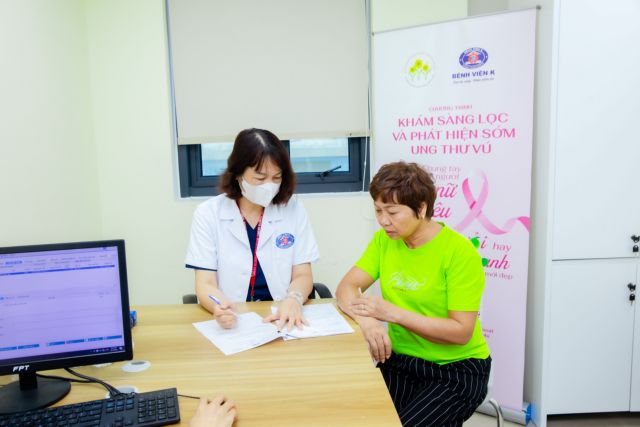 |
| A doctor performs breast cancer screening for a woman at National Cancer Hospital (K Hospital) in Hà Nội. — Photo the Bright Future Fund |
Issued by the Ministry of Health on February 3 under Decision 358/QD-BYT, the National Action Plan carries out Politburo Resolution 72-NQ/TW dated September 9, 2025.
It sets an average annual reduction in breast cancer mortality of 2.5 per cent, consistent with the objective of the World Health Organization's Global Breast Cancer Initiative.
The plan also extends beyond screening. One of its four specific objectives is devoted to assuring the quality of treatment and the provision of continuous, comprehensive and humane care to patients.
By 2035, all oncology and obstetrics specialised facilities, together with every unit responsible for breast cancer screening, diagnosis and treatment at all levels of the system, are required to apply updated clinical protocols and professional guidelines.
Under the plan, at least 80 per cent of patients with breast cancer will receive multimodal treatment and comprehensive care and to complete their course of treatment in accordance with clinical guidance.
These commitments are complemented by early-detection indicators, under which 70 per cent of women aged 40 to 70 are to undergo regular screening, and 60 per cent of invasive breast cancers are to be detected at an early stage.
The plan further requires the clinical guidance on breast cancer diagnosis and treatment to be reviewed and updated, and quality standards for care to be established. — VNS
Society
 Society
 Society
 Society
 Society
 Society
 Society
 Society
 Society
 Society
 Society
 Society
 Society
 Society
 Society