 Society
SBV to curb property price inflation, enforce lending rate rules
1.
|
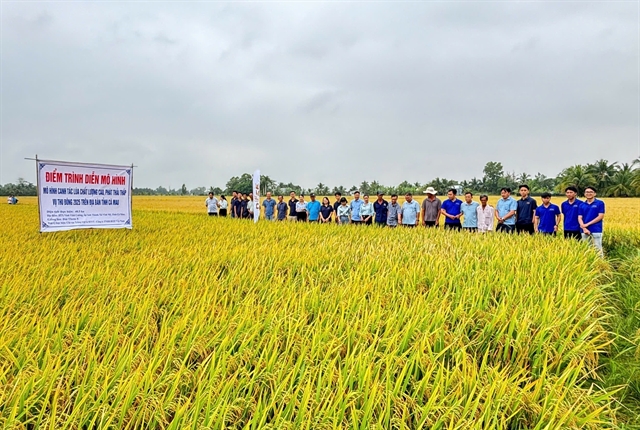
| A demonstration site for a pilot farming model under the “Sustainable Development of One Million Hectares of High-Quality and Low-Emission Rice Associated with Green Growth in the Mekong Delta by 2030” programme in Vĩnh Mỹ Commune, Cà Mau Province. — VNA/VNS Photo |
CÀ MAU — Cà Mau Province plans to scale up high-quality, low-emission rice farming after pilot projects improved profitability, reduced emissions and promoted more sustainable agricultural production.
After two years of implementing the Ministry of Agriculture and Environment’s project on the “Sustainable Development of One Million Hectares of High-Quality and Low-Emission Rice Associated with Green Growth in the Mekong Delta by 2030” (the one-million-hectare rice project), the country’s southernmost province has successfully piloted farming models that have delivered clear economic, social, and environmental benefits.
The models cover a total of 1,380ha involving 720 farming households from seven co-operatives, and have delivered outstanding results, according to the provincial Department of Agriculture and Environment.
|
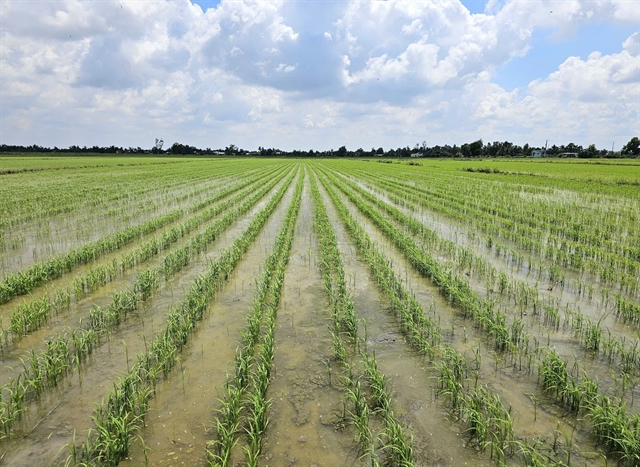
| Row seeding in low-emission rice farming helps reduce the use of seeds, fertilisers, and pesticides, prevent pest outbreaks, and lower production costs. — VNA/VNS Photo |
With the application of mechanisation in land preparation, sowing, irrigation, and harvesting, seeding rates have been reduced to 70–100kg per hectare, or 20–40 per cent less compared to traditional farming methods.
The use of nitrogen fertiliser has fallen by an average of 15–20 per cent, while the number of plant protection chemical applications has been cut by two to four times per crop.
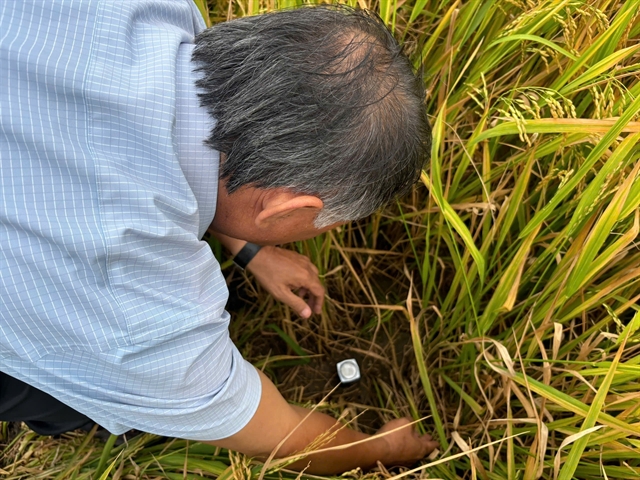
Alternate wetting and drying has been applied once or twice each crop, helping optimise water use and reduce greenhouse gas emissions, contributing to environmental protection, and promoting green, sustainable agriculture.
Farmers' profits have increased by VNĐ2–4 million (US$76–152) per hectare, while total actual income has risen by 15–20 per cent or more compared with traditional farming methods.
|
| Alternate wetting and drying irrigation is applied in low-emission rice cultivation. — VNA/VNS Photo |
The project is not only an opportunity to build a green, climate-resilient agricultural sector but also a driving force in developing a modern and sustainable rice industry, the department said.
It is being implemented in the communes of Vĩnh Thanh, Hòa Bình, Vĩnh Mỹ, Đá Bạc and Khánh Bình, with technical support from the International Rice Research Institute, the Institute of Agricultural Environment, and several large rice companies.
Ngô Nguyên Phong, secretary of the Vĩnh Thanh Commune Party Committee, said that through participation in the one-million-hectare rice project, local farmers and co-operatives have achieved many positive results.
They are gradually changing their production mindset and confidently applying advanced farming practices such as 'One Must, Five Reductions', alternate wetting and drying, using certified seeds, and reducing the use of seeds, fertilisers, and plant protection chemicals, he said.
Co-operatives are also gradually strengthening their role in linking production, supplying agricultural inputs, providing technical guidance and connecting farmers with buyers, he said.
Several businesses have joined farming contracts, helping establish value chains and increase the value of rice, he added.
Trần Quốc Duẫn, a member of the Hồng Phát Agricultural Service Co-operative in Vĩnh Thanh Commune, said: “Support from authorities, particularly investment in production infrastructure and efforts to strengthen links between businesses and farmers, has made it easier for farmers to sell their produce while increasing profits from each crop.”
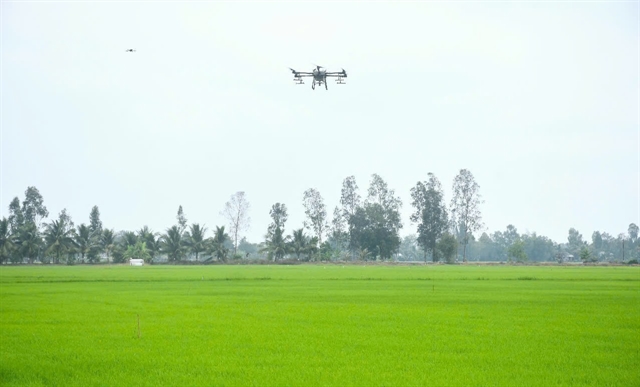
|
| A drone is used in a high-quality, low-emission rice farming model at Hồng Phát Agricultural Service Co-operative in Vĩnh Thanh Commune. — VNA/VNS Photo |
Quality improvements
The rice sector is gradually meeting standards for quality, traceability and emissions reduction, enhancing its competitiveness in domestic and export markets.
By 2030, the province aims to develop 54,680ha of high-quality, low-emission rice cultivation under the project, including 39,980ha producing two to three rice crops a year and 14,700ha under rice–shrimp rotation.
To achieve this goal, authorities will continue to identify eligible farming areas for the project and successful models.
Efforts will also focus on strengthening the operational capacity of co-operatives, developing planting area codes, traceability systems, emissions reduction measures, and quality certification.
Digital transformation and the use of artificial intelligence in production management will also be promoted.
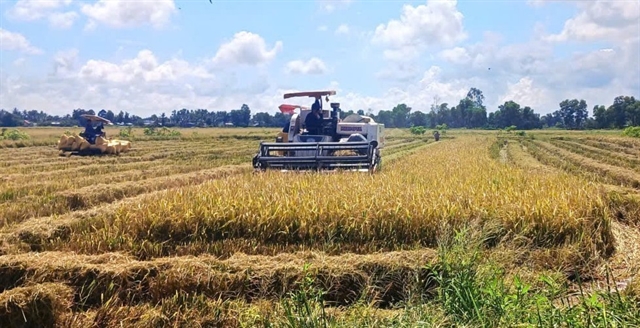
|
| Low-emission rice is harvested at Hồng Phát Agricultural Service Co-operative in Vĩnh Thanh Commune. — VNA/VNS Photo |
However, the project continues to face many challenges, according to the department.
Climate change, particularly unseasonable storms and rainfall, has made it difficult to apply alternate wetting and drying during the summer–autumn crop.
Inadequate infrastructure, slow expansion of cultivation areas, weak business linkages, limited co-operative capacity, difficulties in accessing support policies, and farmers' reluctance to adopt new practices continue to hinder the project.
Lê Văn Sử, vice chairman of the provincial People's Committee, called on departments, sectors and local authorities to expand successful rice farming models, reinforce production and marketing links, and create favourable conditions for farmers and co-operatives to access support policies, particularly with respect to soft loans and mechanisation. — VNS
Society
 Society
 Society
 Society
 Society
 Society
 Society
 Society
 Society
 Society
 Society
 Society
 Society
 Society
 Society