 Society

SBV to curb property price inflation, enforce lending rate rules
1.
|
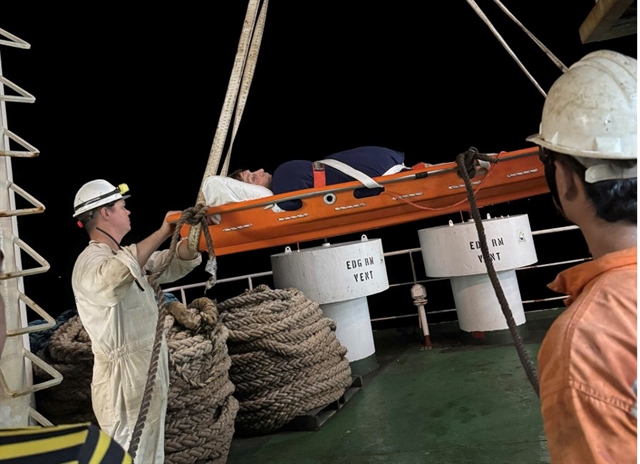
| Renat Vakhitov, a 46-year-old Russian sailor, is transferred from a container ship to a speedboat amid rough seas at night before being taken ashore for emergency treatment after suffering a haemorrhagic. — Photo courtesy of FV Hospital |
HCM CITY — A medical team from FV Hospital travelled more than 40 nautical miles by speedboat and clambered up a rope ladder onto a container ship in rough seas to rescue a Russian crew member who had suffered a suspected stroke at sea.
The hospital said on August 4 that its accident and emergency department received an urgent call from a maritime agent in mid-July after Renat Vakhitov, a 46-year-old Russian sailor on an international shipping route, suddenly developed weakness on one side of his body, raising fears of a stroke.
As the ship lacked facilities to provide emergency stroke treatment and could not immediately divert to shore, it proceeded to Buoy No. 0, the maritime boundary between the international shipping lane and Vietnamese waters, where the patient was transferred to the medical team.
Led by Dr Hồ Châu Anh Thư, the emergency team travelled by ambulance from HCM City to Cầu Đá Port in Vũng Tàu before boarding a speedboat carrying emergency medicines and equipment. After a journey of more than 40 nautical miles through waves of up to three metres, the team boarded the ship.
Thư quickly assessed the patient, who remained conscious but had severe weakness on one side of his body.
The team decided he needed to be evacuated ashore immediately.
The evacuation proved even more difficult than boarding. With the patient on the fifth deck and no dedicated medical evacuation system available, crew members and the medical team carried him down deck by deck before lowering the stretcher onto the speedboat using the ship's crane.
The speedboat reached Cầu Đá Port at about 5am, where an FV Hospital ambulance was waiting. The patient arrived at the hospital two hours later.
|
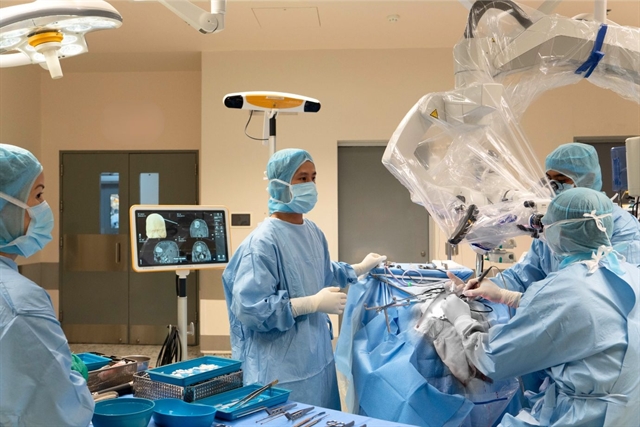
| The FV Hospital surgical team removes a blood clot from the brain of Renat Vakhitov, a 46-year-old Russian sailor. — Photo courtesy of the hospital |
A CT scan confirmed a haemorrhagic stroke caused by bleeding in the right basal ganglia, with a blood clot weighing about 30 grams.
Dr Trần Lương Anh, head of the hospital's neurosurgery and spine surgery department, said the case was on the borderline between conservative treatment and surgery.
Rather than operate immediately, doctors first stabilised the patient's blood pressure, reduced brain swelling, and closely monitored his condition before deciding on the optimal time for surgery.
Three days later, as his headaches worsened and the weakness progressed, surgeons operated to remove the clot.
Anh explained: "The timing of surgical intervention is critical. Operating too early increases the risk of recurrent bleeding, while waiting too long may allow the haematoma to continue compressing the brain and cause further damage to brain tissue,"
The 90-minute operation was performed using a brain navigation system and a surgical microscope, allowing surgeons to reach the haemorrhage through a tube measuring just 7mm in diameter. A specialised ultrasonic device was used to soften the clot before it was aspirated to minimise damage to the surrounding brain tissue.
The patient regained consciousness immediately after surgery. Movement gradually returned to his leg and hand, and, after nearly two weeks of treatment and rehabilitation, he was discharged in stable condition.
Vakhitov said: "When my life was at risk at sea, I was fortunate that the doctors travelled all the way to the ship to bring me ashore for treatment. I am deeply grateful to the medical team, who braved such hardships to save my life."
Dr Trịnh Văn Hải, head of the accident and emergency department, said patients with haemorrhagic stroke should be transferred as quickly as possible to a medical facility capable of providing emergency care and neurosurgery.
Early access to a multidisciplinary team is crucial to assessing the condition, monitoring progression, and selecting the most appropriate treatment strategy, he added. — VNS
Society
 Society
 Society
 Society
 Society
 Society
 Society
 Society
 Society
 Society
 Society
 Society
 Society
 Society
 Society