 Society
SBV to curb property price inflation, enforce lending rate rules
1.
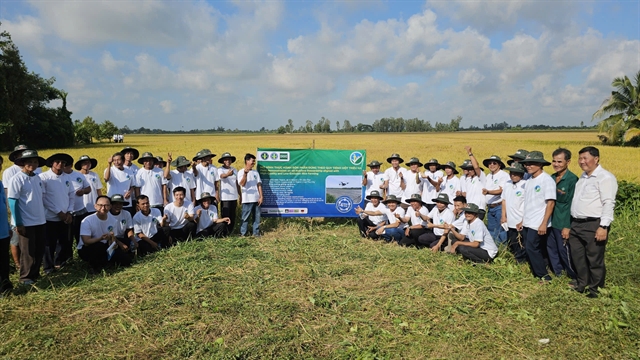 |
| Agricultural experts and farmers visit a rice farm at Kiến Thành Agricultural Cooperative, Vị Thanh 1 Commune, which has a modern fertilisation process and precise nutritional management. VNS Photo Tố Như |
CẦN THƠ — Cần Thơ City is gradually expanding its large raw material areas, aiming for green, sustainable agriculture and enhancing the value of Vietnamese rice based on high-quality, low-emissions rice production models.
These newer models are expected to yield profits of nearly VNĐ30 million (US$1,100) per hectare.
The city's Department of Agriculture and Environment, in coordination with the International Rice Research Institute (IRRI), on Tuesday held a workshop titled 'Scaling up the model of high-quality, low-emissions rice production areas under the One Million Hectare Project'.
After more than two years of implementation, in Cần Thơ's Thanh Vi Commune, the city is gradually moving from the experimental phase to creating large high-quality, low-emissions raw material rice-growing areas.
According to Nguyễn Thanh Duy, deputy head of the municipal Department of Plant Protection and Crop Production, the city is a key rice-producing locality in the Mekong Delta.
Cần Thơ is currently carrying out the one million hectare rice project with over 170,000ha of the crop, along with the participation of 171 cooperatives and cooperative groups.
To date, the entire city has planted over 8,000ha of high-quality, low-emissions rice under the project.
The models show several indicators of improved production, including seed sowing volume reduced by 40-50 per cent, the use of nitrogen fertiliser lowered by over 30 per cent, up to three times less pesticide applied to crops and irrigation water usage reduced by 30-40 per cent.
Meanwhile, producers' profits can increase by up to VNĐ6.5 million ($250) per hectare.
Associate Professor Dr Nguyễn Văn Hùng, a senior scientific expert at IRRI, said that transitioning from a smaller model to a linked production area requires the participation of purchasing businesses, input suppliers, cooperatives and farmer groups of sufficient scale.
Producing the same rice variety that is sown and harvested at the same time will facilitate processing, reduce losses and improve rice quality.
Permanent Vice President and General Secretary of the Việt Nam Rice Industry Association Lê Thanh Tùng said the current challenge no longer lies in production techniques, but in connecting raw material areas with the market through the value chain.
For sustainable development, a shift from small-scale production to building concentrated raw material areas linked with cooperatives and businesses is needed. This will also help establish long-term links between input businesses, cooperatives and retailers or consumers to ensure stable output for farmers, he said.
At the workshop, delegates discussed rice growing area codes issued on the ViriCert database.
This system supports digitising production information and monitoring process compliance, serving traceability and managing the entire production process.
Assigning planting area codes on a digital data platform is not only a technical solution, but also marks a transition to data-based management, aiming to improve quality, transparency and sustainable development.
From these initial models, Cần Thơ is gradually forming raw material areas with synchronous production, linked with businesses and managed with digital technology.
This is an important basis to achieve the goals of the One Million Hectare Project, contributing to building a modern, green and competitive Vietnamese rice industry in the international market. VNS
Society
 Society
 Society
 Society
 Society
 Society
 Society
 Society
 Society
 Society
 Society
 Society
 Society
 Society
 Society