 Society

SBV to curb property price inflation, enforce lending rate rules
1.
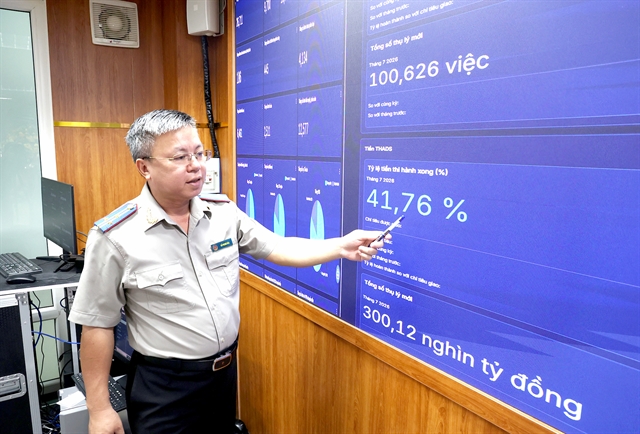 |
| Đỗ Phong Hóa, deputy head of HCM City's Civil Judgement Enforcement agency, monitors data at the Civil Judgement Enforcement Intelligent Operations Centre. — VNA/VNS Photo |
HCM CITY — Digital transformation is improving civil judgement enforcement in HCM City, helping authorities handle a growing workload while reducing processing time and increasing transparency for residents and businesses.
The city has introduced electronic receipts, digital case files, online notifications and data management systems as part of efforts to implement Politburo Resolution No 57-NQ/TW on breakthroughs in science, technology, innovation and national digital transformation.
Digitalising enforcement
Đỗ Phong Hóa, deputy head of the city's Civil Judgement Enforcement agency, said digital transformation had become increasingly important as the number and complexity of cases continued to rise while human resources remained limited.
HCM City became the first locality nationwide to completely replace paper receipts with electronic ones.
As of June 18, more than 202,600 electronic receipts had been issued, covering around VNĐ21 trillion (US$800 million) collected through civil judgement enforcement.
The system allows information to be managed, stored and retrieved digitally while supporting digital signatures during processing.
Notifications through the national digital identification platform VNeID have also enabled parties involved in cases to receive information remotely, reducing the time and costs associated with traditional methods.
More than 8,000 notifications have been sent through VNeID, with the service now integrated into the civil judgement enforcement digital platform.
The city was also the first locality nationwide to officially deploy civil judgement enforcement software, which began operating on January 9 this year.
Data covering more than 180,000 enforcement decisions currently being processed have largely been updated on the system.
The city's Civil Judgement Enforcement Intelligent Operations Centre was launched a day later, automatically collecting and analysing information from digital platforms to help managers monitor progress, assess performance and identify emerging problems.
Technology has also played an important role in cases involving particularly large volumes of data.
In the Trương Mỹ Lan case, the city's civil judgement enforcement authority developed software to classify assets and process payments for 43,108 beneficiaries.
The system allows money to be transferred simultaneously to more than 43,000 people.
Authorities have completed eight rounds of payments totalling more than VNĐ10.3 trillion ($392 million), with the process ensuring accuracy and avoiding complaints related to the payments, according to Hóa.
People-centred services
Digital transformation is also changing the daily work of enforcement officers.
Duy Thị Ngọc Điệp, an enforcement officer at Civil Judgement Enforcement Division No 6, said digital case allocation and document processing had gradually become part of routine operations after some initial difficulties.
Documents can now be transferred electronically to relevant agencies and organisations, while notifications are sent through VNeID and some reports can be generated directly from the system, according to Điệp.
Previously, officers spent considerable time preparing reports, compiling statistics and delivering documents in person. Digital tools have reduced that workload, allowing more time for reviewing and processing cases.
However, Điệp said some software systems remained unstable at times. Greater integration with national databases would help speed up verification of enforcement conditions, she added.
Residents have also benefited from the changes.
Nguyễn Tiến Đạt, a resident of Tân Thuận Ward, said people previously had to visit enforcement offices to complete different stages of an application. They could now submit applications and make payments online from home.
Nguyễn Thiện Nhân, a resident of Gia Định Ward, said electronic receipts were issued immediately after payments, making subsequent procedures more convenient.
Hóa said digital transformation must respond to practical requirements, with professional operations at its core and better services for residents and businesses as the ultimate goal.
Alongside digitalising procedures, authorities need to build comprehensive, accurate and interconnected databases while ensuring the security of personal information, assets, financial transactions and professional data.
Moving records, data and enforcement procedures into the digital environment is gradually transforming civil judgement enforcement in HCM City, contributing to a more modern, transparent and efficient administration centred on serving residents and businesses. — VNS
Society
 Society
 Society
 Society
 Society
 Society
 Society
 Society
 Society
 Society
 Society
 Society
 Society
 Society
 Society