 Society

SBV to curb property price inflation, enforce lending rate rules
1.
|
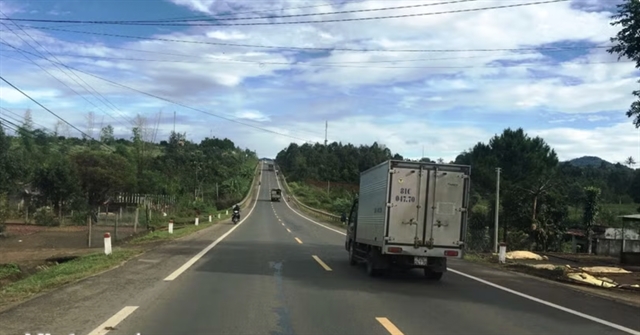
| A section of the Hồ Chí Minh Highway. VNA/VNS Photo |
HÀ NỘI The Hồ Chí Minh Highway Project Management Board has just proposed investing in an additional 600km of expressway along with upgrades to several sections of the route over the next five years.
The total investment for the entire highway is estimated at VNĐ129 trillion (US$4.9 billion), based on June prices.
Over the past few months, the route has already seen investment to bring about 770km up to expressway standard.
In particular, a 300km section of road along the North-South Expressway will be upgraded to four lanes, including Diễn Châu-Bãi Vọt, Bãi Vọt-Hàm Nghi, Hàm Nghi-Vũng Áng, Vũng Áng-Bùng, Bùng-Vạn Ninh and Vạn Ninh-Cam Lộ.
The highway's Cam Lộ-La Sơn-Hoà Liên section will also be upgraded to four lanes, and with construction expected to take place starting next year through 2028.
Nearly 300km of the Hồ Chí Minh Highway have already been upgraded to four lanes or are currently under construction as part of the North–South Expressway, including Gia Nghĩa–Chơn Thành, Hồ Chí Minh City–Thủ Dầu Một–Chơn Thành and Mỹ An–Cao Lãnh, along with upgrades to the Cao Lãnh–Lộ Tẻ–Rạch Sỏi route.
The board proposed that authorities allocate funding to accelerate several additional projects, including upgrades to the Pác Bó–Cao Bằng section (38km); construction of the western Phú Thọ–Cổ Tiết (18.5km) and Cổ Tiết–Yên Bài (30.5km) expressway sections; upgrading the Chơn Thành–Đức Hòa section to expressway standards and widening the Vĩnh Phong–An Xuyên section (39km).
These upgrades will help bring the highway in line with transport demand, according to the management board.
With these new upgrades, the entire Hồ Chí Minh Highway and its component projects will be completed.
To date, projects that have been completed or are under construction have a combined investment of nearly VNĐ91.4 trillion ($3.5 billion), including VNĐ71.59 trillion ($2.7 billion) from the State Budget, more than VNĐ7.1 trillion ($270 million) mobilised through build-operate-transfer projects and nearly VNĐ12.7 trillion ($480 million) through build-transfer projects.
Based on demand, nearly VNĐ84 trillion ($3.2 billion) has already been allocated, of which more than VNĐ62.3 trillion ($2.4 billion) was allocated by 2020, more than VNĐ19.1 trillion ($730 million) between 2021 and 2025 and nearly VNĐ2.5 trillion ($95 million) earmarked for 2026–2030.
The remaining projects required to substantially complete the route have a total investment of more than VNĐ13.9 trillion ($530 million).
These include the Tuyên Quang-Phú Thọ section, valued at more than VNĐ3.7 trillion ($140 million) and implemented by the Tuyên Quang Provincial People's Committee, and four component projects: Chợ Chu-Ngã ba Trung Sơn, Hòa Liên-Túy Loan, Chơn Thành-Đức Hòa and Rạch Sỏi-Bến Nhất Gò Quao-Vĩnh Thuận.
The component projects have a combined investment of more than VNĐ10.2 trillion ($388 million). All of the projects will be carried out by the Ministry of Construction.
According to the board, the goal of substantially completing the entire Hồ Chí Minh Highway by the end of 2026 remains on schedule.
The Pác Bó (Cao Bằng)–Chợ Bến (in Hòa Bình, now Phú Thọ Province) section is approximately 273km long, of which 157km has been completed.
Construction is under way on the Chợ Chu–Ngã ba Trung Sơn section (28.5km), which is expected to be completed in September. Preparations are also under way for investment in the Cổ Tiết–Chợ Bến section (87.5km), comprising the Cổ Tiết–Yên Bài section (30.5km) and the Yên Bài–Chợ Bến section (57km).
The section from Hòa Lạc (Hà Nội) to Tân Cảnh (Quảng Ngãi, formerly Kon Tum) is approximately 1,532km long, including the 684km western branch, all of which has been completed.
In the Central Highlands, the Tân Cảnh–Chơn Thành section (formerly Bình Phước, now part of Đồng Nai City), which is about 553km long, has also been completed, more than one and a half years ahead of the schedule required by the National Assembly. In addition, 121km of branch routes have been completed.
For the Chơn Thành–Đất Mũi (Cà Mau) section, which is approximately 386km long, 257km has been completed and two component projects are currently under construction.
The Chơn Thành–Đức Hòa section (74km) is expected to be technically open to traffic in September and fully completed by the end of 2026.
The Rạch Sỏi–Bến Nhất Gò Quao–Vĩnh Thuận section is expected to technically open to traffic by the end of 2026, although land clearance delays have affected progress. VNS
Society
 Society
 Society
 Society
 Society
 Society
 Society
 Society
 Society
 Society
 Society
 Society
 Society
 Society
 Society