 Society

SBV to curb property price inflation, enforce lending rate rules
1.
|
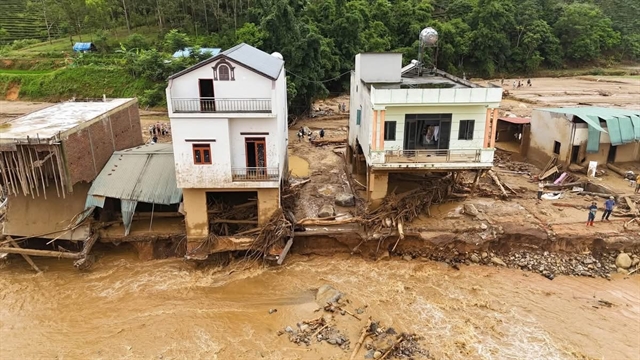
| Homes destroyed by the flood in Mường Than Commune. — Photo baochinhphu.vn |
LAI CHÂU — Nùng Thị Tư cried twice in the space of two weeks. The first time, in the grey hours after a flash flood tore through Mường Than Commune on July 17, there was nothing left to do but weep.
The water had taken everything – her house, her belongings, the quiet, ordinary life she'd built in the mountainous northern province of Lai Châu. By dawn, she and her family had nothing.
The second time she cried, it was in front of a new front door.
"This house gives my family somewhere safe to live again," she said, her voice catching.
"It's given us back our confidence to rebuild after the disaster. Everything, right down to the bowls and chopsticks, the television, the electric fan – it was all here, ready for us. All I want to say is how grateful my family is to the Party, to the State."
Her words echoed what dozens of other families in Mường Than were feeling as they emerged from one of the deadliest natural disasters to hit the region in years.
The flood killed seven people and left one more missing. Eight were injured. Hundreds of households were affected, but 24 families lost their homes entirely, another 20 suffered severe damage, and hundreds more were left living in areas now judged too dangerous to stay.
What happened next was a race against the calendar.
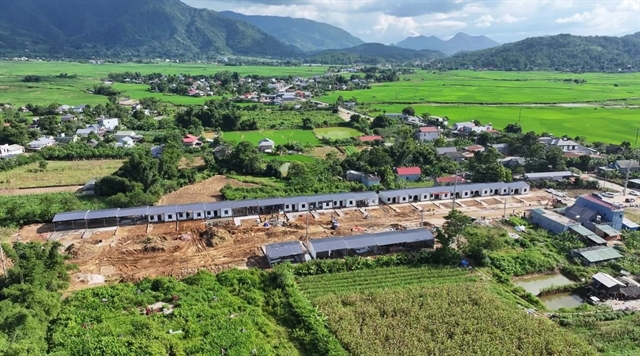
Two days after the flood, provincial authorities issued an emergency construction order, putting Lai Châu's military command in direct charge of rebuilding. The site they chose was Mường Than's Sân Bay Village – solid ground about four kilometres from where the hillside had given way.
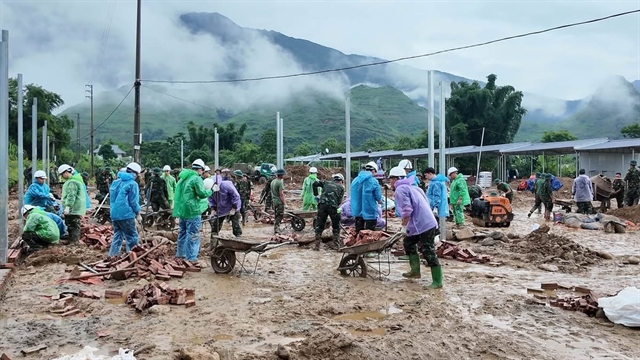
Within days, the quiet village had become a round-the-clock construction site. Excavators growled, hammers rang out, saws whined through the trees – the noise never really stopped, because the work never really stopped.
Crews built whenever the rain let up, and when night fell, floodlights kept the site glowing long after dark. Soldiers, militia members and local workers pushed through exhaustion, mud and repeated downpours, chasing a deadline that left almost no room for error.
"The army had its machinery working around the clock, in shifts that ran back-to-back so there was never a gap," said Tao Văn Giót, Party Secretary of the Party Committee of Mườn Than, in an interview with the Government News.
"Despite everything the flooding threw at them, the soldiers stayed on site, absolutely determined to see it through."
|
| Soldiers getting back to work between downpours. — Photo baochinhphu.vn |
The pace showed in the numbers.
Just eight days after the disaster, families gathered to draw lots for their new plots of resettlement land. Five days after that, on July 30, the first seven families were handed the keys to their new homes – homes that came stocked not just with walls and a roof, but with gas stoves, televisions, electric fans, bedding and even an internet connection.
Colonel Đặng Vĩnh Thụy, commander of Lai Châu's provincial military command, described the improvisation the weather demanded.
"Right now we have 260 soldiers and 50 militia members keeping the site running around the clock, in rotating shifts," he told the Government News.
"Because of how much it's been raining, we've had to adapt – on clear days, we focus on foundations, columns, framing. When it rains, we've already got roofing or tarpaulins up, so work can keep going underneath without interruption."
By his estimate, all 24 homes would be finished and handed over by August 6.
But 24 houses is only the beginning of what Mường Than needs. Nearly 300 households in the commune still live in zones the province now considers at serious risk of landslides, and officials have set themselves a target of moving all of them to safer ground before next year's rainy season arrives.
The plan is for a permanent resettlement area of roughly 18 hectares, also in Sân Bay Village, close to National Highway 32 and, crucially, outside the flood's reach.
According to Colonel Thụy, it won't just be housing. The province intends to build schools, a community cultural house and other public infrastructure alongside it, so that families arrive not just with a safe place to sleep but with the foundations for rebuilding a livelihood.
The flood has receded, but its scars are still written into the hillsides above Mường Than – bare earth where forest used to stand, gullies cut fresh into the slopes.
|
| Construction on all 24 homes is racing to be finished by August 6. — Photo baochinhphu.vn |
Yet in the weeks since, something else has taken root alongside the damage: a visible, almost stubborn insistence on solidarity, between soldiers and civilians, between a Government and the people it serves.
The new houses rising in Sân Bay Village are the clearest evidence of it. The modest structures, still smelling of fresh timber and wet paint, stand as proof that a community battered by disaster can, with enough hands and enough will, put itself back together in a matter of days. — VNS
Society
 Society
 Society
 Society
 Society
 Society
 Society
 Society
 Society
 Society
 Society
 Society
 Society
 Society
 Society