 Society
NA President sets June 2027 deadline for APEC projects, rules out delays, quality cuts and violations
1.
|
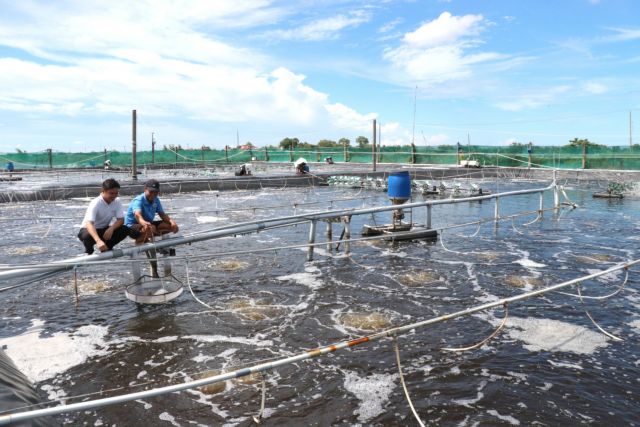
| A high-tech shrimp farming model at the Long Khánh Agricultural Co-operative in Long Thành Commune, Vĩnh Long Province. — VNA/VNS Photo |
VĨNH LONG — Vĩnh Long Province is strengthening the development of shrimp co-operatives and expanding high-tech farming to improve competitiveness, reduce production risks and support sustainable growth in its shrimp industry.
As part of the effort, more shrimp farmers in the Cửu Long (Mekong) Delta province are shifting from small-scale individual production to co-operative-based value chains.
The Long Khánh Agricultural Co-operative in Long Thành Commune is linked with around 60 shrimp-farming households cultivating more than 120ha and producing 800–1,200 tonnes of white-leg shrimp annually, generating revenue of VNĐ130–150 billion (US$4.9–5.7 million).
Ngô Văn Đệ, its chairman, said shrimp farming has become increasingly vulnerable to extreme weather, with prolonged heatwaves, irregular rainfall, and complicated disease outbreaks reducing production efficiency.
In response, the co-operative has adopted scientific and technological solutions alongside traditional farming practices, he said.
“To develop the shrimp industry sustainably, it is necessary to build concentrated farming areas and strengthen links among farmers, co-operatives, and businesses to reduce input costs, secure stable markets and improve product quality.”
|
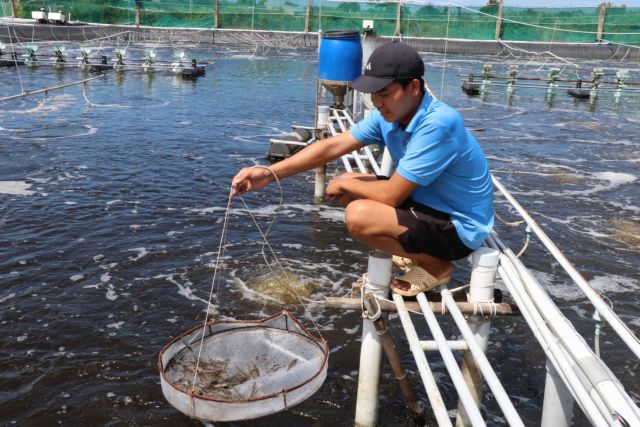
| Trần Huy Hoàng, an engineer at the Long Khánh Agricultural Co-operative in Long Thành Commune, checks the growth of farmed shrimp. — VNA/VNS Photo |
Agricultural co-operatives help strengthen links between farmers, standardise production practices, improve disease control, enable bulk purchases of farming inputs to reduce costs, and enhance farmers' bargaining power with buyers.
The An Thạnh Agricultural Co-operative in Thạnh Phú Commune has 151 members farming giant river prawns in rice fields on about 50ha.
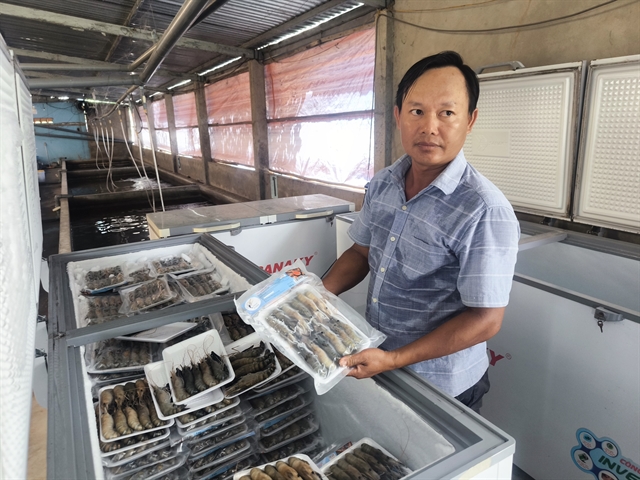
Its soft-shell giant river prawn model has doubled the value of the prawns, providing members with higher incomes while promoting sustainable production.
Harvested immediately after moulting, when their shells are still soft, the prawns command premium prices.
The co-operative has built a closed production chain, from supplying farm inputs to members to buying their produce, ensuring quality and stable market access.
Its product has been recognised as a three-star product under the country’s “One Commune – One Product” programme and is protected under the “Tôm càng lột xứ dừa” (Soft-shell giant river prawn from the Coconut Land) brand.
|
| Nguyễn Hữu Nam, director of An Thạnh Agricultural Co-operative in Thạnh Phú Commune, introduces packaged soft-shell giant river prawns. — VNA/VNS Photo |
Thái Phước Lộc, chairman of the province Co-operative Alliance, said that as agriculture faces increasing impacts from climate change and market competition, the collective economy should focus on improving operational quality and delivering practical benefits for members.
Co-operatives should act as a bridge between producers and businesses by organising production based on market demand and building value chains covering seed and input supply, production, harvesting, processing, and marketing, he said.
High potential
With its 130-kilometre coastline, Vĩnh Long has great potential for aquaculture development, especially high-tech shrimp farming.
In recent years, high-tech shrimp farming models have delivered strong results, emerging as a new growth driver for the province's coastal areas.
Trường Long Hòa Ward is one of the province's key high-tech shrimp farming areas.
It now has 265 households engaged in intensive white-leg shrimp farming across 560.8ha.
Nguyễn Minh Vương in Trường Long Hòa Ward is among the pioneers in applying high technology to raise white-leg shrimp on his 8ha farm.
His entire production process is carried out in a closed system, from water treatment and environmental management to disease control, he said.
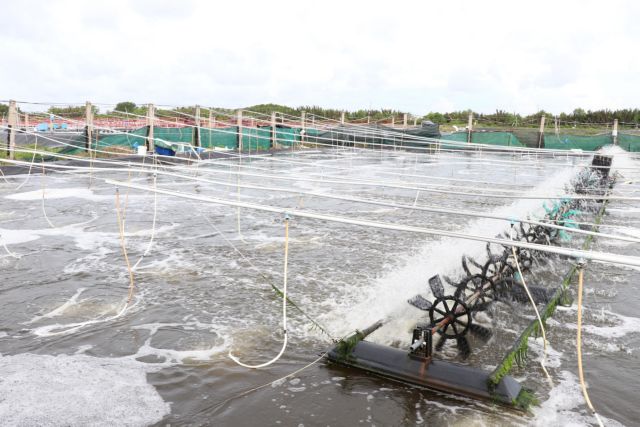
|
| A high-tech shrimp farming model operated by Nguyễn Minh Vương in Trường Long Hòa Ward. — VNA/VNS Photo |
High-tech shrimp farming requires serious investment but enables farmers to better manage production, reduce environmental risks, improve survival rates, and increase yields, resulting in higher returns.
It is also considered an effective way to address the growing challenges posed by climate change and aquatic animal diseases.
Lê Thanh Truyền in Trường Long Hòa Ward has resorted to high technology since 2020 to raise white-legged shrimp in five industrial ponds on his 12ha farm.
The model produces 7–10 tonnes of shrimp per pond in each farming cycle, he said.
In favourable seasons, profits reach VNĐ400 million (US$15,200) per pond after four months of production, he added.
According to the province People's Committee, high-tech shrimp farming covered 6,325ha and produced about 61,000 tonnes in the first six months of the year.
The province plans to develop concentrated farming areas to support processing and exports.
Châu Văn Hòa, Deputy Chairman of the People's Committee, said the province is developing a modern, sustainable fisheries sector.
Key measures include using science and technology, promoting digital transformation, adapting to climate change, and strengthening links between raw material areas, processing, marketing, and exports, he said.
The province is prioritising investment in large-scale farming areas while upgrading supporting infrastructure and environmental monitoring systems, he added.
Speaking at a meeting with the People's Committee on July 22, Deputy Minister of Agriculture and Environment Võ Văn Hưng said Vĩnh Long has much potential to develop its marine and agricultural economies, particularly the fisheries sector.
It should continue building on its strengths in shrimp farming by increasing added value, diversifying products, and improving market competitiveness, he added.
Vĩnh Long has asked the Ministry of Agriculture and Environment to prioritise investment in fisheries infrastructure, including high-tech shrimp farming areas, in the 2026–30 period.
It has also proposed investment in a testing and quality inspection centre to strengthen seafood production, processing, and exports. — VNS
Society
 Society
 Society
 Society
 Society
 Society
 Society
 Society
 Society
 Society
 Society
 Society
 Society
 Society
 Society