 Society
Building community shield to protect children in digital space
1.
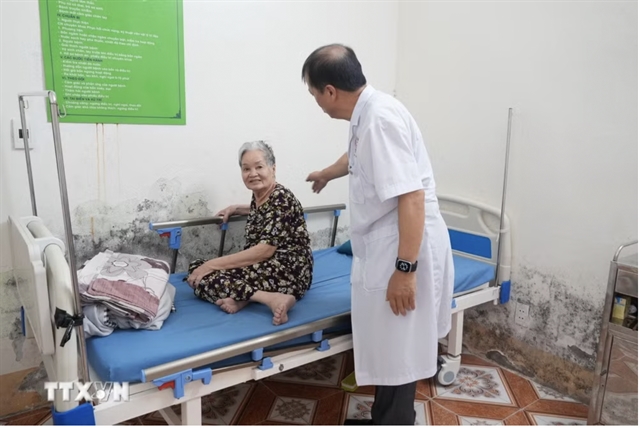 |
| A doctor checks the health of an elderly patient at a rehabilitation centre in Lạng Sơn Province. — VNA/VNS Photo |
HÀ NỘI — Many localities across the country in recent years have been enhancing digital transformation, reinforcing the local healthcare sector and improving human resources to build up a modern and equal healthcare system to meet people’s needs.
The effort is also part of the implementation of Resolution No.72 by the Politburo on breakthroughs in protecting, caring for and improving people's health.
To bring people a high-quality healthcare service from the grass-roots level and early and remote disease prevention, and improve people’s lives in the context of the country’s aging population, many provinces have carried out several breakthrough measures to increase their healthcare services.
In Quảng Ninh Province, the implementation of the National Target on People’s Health, Population and Development in the 2026-35 period has gained significant achievements.
The province sets a goal of 100 per cent of people having electronic health books, managing their health according to their life cycle. All medical establishments deploy the family doctor model and apply health monitoring devices at home.
Preventive health work is given priority in ethnic minority, mountainous, border and island areas.
The province also focuses on taking care of children's nutrition, reducing gender imbalance at birth, and adapting to an aging population.
The province strives to have over 90 per cent of communes and wards meeting the national health criteria by 2030 and expand prenatal and newborn screening.
Meanwhile, in the northern mountainous province of Lạng Sơn, the system of preventive and grassroots-level healthcare and digital transformation and science-technology application have been reinforced.
By 2030, Lạng Sơn strives to have an average life expectancy of 75.5 years, and essential vaccination rates and health insurance coverage are both above 95 per cent.
From 2026, people will receive periodic health checks or free screenings at least once a year and create an electronic health book.
Hoàng Xuân Trường, deputy director of Lạng Sơn Department of Health, said that medical facilities have implemented health checks and created electronic health books as planned.
Total implementation cost in 2026 is expected to be more than VNĐ161 billion (US$6.1 million).
Vice Chairman of Lạng Sơn Province's People's Committee Trần Thanh Nhàn said that the locality will continue to improve the quality of grassroots healthcare, promote digital transformation, effectively mobilise resources and strengthen supervision to effectively implement the goals of Resolution 72.
As a locality with the largest health system in the country, HCM City aims to develop a health system according to a multi-layered model, taking people as the centre, ensuring continuous health care from disease prevention to treatment and recovery.
The city currently has 169 hospitals, more than 13,000 medical facilities, and nearly 300 medical stations, and is also the medical examination and treatment centre of the southern region.
According to Tăng Chí Thượng, director of the HCM City Department of Health, facing the trend of population aging and increasing chronic diseases, the city is focusing on building a multi-layered health system with continuously connected care levels, while promoting the application of electronic health records, electronic medical records, remote consultations and shared databases to improve the quality of medical examination and treatment.
Massively investing in grassroots healthcare, promoting digital transformation and innovating healthcare models in many localities are creating an important foundation to realise the goal of Resolution 72 towards building a modern, equitable and people-centred healthcare system.
Development of healthcare human resources
If investment in the grassroots-level healthcare system creates a foundation for improving the quality of primary healthcare, human resources is a decisive factor in implementing the targets of the resolution.
Experience in many localities shows that, alongside the need to invest in infrastructure and accelerate digital transformation, the shortage of healthcare personnel – particularly at the grassroots level – remains a major challenge that must be addressed.
Following the implementation of the two-tier local government model, Gia Lai Province has become one of the provinces facing significant pressure on its healthcare workforce.
The number of commune-level health stations has been reduced from 373 to 135, while the population served by each station has nearly tripled.
The province is currently short of nearly 500 healthcare workers. Many health stations also continue to face shortages of facilities, medical equipment and information technology infrastructure.
To address these challenges, Gia Lai has developed a specialised healthcare development plan, that introduces a comprehensive package of measures to attract, train and upskill healthcare personnel.
The province has also deployed and seconded doctors and medical technicians from higher-level hospitals to support primary healthcare facilities, while recommending that the central government promptly finalise tailored policy mechanisms and prioritise investment for mountainous, remote and disadvantaged areas following the administrative restructuring.
In parallel with addressing workforce shortages at the grassroots level, many localities are also focusing on improving the quality of healthcare personnel through professional training, technology transfer and stronger collaboration among healthcare facilities.
In southernmost Cà Mau Province, the conference on “Enhancing Healthcare and Health Protection in the Context of Population Ageing” focused on discussing measures to strengthen the healthcare network responsible for protecting the health of officials in response to new demands.
Drawing on local experience, Cà Mau authorities also proposed expanding professional support, specialised training and telemedicine services to enhance the capacity of frontline doctors.
In the field of specialised training, Đà Nẵng City continues to stand out as a model for international cooperation.
More than 20 experts from the international non-profit organisation Orbis, representing seven countries, provided hands-on training to over 230 ophthalmologists, nurses and eye care professionals through a practical mentoring approach that combined live surgical demonstrations, clinical workshops and advanced simulation-based training.
The programme has enabled Vietnamese healthcare professionals to gain access to advanced ophthalmic techniques, gradually improving the quality of eye-care services for the public, particularly in the Central Highlands and central regions of Việt Nam.
From strengthening grassroots healthcare to developing human resources and accelerating digital transformation, localities across the country are making concerted efforts to improve the quality of healthcare services for the public, contributing to the implementation of Resolution 72 and the development of a modern, sustainable healthcare system. — VNS
Society
 Society
 Society
 Society
 Society
 Society
 Society
 Society
 Society
 Society
 Society
 Society
 Society
 Society
 Society