 Society

Việt Nam, EU and Belgium seek deeper, practical cooperation
1.
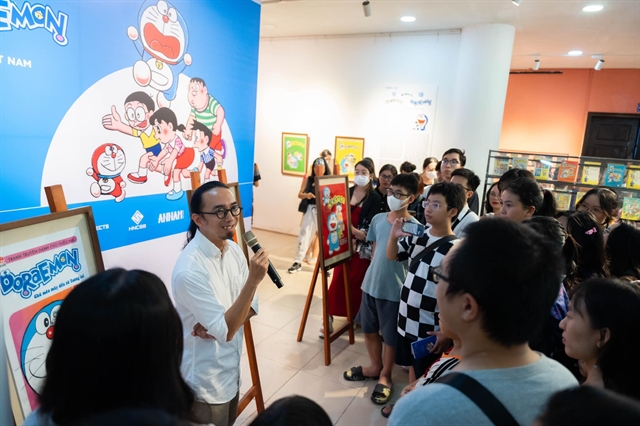 |
| Readers gather at an exhibition celebrating over 30 years of the comic series 'Doraemon' in Việt Nam in September 2024. The classic children's manga is among the most pirated Japanese cultural products in VIệt Nam. — Photo thethaovanhoa.vn |
Bảo Hoa
HÀ NỘI — From the classic Doraemon comic books to more recent manga series, off- and online copyright infringement of Japanese cultural products in Việt Nam is a pressing issue that the two governments are working hard together to prevent.
Việt Nam’s Kim Đồng Publishing House purchased the licence to publish Doraemon from Japanese author Fujiko F. Fujio in 1998, and since then, the ‘blue robot cat from the future’ has become a friend to many generations of Vietnamese readers and an integral part of their childhood.
However, the comic series is among the most pirated Japanese cultural products in Việt Nam.
The country has also been identified by Japanese authorities as a major source of websites that illegally translate and publish Japanese comics.
As these findings negatively affect Japanese authors and Vietnamese publishers, readers and the copyright market, authorities from the two countries are collaborating to toughen up copyright enforcement.
According to data from Kim Đồng Publishing House, nearly 1,000 of its licensed titles have been illegally copied and sold over the last five years, with best-sellers like Doraemon and newly released titles being the most pirated.
A common piracy practice is to scan copyrighted paper books into PDF or EPUB files then distribute them for free or for a fee in private online groups, forums and archives, according to Vũ Thị Quỳnh Liên, Kim Đồng’s editor-in-chief.
“Copyrighted content is also being converted into speech using automated text-to-speech software or artificial intelligence, and then uploaded to social media platforms,” she said at a copyright seminar on online piracy in Việt Nam, held recently by the Copyright Office of Việt Nam in collaboration with Japan’s Agency for Cultural Affairs in Hà Nội.
Books with unclear origin are being sold by multiple accounts on these platforms. As demand for licensed titles fell, Kim Đồng had to reduce the number of printed copies by 30 per cent, according to Liên.
“Our revenue is being affected, and so is our opportunity to reinvest in copyright purchases,” she said.
“Việt Nam is being seen by international partners as lacking effective measures to address copyright infringement, which makes it hard for us to build trust and that’s blocking readers’ access to licensed products.”
 |
| Police in Bắc Ninh Province examines counterfeit textbooks confiscated from an interprovincial operation, which produced and distributed the books in August 2025. More than 185,000 counterfeit books worth over VNĐ8 billion (US$314,500) and several printing equipment were confiscated. — VNA/VNS Photo |
Japan’s perspective
According to data from Authorized Books of Japan (ABJ) – a Japanese anti-piracy industry group focussing on comics copyright, there are currently 961 active pirated comic websites in Japan, which publish either original comics in Japanese to serve readers in Japan, their English translations for a global audience, or Vietnamese translations for readers in Việt Nam.
Eighty-eight of these sites are in Vietnamese, only behind those in English (429 sites) and Japanese (158 sites).
The amount of royalties Japanese authors are losing due to these websites was estimated to be about 8.5 trillion yen (US$51.9 million) per year, of which two-thirds are due to those in English.
Of the top 10 sites in English that attract the most views – approximately 400-500 million per month – at least three originate from Việt Nam.
The sites in Vietnamese are mainly operated by people in Việt Nam, with the majority of their views also coming from the country. They are often laden with advertisements in the Vietnamese language, which cover the comics and only disappear when readers click on them, according to ABJ.
"These websites operate to make illegal profit not directly from comics, but from advertising," said ABJ’s director Atsushi Ito.
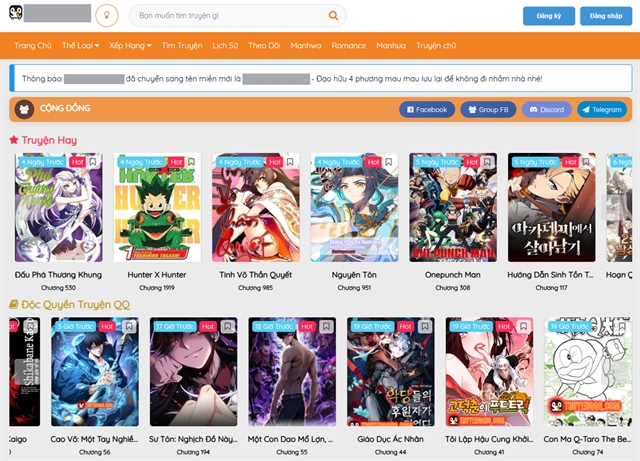 |
| Screenshot of a website in Vietnamese that publishes unauthorised digital translated copies of Japanese comics. |
From their experience collaborating with Japanese authorities to curb online comic piracy – with measures ranging from prohibiting advert placements on these websites, requesting site operators to take down pirated content, requesting host providers to take down the sites and blocking users’ access – ABJ said criminal prosecution is the most effective way to stop their activities permanently.
“The arrested site operators usually do not resume operations, which goes to show that the measure is deterrent enough to other potential offenders,” Ito said.
The industry group asked Việt Nam’s police to accelerate criminal investigations and prosecutions of these pirate sites, and put more effort into raising awareness of Vietnamese people on copyright protection.
Strengthening collaboration
Copyright authorities from Việt Nam and Japan have been working together over the last three years, and recently, Japan’s Content Overseas Distribution Association (CODA) established an office in HCM City on April 1.
Connected to a Vietnamese law firm, the CODA Vietnam Center aims for faster collection of infringement information and pirated content takedown, and more efficient implementation of enforcement measures.
Katsuyoshi Kobayashi, director of the Office for International Copyrights at Japan’s Agency for Cultural Affairs, expressed his hope that the two countries will continue working together to provide readers access to quality, legal cultural products.
“The Copyright Office of Việt Nam has told us how much Vietnamese readers love Japanese manga – that’s a joy to Japan,” he said.
“We will definitely allow more manga to come to Việt Nam, but for that to happen, people’s awareness of and respect for copyright must be improved.”
Việt Nam’s legal system has long paid attention to copyright protection and will be further adjusted to ensure stronger enforcement on infringements, according to Phạm Thị Kim Oanh, deputy director of the Copyright Office of Việt Nam.
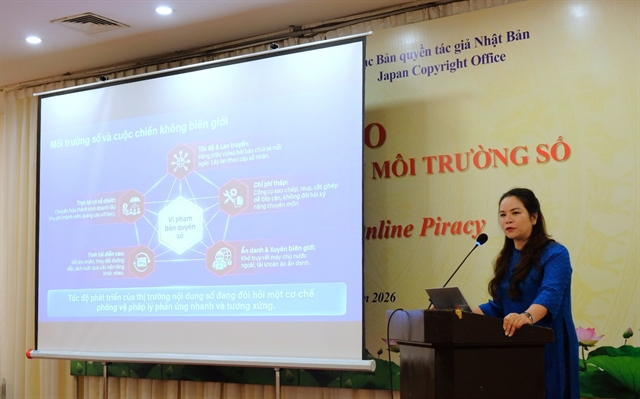 |
| Phạm Thị Kim Oanh, deputy director of the Copyright Office of Việt Nam, speaks at a seminar on online piracy held in collaboration with Japan’s Agency for Cultural Affairs in Hà Nội on July 30. — VNS Photo Bảo Hoa |
Under the Criminal Code, violators of author’s rights and related rights may face up to three years of imprisonment and administrative fines of up to VNĐ3 billion ($114,000), while violating organisations may face operational suspension of up to two years.
“We will consider making further amendments to the Criminal Code to make the penalties more deterrent for copyright infringement in the digital environment,” said Oanh.
Thousands of online pirated content pieces were taken down in the last two months since the Government launched an intensive campaign on May 5 to crack down on intellectual property infringement, especially pirated broadcasts of the World Cup football tournament, she added.
In July, seven people who allegedly operated the illegal Japanese animation streaming site HiAnime was seized and prosecuted by Việt Nam's Ministry of Public Security, with support from the US Department of Homeland Security.
However, it is possible that the pirated Japanese comic sites have not received proper attention due to a lack of data from Việt Nam’s side, Oanh said.
“We hope that our Japanese partners will continue to inform us of the infringements so that we can quickly handle them in accordance with the law,” she said.
“Việt Nam’s State management agencies and the Copyright Office are committed to cooperating with all parties to ensure strict enforcement of copyright regulations.” — VNS
Society
 Society
 Society
 Society
 Society
 Society
 Society
 Society
 Society
 Society
 Society
 Society
 Society
 Society
 Society