 Talk Around Town
Planning strategy gives Hà Nội room to raise stature
1.
 |
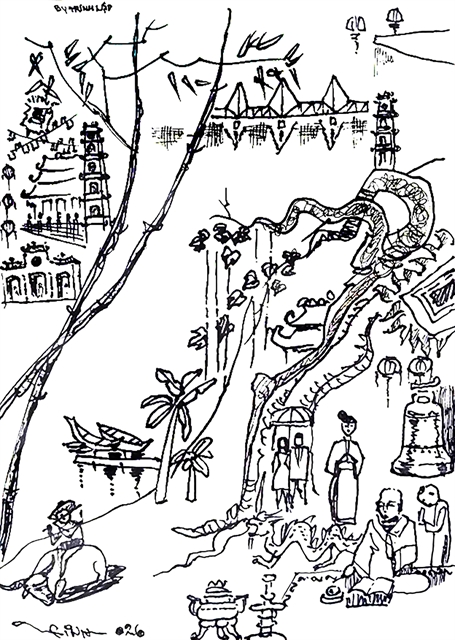
| Illustration by Trịnh Lập |
Nguyễn Mỹ Hà
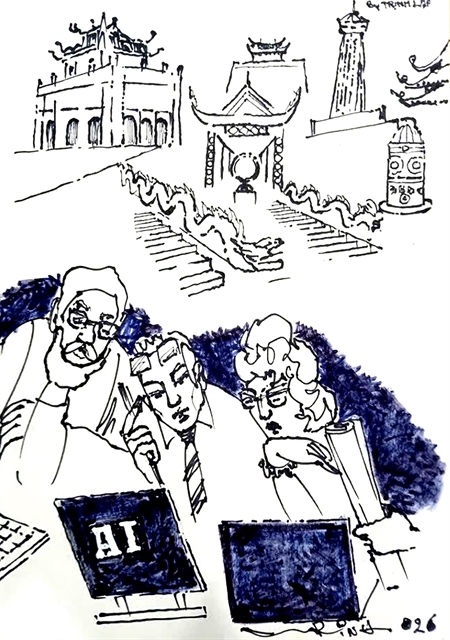
It is official: the groundbreaking ceremony to turn the dreams of generations of Vietnamese people into reality was held on September 29, the 19th day of the eighth lunar month, a few days after the Mid-Autumn Festival. The ceremony was greeted with joy by many people from all walks of life.
Yours truly, for one, also shares the joy and hope surrounding this ceremony and the joint efforts to resurrect the long-lost seat of power, the thousand-year-old evidence of our country when it was still a kingdom.
In 2010, Hà Nội celebrated the millennial anniversary of Thăng Long Citadel, which was made the capital of the Lý Dynasty by King Lý Thái Tổ in 1010. The remnants of Thăng Long were found within the ruins of the Imperial City, but it was all but a vast and empty plot of land, with some scattered structures built in the 19th century.
Where were the giant palaces and landscape pavilions? How do we envision the life our ancestors had? What type of palaces were built on such giant yet ornate stone column bases that remain?
The Lý Dynasty existed for 200 years and was succeeded by the Trần Dynasty, which lasted for another 200 years, but it was a smooth transition within an extended family, so there was no power struggle to win the throne. Next in line was the Later Lê Dynasty, the longest monarchy in Vietnamese history, which lasted for 350 years.
The Lê Dynasty was divided into two periods. The first period lasted for 99 years from 1428, after King Lê Thái Tổ warded off the Ming invaders to found the Lê Dynasty. It lasted until 1527, when it was briefly toppled by the Mạc Dynasty until 1533.
Demonstrating power
The later period of the Lê Dynasty lasted from 1533 until 1789, usually known as the Lê Trung Hưng period, when the centre of power was contested between the Mạc and the Lê. Two powerful clans, the Nguyễn and the Trịnh, were trying to win the Lê King's approval. The Trịnh family supported the Lê King in warding off the Mạc and occupied the northern part of the country.
The Nguyễn family was also pro-Lê King, but they did not like the Trịnh, so they broke away in the south and moved further southward to claim new land. This period lasted for almost 150 years, but the Lê Kings did not have real power; it was shared between the Trịnh and the Nguyễn.
Conflicts, wars and local rebellions ravaged the country. Royal court examinations to select talented people through a three-round system of testing for royal posts began to deteriorate due to corruption in the second half of the 18th century.
The groundbreaking ceremony was for the reconstruction of Điện Kính Thiên, or the Celestial Palace, as it was during the Lê Dynasty. The original Điện Kính Thiên was built in 1428 under King Lê Thái Tổ and completed under King Lê Thánh Tông in 1465. It was built on the ground where former palaces under the Lý and Trần dynasties had stood.
While the original Kính Thiên Palace took 37 years and the reigns of five Lê Kings to complete, the current reconstruction is expected to be completed in 2029.
The project investor is the Thăng Long–Hà Nội Heritage Conservation Centre under the Hà Nội People's Committee, and the project will cover over 10,000 square metres, including the Kính Thiên Ground, Đan Trì Yard and surrounding yards.
After 15 years of research and preparation, the Hà Nội City Committee has co-ordinated with historians, archaeologists and architects to work on intangible heritage and conduct comparative studies with other historical sites in the region to establish a sound historical and archaeological background.
The Lê Dynasty's Kính Thiên Palace was the royal court of the dynasty, where important royal processions and inaugurations took place. It had also been used under the previous dynasties of the Lý and Trần.
Underground history
After the Thăng Long Citadel relic was recognised by UNESCO in 2010, a 100-sq.m zone was unearthed the following year, revealing foundations, brick floors and beams belonging to different dynasties. Over the past four years, the total excavated area has expanded to 10,000sq.m.
Archaeologists have said that there is a cultural layer more than six metres deep, with historical layers from Đại La Citadel through the Lý, Trần, Lê and Nguyễn dynasties, representing more than 1,300 years of history underground.
The resurrection of the palace may fulfil the longing of millions of Vietnamese to see history become a visual object, revived and reconnected with today's people, but it will be more of a museum or memorial site than a real seat of power as it was in history.
If we treat it as a memorial site, then, as visitors, we would like to see the presence of the Lý and Trần dynasties resurrected, revived and represented on this very sacred and solemn ground, where they were the ones who came first.
Fifteen years has been quite a wait, and we have no doubt about the hard work the researchers and archaeologists have put into trying to put the pieces of history together.
Today, the Lý Dynasty Temple worshipping nine Lý kings is located in Bắc Ninh Province, 30km north of Hà Nội.
The Trần Dynasty Temple worshipping 14 kings is located in the former province of Nam Định, now part of Ninh Bình Province. Other temples can be found in Thái Bình, today's Hưng Yên Province, and also in Quảng Ninh Province.
Thirteen centuries of history, civilisation and culture have accumulated at this royal court in Thăng Long Imperial City. If we must wait longer to do it right, we certainly can.
Today, the Thăng Long–Hà Nội Conservation Centre is responsible for the project, but ownership of the future palace must belong to the people, represented by the state.
Private contractors can take part in the construction process but future earnings should, in turn, benefit the study and research of the heritage and serve the longer-term purpose of keeping history intact and connected to our people today. — VNS
Talk Around Town
 Talk Around Town
 Talk Around Town
 Talk Around Town
 Talk Around Town
 Talk Around Town
 Talk Around Town
 Talk Around Town
 Talk Around Town
 Talk Around Town
 Talk Around Town
 Talk Around Town
 Talk Around Town
 Talk Around Town
 Talk Around Town