 Economy
Charity programme brings specialised medical services to residents in Tuyên Quang
1.
|
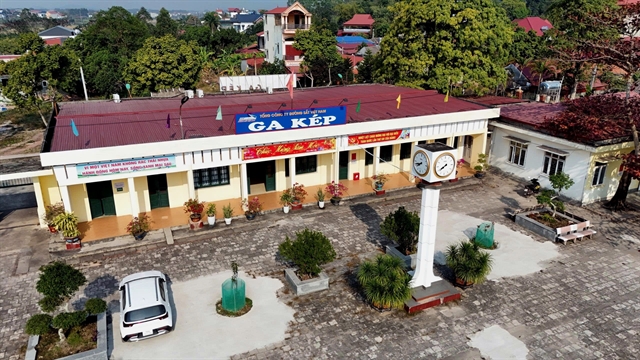
| Kép Station in Kép Ward, Bắc Ninh Province, serves as the international intermodal railway station and an important link in the national and regional logistics chain. — Photos courtesy of Bắc Ninh Province |
BẮC NINH — Bắc Ninh Province aims to develop logistics into a key economic sector by 2030, positioning itself as a regional and international logistics hub.
Phạm Văn Thịnh, vice chairman of the provincial People’s Committee, said the northern province would optimise its supply chain network, particularly to better serve major industrial parks and clusters, thereby enhancing businesses’ competitiveness and continuing to attract foreign direct investment (FDI).
Bắc Ninh also plans to integrate logistics services more deeply into global supply and value chains by promoting science and technology, innovation, digital transformation and green transformation. Priority will be given to smart logistics solutions and the gradual adoption of advanced logistics models.
The province will develop logistics services based on coordinated and modern multimodal infrastructure. A key focus will be on closely connecting logistics centres with strategic transport infrastructure, including Gia Bình International Airport, international rail routes, inland waterways, expressways and Ring Roads No. 4 and 5.
|
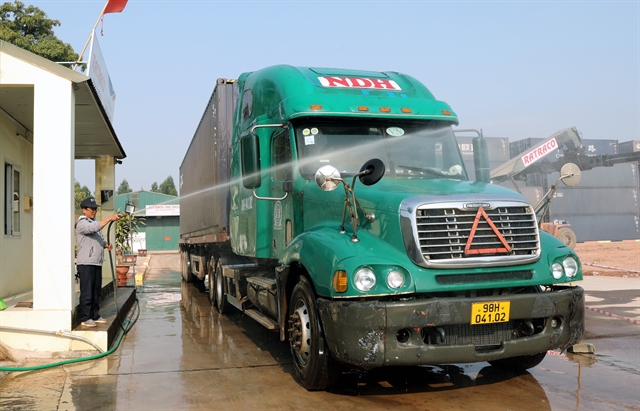
| Cargo volumes passing through Kep Station in Kép Ward, Bắc Ninh Province, have increased sharply, helping expand rail transport capacity, facilitate imports and exports, and improve the circulation of goods. |
The approach is expected to ensure seamless connectivity across the inter-provincial economic region, creating momentum for socio-economic development while contributing to national defence and security.
By 2030, Bắc Ninh aims for logistics services to contribute around 4-5 per cent of the province’s GRDP, with annual logistics growth maintained at 12-15 per cent. The province also targets an outsourcing rate of 50-55 per cent, particularly in electronics and supporting industries, while reducing logistics costs to the equivalent of 16-18 per cent of GRDP.
|
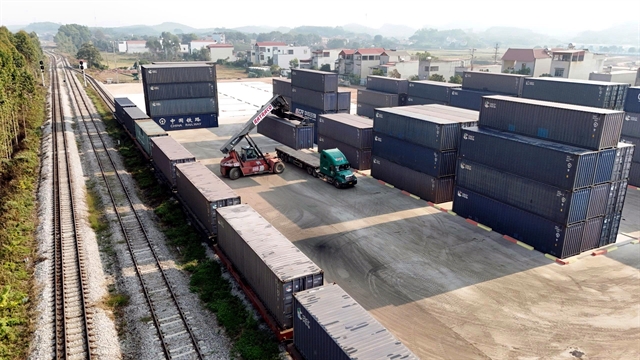
| Cargo loading and unloading activities at Kép Station in Bắc Ninh Province. |
To become a major goods transhipment hub connecting seamless supply chains between Việt Nam, China, and Southeast Asia, Bắc Ninh plans to develop a multimodal logistics ecosystem covering road, rail, waterway and air transport.
The province intends to make full use of the expanded administrative and economic space following the merger of Bắc Ninh and Bắc Giang, closely integrating its logistics infrastructure network with strategic transport projects now under construction, including Gia Bình International Airport, Ring Roads No. 4 and 5 and international rail routes.
Several large-scale core infrastructure projects have been prioritised for early operation, including the inland container depot (ICD) and logistics service complex in Vo Cuong Ward and Tam Da Commune, Sen Ho ICD and Tan Chi ICD. These facilities are expected to meet warehousing and goods circulation needs for concentrated industrial parks.
The province will also provide maximum support to develop the Bắc Giang International Logistics Centre into a modern logistics hub serving cross-border trade with China.
|
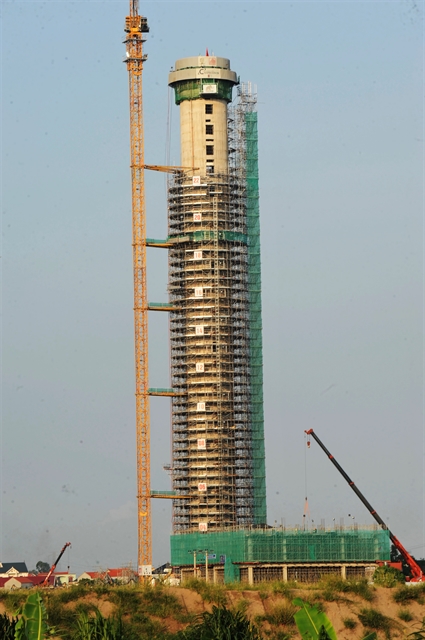
| The air traffic control tower at Gia Bình International Airport in Bắc Ninh Province is nearing completion. |
In addition, Bắc Ninh plans to improve inland waterway transport by upgrading 52 inland waterway ports, including Đáp Cầu, Tri Phương, Đức Long, Yên Hà ports, along five major rivers, namely the Cầu, Đuống, Thái Bình, Thương, and Lục Nam, with a combined length of 405km.
Thịnh said Bắc Ninh would seek to attract global logistics companies such as DHL, UPS, Maersk and FedEx to establish regional distribution hubs in the province, gradually positioning Bắc Ninh as a core international logistics management centre for northern Việt Nam.
The province also plans to link logistics development with digital and green transformation to meet stringent international standards, including the Carbon Border Adjustment Mechanism (CBAM), particularly in the Nordic and EU markets.
By 2030, Bắc Ninh aims for 60 per cent of local e-commerce businesses to use e-logistics services. It also plans to develop large-scale fulfilment centres serving domestic and cross-border e-commerce, while applying advanced technologies such as the Internet of Things (IoT), Big Data, blockchain, electronic proof of delivery (e-POD), and autonomous robots.
To promote green logistics, Bắc Ninh encourages ICDs and logistics centres to switch to renewable energy, including rooftop solar power, use electric forklifts and optimise energy-efficient cold storage systems towards the Net Zero goal. The province also plans to develop a green urban delivery model using eco-friendly vehicles.
Total retail sales of goods and revenue from consumer services in Bắc Ninh during the first eight months of 2026 were estimated at VNĐ78.82 trillion (US$3 billion), up 19.17 per cent year-on-year. Most service sectors maintained positive growth.
Domestic trade in the province also continued to expand, meeting the needs of production, business and consumption. The goods distribution network has been developed in a more modern and integrated manner, alongside traditional markets, supermarkets, shopping centres, and online sales channels.
The province’s import and export activities also recorded positive results. Bắc Ninh has focused on removing difficulties for businesses, diversifying markets and supply chains, making effective use of free trade agreements (FTAs), promoting trade and supporting connections between businesses and markets.
The province’s total import-export turnover in the first eight months of 2026 reached approximately US$152.5 billion, 1.36 times higher than the same period last year.
Exports exceeded $75.48 billion, up 31.84 per cent year-on-year, ranking first nationwide, while imports were estimated at $77.07 billion, up 40.28 per cent.

|
| The project to build a road linking Gia Bình International Airport with Hà Nội, including the section through Bắc Ninh Province. |
Nguyễn Duy Hà, chairman of the Bắc Ninh Transport and Logistics Association, said digital transformation should go beyond warehouse management software or standalone tracking systems.
"Information needs to be connected between factories, transport providers, warehouses and customs on a unified data platform. When cargo-flow data and documents are updated simultaneously, businesses can proactively coordinate vehicles, reduce empty return trips and shorten customs clearance times," he said.
Nguyễn Thế Thi, deputy director of the provincial Department of Industry and Trade, said logistics costs still accounted for a high proportion of production costs in the province.
"Transport infrastructure and digital data infrastructure are not yet fully interconnected, while the sharing of cargo-flow data among factories, transport providers and ports and warehouses remains fragmented," he said.
Most domestic logistics companies are small-scale and mainly provide individual services such as warehouse rental and short-distance transport, without sufficient capacity to control higher-value segments of the supply chain, he added.
This situation requires Bắc Ninh to accelerate management reform and make a stronger shift towards data-driven digital logistics models.
Nguyễn Văn Quân, deputy head of the project management board of the Bắc Giang International Logistics Centre in Bắc Ninh Province, said the centre had invested in a solar power system as part of its development of a modern green logistics model.
"During construction, we have incorporated solutions involving renewable energy, such as solar power. We have invested in a solar panel system to optimise operating costs and make it part of our development of a modern logistics model," he said. — VNS
Economy
 Economy
 Economy
 Economy
 Economy
 Economy
 Economy
 Economy
 Economy
 Economy
 Economy
 Economy
 Economy
 Economy
 Economy